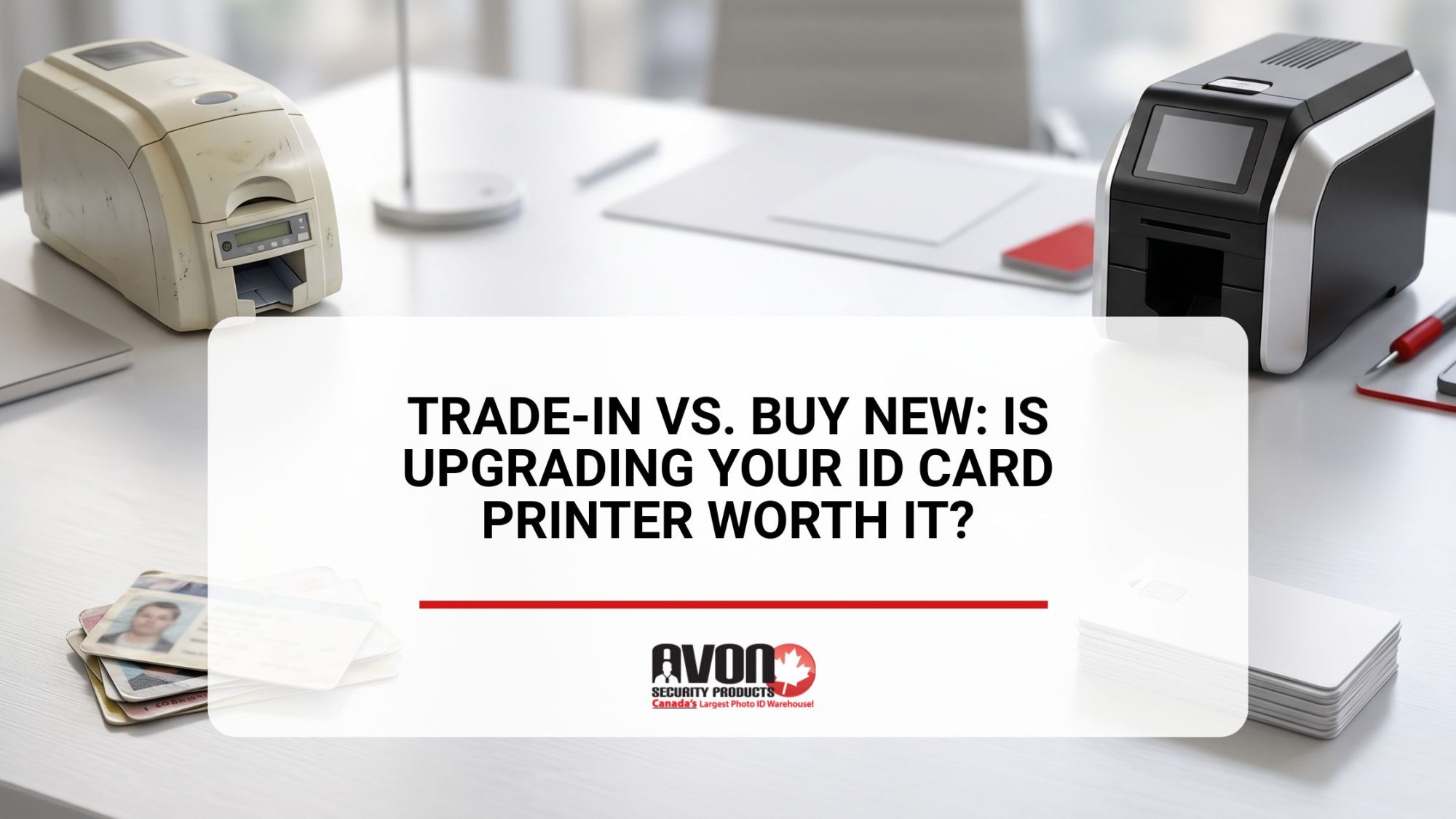
Trade-In vs. Buy New: Is Upgrading Your ID Card Printer Worth It?

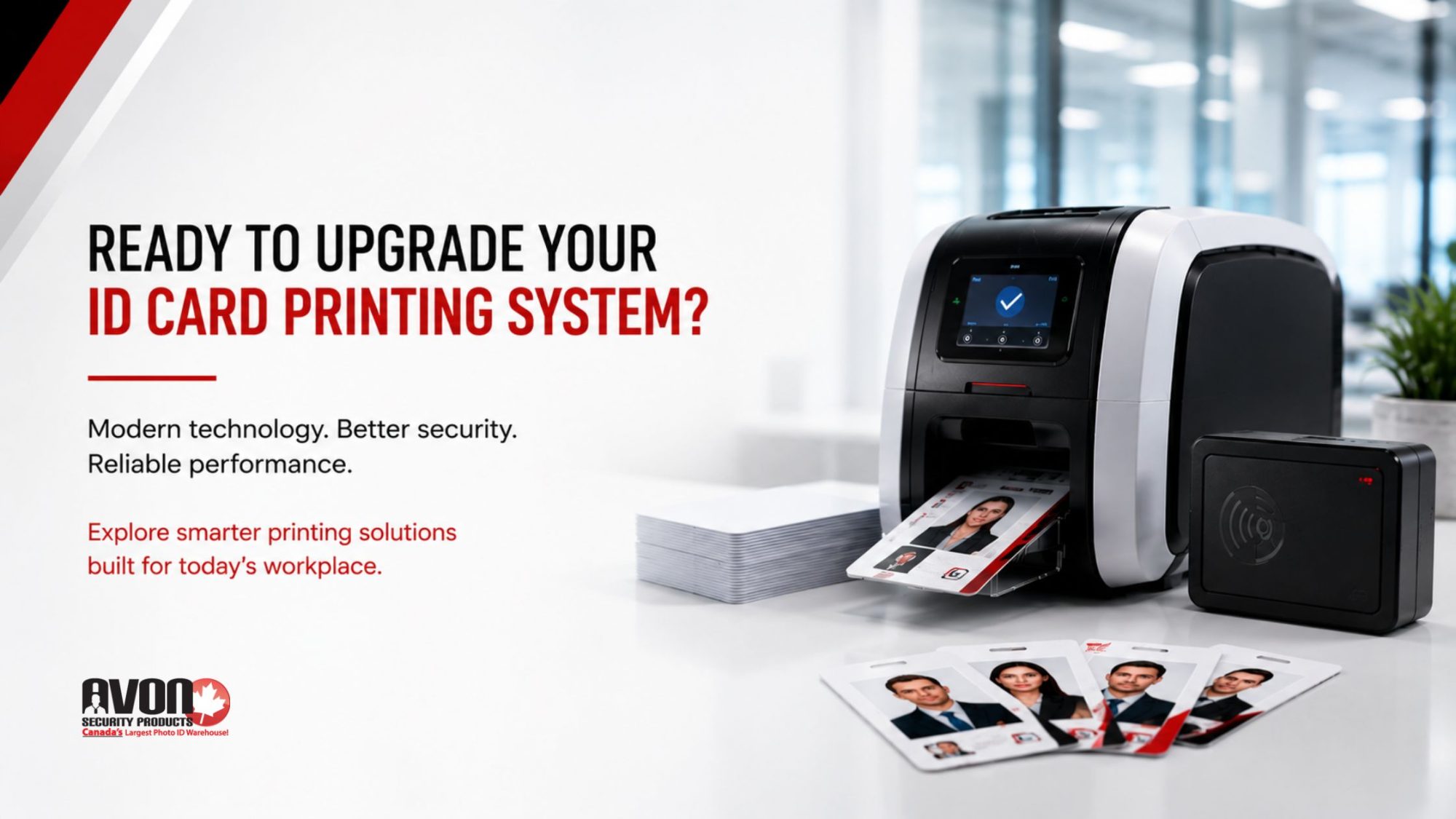
Comparison of an older ID card printer and a modern ID card printer, illustrating considerations when deciding whether to trade in existing equipment or upgrade to a new badge printing system

An ID card printer is no longer just a machine that prints employee badges. For many organizations, it has become part of a larger security ecosystem tied to access control, visitor tracking, compliance, workplace identification, and operational efficiency.

The problem is that many businesses are still relying on outdated printers that were designed for a very different workplace environment. Slow print speeds, fading cards, software compatibility issues, limited security features, and expensive maintenance costs often become “normal” over time because teams simply adapt around them.

But eventually, every organization reaches the same question. Do you keep repairing older equipment, trade it in, or invest in a completely new system?

The answer depends on far more than the price tag.

Inside This Guide

  • How to tell when your current ID card printer is holding your organization back
  • The biggest advantages of upgrading to modern ID card printing technology
  • When an ID card printer trade in makes financial sense
  • Hidden costs organizations overlook when keeping older printers too long
  • Key differences between repairing, trading in, and buying new equipment
  • What to consider before choosing your next ID card printing system
  • How Avon Security Products helps Canadian organizations modernize credential printing workflows

The Real Cost of Holding Onto an Old ID Card Printer

Most organizations do not replace badge printing equipment because they want the latest technology. They replace it because older systems quietly start creating operational problems.

At first, the issues seem manageable.

  • A ribbon error here
  • A software crash there
  • Cards taking longer to print
  • Colours looking inconsistent
  • Replacement parts becoming harder to source

Over time, those small frustrations begin affecting productivity, employee onboarding, visitor processing, and security workflows.

Older printers also struggle to integrate with modern workplace infrastructure. Many businesses now require stronger encryption capabilities, faster card production, cloud connected workflows, mobile credential support, and integration with broader access control systems. Legacy printers often cannot keep up.

Organizations exploring more advanced workplace credentialing solutions are increasingly moving toward modernized and more adaptable secure ID card systems that support evolving operational requirements.

Modern credential programs are increasingly tied to broader identity verification and workplace security standards, including frameworks outlined by the National Institute of Standards and Technology (NIST) for secure identity management and credential systems.

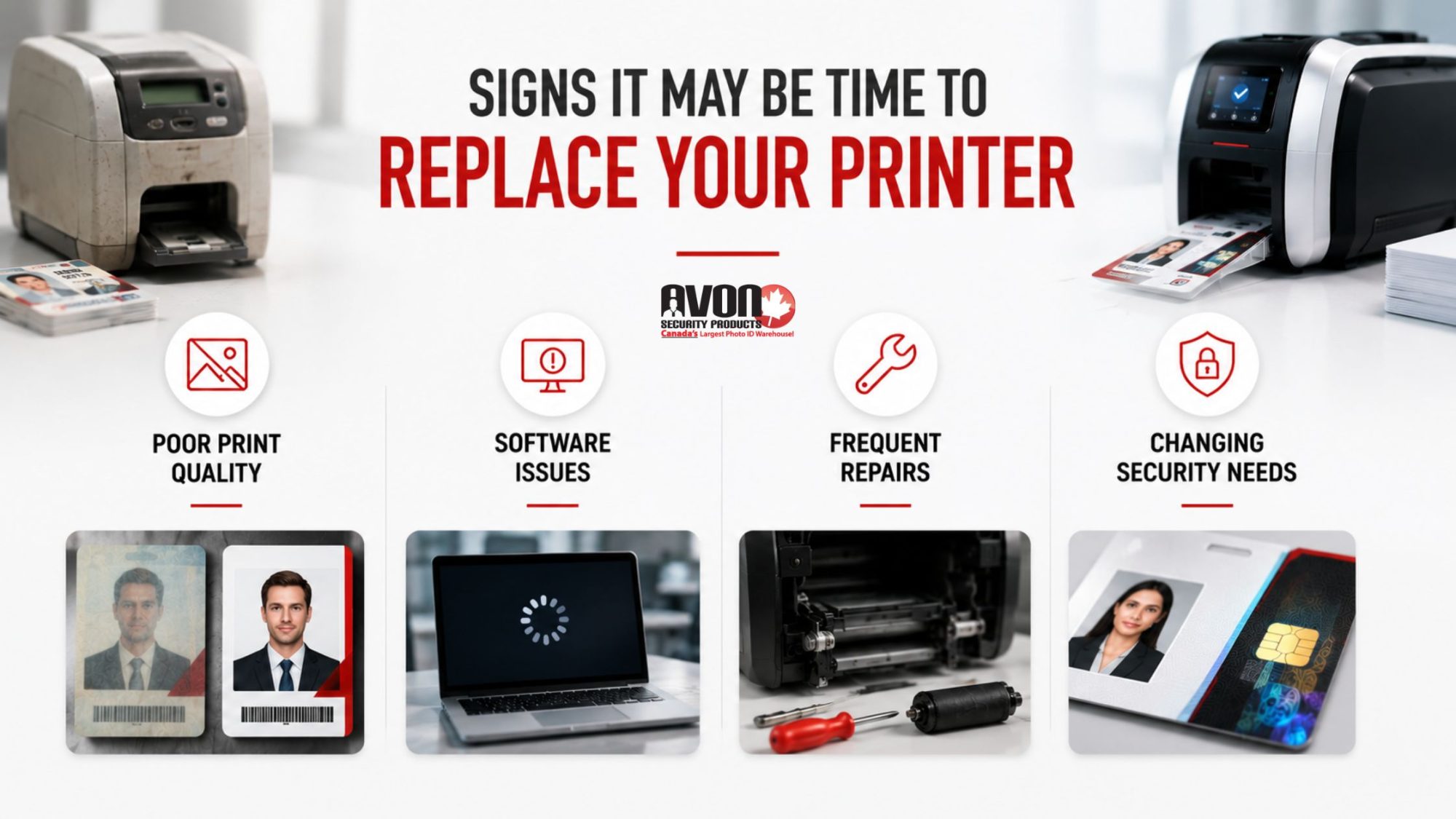
Signs It May Be Time to Replace Your Printer

Some ID card printers continue functioning long after they stop being cost effective. That distinction matters.

A printer that technically still works may still be slowing down operations, increasing maintenance expenses, or creating security limitations that impact the organization as a whole. Here are some of the most common signs that upgrading your ID card printer may make sense.

Your Print Quality Is Becoming Inconsistent

Faded text, poor colour accuracy, streaking, and blurry photos can make employee credentials look unprofessional and difficult to verify quickly.

For organizations relying on visual identification, poor print quality becomes more than a cosmetic issue. It can affect workplace security and employee confidence.

Your Software No Longer Works Smoothly

Older printers often struggle with newer operating systems and updated credential management platforms.

Compatibility issues can create delays, security vulnerabilities, and workflow interruptions that increase IT support requirements.

Many organizations upgrading their systems also modernize their ID card printing software at the same time to improve reliability and simplify credential management.

Repairs Are Becoming More Frequent

There is a major difference between occasional maintenance and constant troubleshooting.

If your organization is regularly paying for replacement parts, technician visits, or downtime related to printer issues, the long term cost of keeping older equipment may already exceed the value of upgrading.

Your Security Needs Have Changed

Modern workplaces require more advanced credential protection than many older printers were designed to support.

Features like holographic overlays, smart card encoding, enhanced authentication options, and improved encryption capabilities are becoming increasingly important for secure credential programs.

Infographic highlighting common signs that an ID card printer may need

Why Newer ID Card Printers Change More Than Print Quality

Many organizations assume a new printer simply produces better looking cards.

In reality, modern ID card printing systems improve operational efficiency across the entire credential management process.

That includes:

  • Faster print speeds
  • More reliable ribbon handling
  • Higher resolution image quality
  • Improved security features
  • Better software integration
  • Reduced maintenance requirements
  • Easier scalability for growing organizations

The difference becomes especially noticeable in environments handling large employee populations, visitor traffic, contractors, or multi location credential programs.

Modern enterprise systems are also designed to support more flexible workflows, including remote management capabilities and integration with broader workplace security infrastructure.

Organizations evaluating new systems often compare different ID card systems based on scalability, security requirements, print volume, and long term operational support.

As workplace credential programs become more connected to physical access infrastructure, many organizations are aligning badge systems with modern Physical Access Control System (PACS) strategies recommended through U.S. government identity management guidance.

Trade In vs. Buy New: What Actually Makes Sense?

The answer depends on your current equipment, operational goals, and future growth plans. For some organizations, trading in older equipment can reduce upgrade costs while simplifying the transition process.

For others, continuing to maintain outdated hardware may create greater long term expenses than investing in a completely new system.

When a Trade In May Be Worth It

A trade in can make sense if:

  • Your printer still functions reasonably well
  • The manufacturer still supports parts or servicing
  • Your organization wants to offset upgrade costs
  • You are moving to a newer model within the same ecosystem
  • Your print volume or operational demands are increasing

Trade in programs can help organizations modernize without fully absorbing the cost of a brand new deployment all at once.

When Buying New Makes More Sense

Sometimes older equipment has simply reached the end of its useful life. If your current printer suffers from repeated failures, lacks modern compatibility, or cannot support your security requirements, purchasing a completely new system often delivers better long term value.

This becomes especially important for organizations prioritizing reliable ID card printers that can support ongoing operational demands without constant maintenance interruptions.

The Hidden Operational Costs Organizations Overlook

One of the biggest mistakes organizations make is focusing only on hardware pricing.

The true cost of outdated equipment usually appears elsewhere:

  • IT support time
  • Staff delays
  • Slower onboarding workflows
  • Visitor bottlenecks
  • Reprint waste
  • Emergency repair calls
  • Security limitations
  • Downtime during critical periods

Those costs add up quickly. In many cases, organizations spend years trying to stretch outdated equipment beyond its practical lifespan while unintentionally increasing operational inefficiency.

This is also why organizations researching upgrades should understand the common mistakes to avoid when buying an ID card printer before making a replacement decision.

Modern workplace security increasingly depends on stronger coordination between cybersecurity and physical security systems, especially as credential management becomes more integrated with broader operational infrastructure.

Security Expectations Have Changed Fast

The way organizations think about credentials has evolved dramatically.

Employee badges now frequently support:

  • Building access
  • Visitor verification
  • Time tracking
  • Multi site access management
  • Compliance requirements
  • Secure authentication workflows

Government identity management frameworks continue emphasizing the importance of secure, authenticated credentials that support both identity verification and controlled facility access across modern organizations.

Modern ID card printing technology is increasingly tied directly to broader workplace security infrastructure. Organizations upgrading older printers often discover that newer systems allow them to improve operational security while simplifying day to day credential management at the same time.

Many businesses also integrate badge issuance with broader visitor management systems to improve building oversight and streamline front desk workflows.

Why Modern Datacard and Enterprise Printers Matter

Not all printers are built for modern credential environments.

Many newer enterprise printers now focus heavily on:

  • Security encryption
  • Faster batch printing
  • Remote printer management
  • Cloud compatibility
  • Enhanced ribbon efficiency
  • Smart card encoding
  • Improved durability

Organizations evaluating upgrades are increasingly exploring new Datacard printers for modern ID workflows because of their ability to support higher security requirements and more scalable credential programs.

For growing organizations, choosing the right platform now can help avoid another costly replacement cycle later.

Modern ID card printing system producing employee badges with enhanced security and performance features, designed to support workplace credential management and access control programs.

How Avon Security Products Helps Organizations Upgrade Smarter

Upgrading an ID card printer should not feel like guessing. Avon Security Products helps Canadian organizations evaluate outdated badge printing equipment, compare replacement options, and determine when a trade in or full upgrade makes the most operational and financial sense.

From professional badge printers and ribbons to credential software and visitor management solutions, Avon helps organizations modernize ID printing workflows with technology designed for today’s workplace security needs.

The goal is not simply replacing hardware. It is helping organizations build more reliable, secure, and scalable credential programs that support long term operational growth.

Modernizing an ID card printing system is not only about improving print quality. It also supports stronger physical security practices, secure credential issuance, and more reliable access management aligned with evolving cybersecurity recommendations in Canada.

Key Takeaways

  • Older ID card printers often create hidden operational costs long before they fully stop working
  • Modern ID card printers improve print quality, workflow efficiency, software compatibility, and security capabilities
  • Trade in programs can help reduce upgrade costs when existing equipment still holds value
  • Repeated repairs and software compatibility issues are strong indicators that replacement may make sense
  • Modern credential programs increasingly require stronger integration with workplace security systems
  • Choosing the right printer involves more than hardware pricing alone
  • Avon Security Products helps Canadian organizations evaluate, upgrade, and modernize ID card printing systems with long term operational support in mind

Frequently Asked Questions

How do I know if my ID card printer is too old?

If your printer experiences frequent errors, declining print quality, software compatibility issues, or increasing maintenance costs, it may be time to evaluate replacement options. Older printers can continue functioning while still creating operational inefficiencies that affect security workflows, onboarding processes, and overall credential management reliability.

Is an ID card printer trade in worth it?

An ID card printer trade in can help reduce upgrade costs if the equipment still functions reasonably well and retains manufacturer support. Trade ins are often beneficial for organizations moving to newer systems with improved security features, faster printing speeds, and better long term software compatibility.

What are the biggest benefits of newer ID card printers?

Modern ID card printers typically offer improved print quality, stronger security features, faster production speeds, better ribbon efficiency, and easier integration with modern credential management platforms. Many also support advanced encryption, smart card encoding, and scalable enterprise workflows for growing organizations.

What is usually required for an ID card printer trade in?

Most trade in programs require organizations to provide details about their current printer model, operational condition, and existing workflow setup. Eligibility may depend on manufacturer support status, compatibility with newer systems, and whether the equipment still functions reliably on an older operating system or legacy printing environment.

Should organizations repair or replace older badge printers?

The decision depends on repair frequency, maintenance costs, operational downtime, and compatibility limitations. If repairs are becoming frequent or the printer no longer supports your organization’s security and workflow requirements, replacement often provides better long term value and reliability.

What should organizations consider before upgrading an ID card printer?

Organizations should evaluate print volume, security requirements, software compatibility, future scalability, support availability, and overall operational efficiency. The best upgrade decision balances current needs with long term credential management goals rather than focusing only on initial hardware pricing.

Upgrade Your ID Card Printing System With Confidence

Modern ID card printing systems are no longer optional for organizations managing workplace security, employee credentials, visitor identification, and scalable operational workflows.

Whether your organization is considering a trade in, replacing outdated equipment, or evaluating completely new badge printing technology, Avon Security Products helps Canadian organizations make smarter upgrade decisions with reliable technology, trusted manufacturer solutions, and long term support designed for modern security environments.

How Canadian Organizations Are Modernizing Their ID Card Systems

Employees using access control cards in a modern office environment, illustrating best practices for cleaning ID cards without damaging print quality, RFID technology, or security features.

Modern ID card systems are secure credentialing platforms that help organizations manage employee identification, access control, visitor tracking, and workplace security through connected badge printing and authentication technology.

Across Canada, organizations are rethinking how identification works inside offices, hospitals, schools, government facilities, and industrial environments. The plastic badge clipped onto a lanyard is no longer just a photo ID. It has become part of a much larger infrastructure tied to security, operations, access management, and workplace efficiency.

As hybrid work models evolve, security expectations rise, and organizations demand faster credential management, many companies are upgrading from outdated badge printers and disconnected systems toward fully integrated modern ID card systems that support smarter, more secure workplaces.

Inside This Guide

  • Why Canadian organizations are upgrading outdated ID card systems
  • How modern badge programs improve security, access control, and credential management
  • What organizations should assess before upgrading printers or software
  • How integrated ID infrastructure supports scalability and operational efficiency
  • Why enterprise grade printer technology and Canadian support matter long term

The Old ID Badge Model Is Starting to Break Down

A surprising number of organizations still rely on aging printers, outdated software, manually managed spreadsheets, and badge systems that were implemented years ago with little long term planning.

At first, those systems may still appear functional. Employees can receive cards. Visitors can be printed temporary badges. Doors still unlock. But underneath the surface, inefficiencies start stacking up quickly.

Older systems often create problems such as:

  • Slow badge issuance
  • Frequent printer downtime
  • Limited security features
  • Inconsistent card quality
  • Difficulty replacing supplies
  • Weak integration with access systems
  • Manual approval workflows
  • Limited scalability for growing teams

The problem is not simply that the hardware is old. The bigger issue is that many legacy systems were never designed for how modern organizations operate today.

Canadian businesses are now prioritizing flexibility, centralized management, stronger authentication, and faster credential issuance across multiple departments and locations. That shift is pushing organizations toward smarter, more connected corporate ID systems.

Security Is No Longer Just About the Badge

The modern workplace has changed dramatically over the last few years. Organizations now manage rotating hybrid schedules, temporary contractors, third party vendors, remote onboarding, shared workspaces, and growing cybersecurity concerns. Physical security and digital security increasingly overlap.

That means ID cards now serve multiple purposes at once.

A single badge may be used for:

  • Building access
  • Secure printing
  • Visitor management
  • Attendance tracking
  • Time logging
  • Department authentication
  • Cashless cafeteria payments
  • Elevator access
  • Parking permissions

This is where technologies like proximity card systems become increasingly valuable. Instead of relying solely on visual identification, organizations are integrating RFID, smart card encoding, and encrypted authentication features directly into employee credentials. That creates stronger security while reducing friction for employees moving throughout a facility.

Provincial government guidance in British Columbia also highlights how visible identification programs support workplace safety, access control, and security awareness across organizational environments. The result feels less like traditional badge printing and more like connected infrastructure.

The Organizations Modernizing Fastest Might Surprise You

Large corporations are not the only organizations upgrading their badge programs.

Across Canada, modernization is happening inside:

  • Healthcare facilities
  • School boards
  • Universities
  • Manufacturing plants
  • Municipal buildings
  • Construction firms
  • Distribution centers
  • Financial institutions
  • Property management companies

Healthcare organizations, for example, often need secure staff credentials that support role based access across sensitive departments.

Educational institutions require scalable student and faculty card issuance with integrated access permissions.

Corporate offices are investing in flexible employee badge systems that support hybrid work environments while improving workplace security and visitor management.

The Government of Canada itself maintains structured credentialing and identification programs for employees, contractors, students, and visitors across secure operational environments, reinforcing how important modern badge infrastructure has become for large organizations.

The common thread is simple. Organizations want systems that work faster, integrate more easily, and reduce administrative strain.

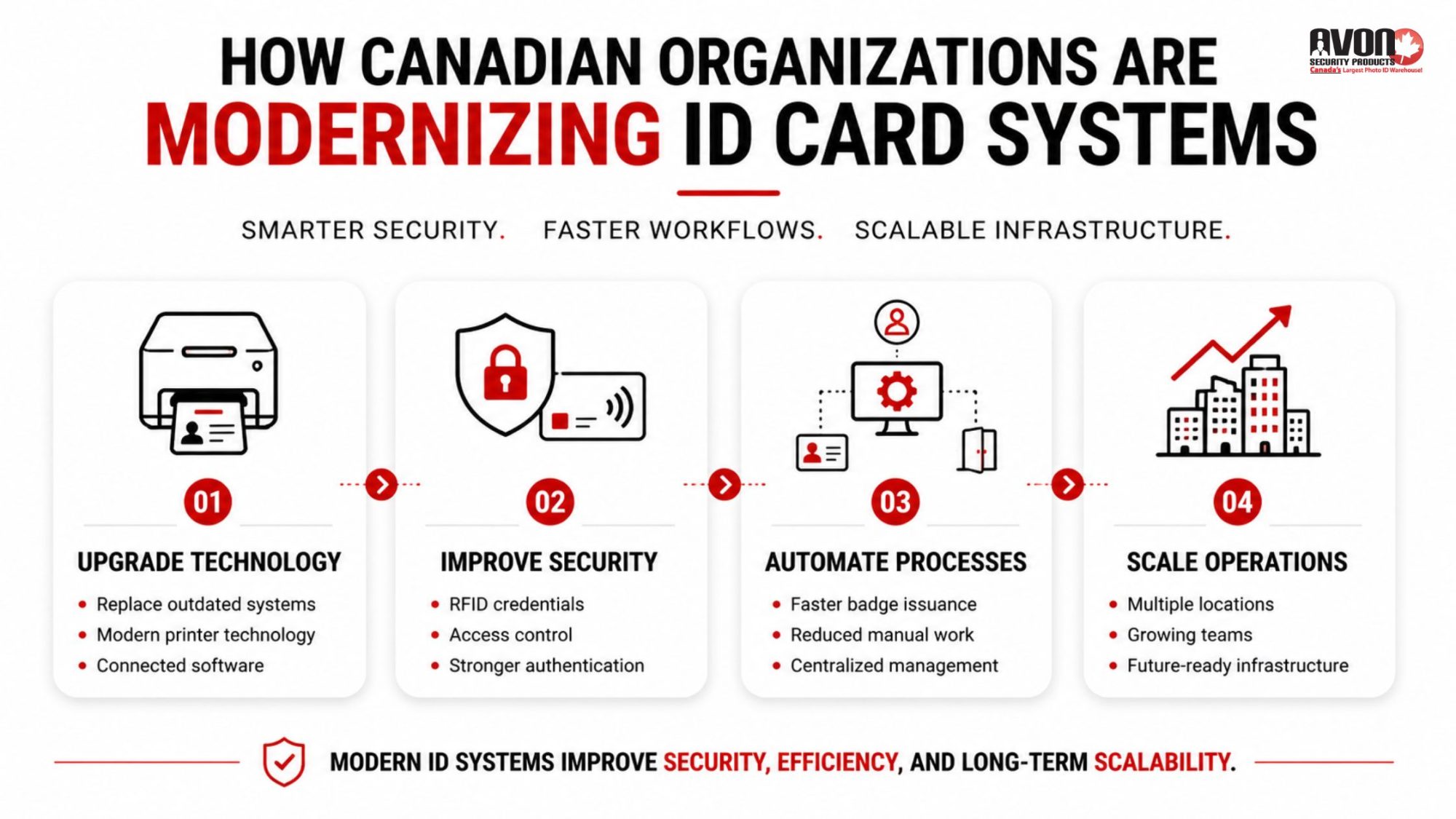
Infographic showing how Canadian organizations are modernizing ID card systems through upgraded technology, improved security, automated credential management, and scalable workplace infrastructure.

Assessing and Auditing Existing ID Card Systems Before Upgrading

One of the biggest mistakes organizations make is upgrading hardware without evaluating the larger credentialing workflow around it.

A modern printer alone does not solve operational inefficiencies.

Before upgrading, organizations should carefully assess:

  • Current badge issuance processes
  • Security vulnerabilities
  • Software compatibility
  • Supply reliability
  • Card durability issues
  • Printer maintenance history
  • Employee onboarding workflows
  • Access control integration limitations

Many organizations discover their biggest bottlenecks are not actually the printers themselves. The issues often come from disconnected approval processes, inconsistent policies, outdated encoding methods, or manual credential management.

The RCMP’s Access Management Guide also emphasizes the importance of properly managing physical access systems, credential controls, and ongoing security oversight as part of modern organizational security planning.

A proper audit helps organizations identify where modernization will create the greatest operational improvements.

Design and Branding Matter More Than Organizations Realize

An ID badge is often one of the most visible branded items employees carry every day.

Poorly designed cards can appear outdated, inconsistent, or difficult to verify visually. Modern organizations are investing more heavily in professional card design that balances branding, usability, and security.

That includes:

  • Cleaner layouts
  • Better photo quality
  • Department color coding
  • Embedded security elements
  • Custom holographic overlays
  • Improved card durability
  • Scannable barcode integration

Organizations are also paying closer attention to what to include on employee ID cards beyond simply a name and photo.

Depending on the environment, badges may include:

  • Expiration dates
  • Security clearance indicators
  • Department identifiers
  • Emergency response roles
  • QR codes
  • Smart chip encoding
  • Visitor classification markers

The badge itself becomes part of the organization’s operational infrastructure.

Integration Is Becoming the New Standard

Modern ID infrastructure no longer operates independently.

Organizations increasingly want badge systems connected directly to:

  • HR platforms
  • Visitor management systems
  • Security software
  • Access control systems
  • Time tracking tools
  • Student information systems
  • Building management platforms

This integration reduces duplicate administrative work while improving consistency across departments.

When an employee leaves the organization, access permissions can be updated immediately. When a contractor is approved, credentials can be generated faster. When a visitor arrives, temporary badges can be issued more efficiently.

Connected systems create smoother workflows while strengthening overall security management.

Standards organizations like NIST have also published extensive guidance on integrating secure credentials with physical access control systems as workplaces continue modernizing security infrastructure.

That is one reason organizations are investing more heavily in enterprise grade ID card software solutions that support centralized credential management rather than isolated desktop workflows.

Why Printer Technology Is Quietly Becoming a Competitive Advantage

Printer technology has advanced significantly over the last several years.

Modern printers offer:

  • Faster print speeds
  • Improved image resolution
  • Enhanced encoding support
  • Better ribbon efficiency
  • Cloud connected management
  • Remote diagnostics
  • Improved security protocols
  • Reduced downtime

Organizations running high volume badge programs often discover that upgrading hardware dramatically improves operational efficiency over time.

Avon Security Products supports Canadian organizations with advanced printer technology through partnerships with trusted manufacturers, including access to systems like the Entrust DSE printer, which helps organizations manage secure, enterprise level credential issuance with greater reliability and scalability.

For organizations issuing hundreds or thousands of credentials annually, those efficiencies matter.

Streamlining Issuance and Management Processes Changes Everything

The organizations modernizing most successfully are not simply buying better hardware. They are redesigning the entire credential lifecycle.

That includes:

  • Faster onboarding workflows
  • Standardized badge approvals
  • Automated card expiration tracking
  • Centralized employee databases
  • Secure visitor credentialing
  • Simplified replacement card management

These improvements reduce administrative burden while creating more consistent security practices across departments.

The Canadian Centre for Cyber Security also recognizes physical access controls, credential systems, and secure authentication tools as important components of broader organizational security strategies.

Modernization also improves the employee experience itself. New hires receive credentials faster. Visitors move through check in more smoothly. Security teams spend less time troubleshooting outdated equipment. Small operational improvements compound quickly across large organizations.

Planning for Scalability Matters More Than Most Organizations Expect

Many organizations outgrow their original badge systems much faster than anticipated.

A company that once issued 50 employee badges may suddenly need:

  • Multiple office support
  • Visitor management integration
  • Secure contractor credentials
  • Access control expansion
  • Mobile credential compatibility
  • Higher print volumes

Modernization should account for future operational growth, not just immediate needs.

Scalable systems help organizations avoid expensive infrastructure replacements later while creating more flexibility for evolving workplace requirements.

This becomes especially important as organizations continue exploring modern uses for security ID cards beyond traditional identification alone.

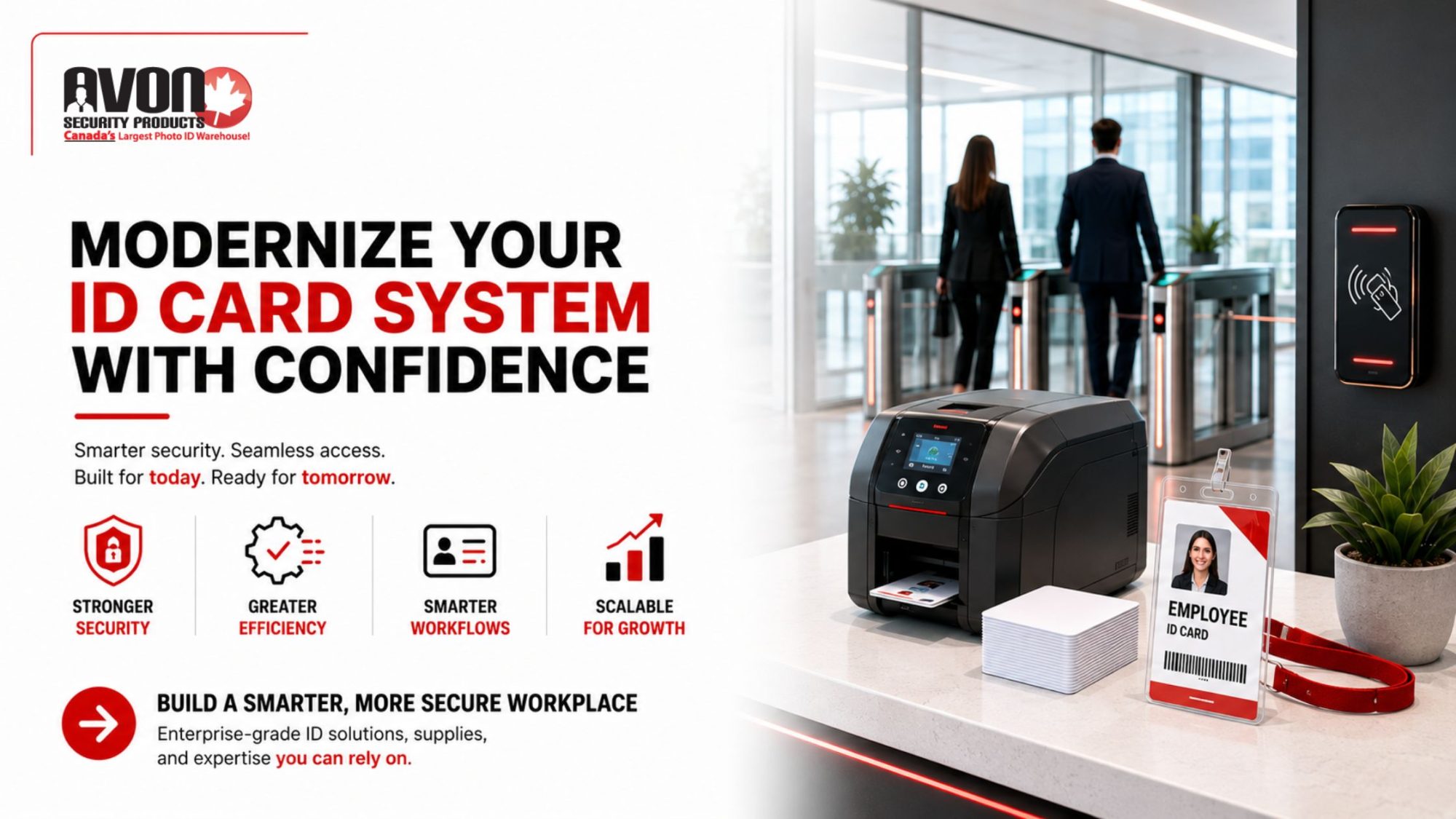
Modern employee ID card system featuring an ID card printer, access control reader, and employee badge in a secure office environment designed to improve workplace security and operational efficiency

Canadian Organizations Want Canadian Support

Support matters more than many organizations realize until something breaks.

Printer downtime, supply shortages, software issues, or encoding problems can quickly disrupt daily operations.

Avon Security Products supports organizations across Canada with:

  • Enterprise ID card printers
  • Genuine ribbons and supplies
  • Secure card technologies
  • Technical guidance
  • Product support
  • Professional badge issuance solutions

Organizations benefit from Canadian based expertise, reliable product access, and guidance tailored to real operational environments across healthcare, education, corporate, and government sectors.

That level of support becomes increasingly valuable as ID infrastructure grows more sophisticated.

Key Takeaways

  • Modern ID card systems now support security, access management, visitor tracking, and operational workflows simultaneously.
  • Canadian organizations are upgrading outdated badge infrastructure to improve efficiency, scalability, and credential security.
  • Integrated systems connected to HR, security, and access platforms create smoother management processes.
  • Advanced printer technology improves reliability, print quality, and long term operational performance.

Avon Security Products supports Canadian organizations with enterprise grade ID systems, supplies, and credentialing expertise.

Frequently Asked Questions

Why are Canadian organizations upgrading their ID card systems?

Many organizations are modernizing their ID systems to improve security, simplify credential management, support hybrid workplaces, and integrate access control more effectively. Older systems often struggle with scalability, reliability, and modern security requirements.

What features do modern ID card systems include?

Modern systems may include RFID technology, smart card encoding, visitor management integration, cloud connected software, access control compatibility, centralized credential management, and advanced badge security features.

How do proximity cards improve workplace security?

Proximity cards help organizations control physical access more securely by allowing authorized users to access specific areas without relying solely on visual identification. Many systems also support encrypted authentication and activity tracking.

When should an organization upgrade its badge printing system?

Organizations should consider upgrading when they experience frequent printer downtime, slow issuance processes, outdated software limitations, security concerns, or increased credential management demands due to growth or operational changes.

What industries benefit most from modern ID badge systems?

Healthcare, education, government, manufacturing, corporate offices, and property management organizations commonly benefit from modernized ID infrastructure because they often manage high volumes of employees, visitors, contractors, or secure access requirements.

Final Thoughts

Modernizing an ID card system is about more than upgrading hardware. It is about creating a more secure, efficient, and scalable way to manage people, access, and workplace operations.

With the right technology and support, Canadian organizations can build modern ID card systems that are ready for both today’s security needs and tomorrow’s growth.

Common Mistakes to Avoid When Buying an ID Card Printer

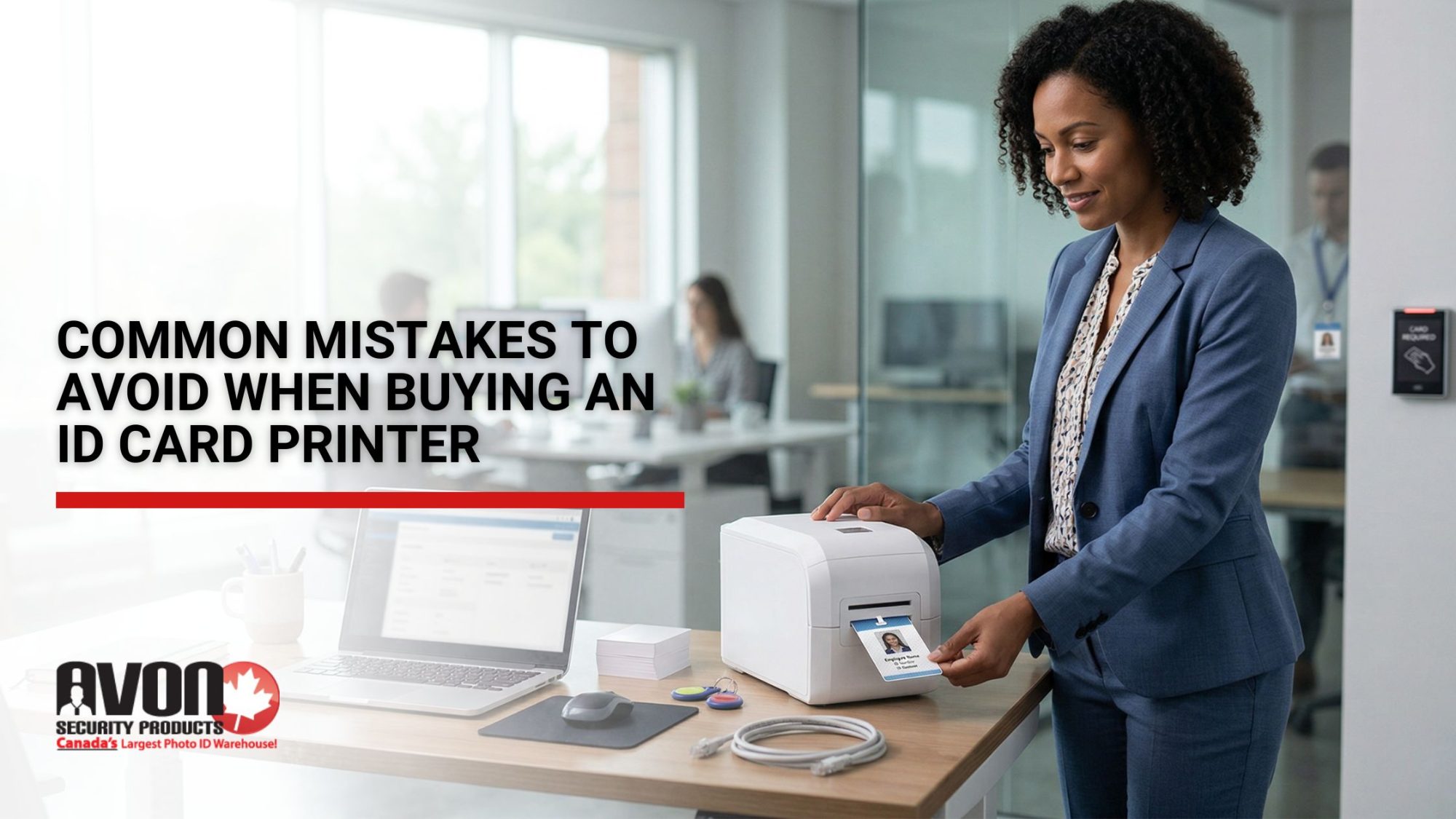
Professional office setting where a woman uses an ID card printer to print an employee badge, highlighting common mistakes to avoid when buying an ID card printer for business use in Canada

Organizations across Canada rely on ID cards every day. Employees badge into offices, students access campus facilities, healthcare staff verify identity quickly, and government agencies manage secure credentials. Behind each of these systems is a decision that often seems straightforward at first: choosing an ID card printer.

Yet many organizations approach this purchase with limited information. They focus on the printer itself rather than the broader badge printing ecosystem. The result can be unexpected costs, operational delays, or equipment that fails to meet long term needs.

If you are evaluating ID card printers in Canada, understanding common purchasing mistakes can save significant time and money. The right printer should support your workflow, security requirements, and future growth. The wrong one can create friction that follows your organization for years.

Below are some of the most common mistakes organizations make when selecting an ID card printer and how to avoid them.

Prioritizing Price Instead of Long Term Value

Budget considerations matter. However, choosing the lowest priced printer often leads to higher long term costs. Entry level printers may appear affordable at first, but they can lack durability, scalability, and compatibility with advanced security features. Organizations sometimes discover later that the printer cannot support additional modules such as encoding systems or dual sided printing upgrades.

A strong purchasing decision looks beyond the hardware price. Total cost of ownership includes supplies, maintenance, training, and future expansion.

Organizations that invest in new datacard printers for businesses often benefit from improved reliability, faster printing speeds, and compatibility with modern credential technologies. When evaluating printers, consider long term operational value rather than simply the upfront price.

Overlooking Print Quality and Technology Differences

Print quality affects more than appearance. It directly impacts security and usability. Poor print resolution can make photos difficult to recognize. Text and barcodes may appear blurred, which can interfere with scanning systems or access control technology. Over time, low quality printing may also fade faster, requiring more frequent card replacement.

Organizations using encoded credentials such as a proximity card should also consider how printing quality interacts with embedded technologies. High quality printers ensure that graphics, photos, and encoded features all function properly within the same card design.

Research on smart identification systems shows that technologies such as RFID and NFC are increasingly embedded in modern credentials to automate authentication and improve facility access control. One academic study examining RFID enabled identification systems explains how these technologies strengthen identification and tracking across secure environments.

Choosing a printer designed for professional identification systems ensures cards remain clear, durable, and secure.

Ignoring Print Volume and Speed Requirements

Many organizations underestimate how frequently they will print ID cards. What begins as a small project quickly becomes a daily operational need.

For example, schools may initially print staff credentials but later add student IDs, visitor passes, and replacement cards throughout the year. Corporate offices may need badges for contractors, temporary workers, and new hires.

If the printer cannot handle the required volume, the process becomes slow and inefficient. Lower capacity printers may overheat or require frequent pauses during large print runs.

Understanding expected card production helps determine the right printer category. Entry level printers are often ideal for small offices. Mid range or industrial printers are better suited for high volume environments where speed and durability matter.

Choosing the Wrong Printer Type or Model

Not all ID card printers operate the same way. Different printing technologies produce different results.

Most modern systems rely on dye sublimation or retransfer printing. Dye sublimation printers are common for everyday identification cards and produce reliable color images on standard PVC cards. Retransfer printers are typically used when higher image quality, edge to edge printing, or specialty card materials are required.

Organizations that overlook these differences may end up with cards that lack the professional appearance or durability they expected.

A comprehensive ID card printer buying guide should evaluate several factors including print technology, card compatibility, image quality, and integration with existing systems. Selecting the correct model ensures the printer supports both operational needs and visual quality standards.

Neglecting Security Features

ID cards are not just identification tools. They are security devices. Modern credentials often incorporate security elements such as holographic overlays, smart chip encoding, magnetic stripe technology, or embedded proximity access features. These elements protect against unauthorized duplication and strengthen access control systems.

Organizations sometimes purchase printers without considering how these security components will be integrated. A printer that cannot support encoding modules or specialized laminates may limit future security upgrades.

Many organizations also integrate identification systems into larger identity management frameworks. The Government of Canada’s Identity, Credential and Access Management framework outlines how secure credentials such as smart cards are used to control access to facilities, systems, and sensitive information.

Security researchers also continue to study vulnerabilities within RFID credential systems. Academic analysis of RFID authentication and security challenges highlights why secure encoding and credential management are essential components of modern access control systems.

A well designed ID printing system considers both visual identification and credential security. Selecting equipment that supports secure printing and encoding ensures your system evolves alongside your organization’s safety requirements.

Not Considering Dual Sided Printing Needs

Another common oversight is failing to consider whether cards require printing on both sides. Many organizations begin with simple front facing credentials. Over time they realize that the back of the card could contain important information such as emergency contacts, barcodes, access instructions, or policy reminders. At that point, a single sided printer becomes a limitation.

Understanding the difference between a single-sided vs dual-sided ID printer helps organizations plan ahead. Dual sided printing systems allow more flexibility for design and information placement without requiring manual refeeding of cards. Planning for dual sided capability early can prevent costly upgrades or replacements later.

Ignoring Future Needs and Scalability

Operational needs rarely stay static. A company with 50 employees today may have 200 within a few years. A healthcare facility may introduce new credential requirements for contractors, volunteers, and temporary staff. Schools may expand programs that require additional badge access. If the printing system cannot scale with these changes, organizations may be forced to replace equipment prematurely.

Scalable solutions allow for upgrades such as encoding modules, lamination systems, or higher capacity card hoppers. These features allow the printer to grow with the organization rather than becoming obsolete.

Credential technologies also play a role in broader security infrastructure. Canada’s national cybersecurity guidance on Identity, Credential and Access Management explains how scalable credential systems help organizations manage identity verification and secure access across expanding digital and physical environments. Thinking about future needs during the purchasing stage helps avoid costly replacements later.

Disregarding Support, Maintenance, and Technical Assistance

One of the most overlooked factors in printer purchasing decisions is ongoing technical support.

Even the most reliable printers require occasional troubleshooting, supply replacements, and system updates. When organizations purchase equipment from overseas vendors or unfamiliar online marketplaces, technical assistance may be difficult to access.

Reliable suppliers provide guidance on setup, software compatibility, and operational training. They also supply genuine ID printer supplies and ribbons that maintain printer performance and protect warranty coverage.

Long term success with badge printing depends on having access to knowledgeable support teams that understand the equipment and its applications.

Overlooking Maintenance Requirements

Every ID card printer requires routine care to maintain consistent performance. Cleaning kits, calibration tools, and periodic servicing help prevent issues such as streaking, color inconsistency, or print head damage. Organizations that neglect maintenance often experience reduced print quality and unexpected downtime.

Planning for ID card printer maintenance ensures the equipment continues operating smoothly throughout its lifecycle. Preventative care extends printer longevity and protects the investment organizations make in their badge printing systems.

The Value of Local Expertise When Choosing an ID Card Printer

Selecting an ID card printer should never be treated as a simple equipment purchase. It is part of a larger identification and security system that supports daily operations. Organizations benefit greatly from working with knowledgeable suppliers who understand credential printing technologies, security requirements, and system compatibility.

Avon Security Products provides Canadian based expertise and support for organizations seeking secure badge printing solutions. From schools and hospitals to corporate offices and government facilities, we help organizations evaluate the full picture. With the right guidance, organizations can make confident purchasing decisions that protect both their operations and their investment.

The Hidden Costs of Buying ID Printers from Overseas Suppliers

Professional ID card printer producing a photo ID card on an office desk, illustrating the risks and hidden costs of buying ID printers from overseas suppliers.

At first glance, buying an ID printer from overseas can look like a smart financial move. The sticker price seems lower. The product specs appear comparable. The supplier promises fast delivery and global support. But for many Canadian organizations, that initial saving quietly disappears once the real costs begin to surface.

Hidden costs are rarely listed on a product page. They show up later in delayed shipments, unexpected fees, inconsistent print quality, and long support wait times. Over time, these issues do more than strain budgets. They disrupt operations, introduce compliance risks, and create avoidable frustration for teams that rely on secure identification systems every day.

This is where working with a Canadian ID printer supplier changes the equation. Local purchasing is not just about patriotism. It is about predictability, accountability, and long term value.

Duties, Taxes, and Currency Fluctuations That Add Up Quickly

Overseas pricing is often presented in foreign currency and excludes the costs that come with importing technology into Canada. Duties, brokerage fees, customs clearance charges, and fluctuating exchange rates can significantly inflate the final price.

What starts as a competitive quote can quickly become unpredictable. Currency shifts between the time of purchase and the time of payment can add hundreds or even thousands of dollars to a single order. These costs are difficult to forecast and even harder to explain when budgets are already approved.

According to the Canada Border Services Agency, commercial imports are subject to specific duty classifications and tax rules that many buyers only discover after goods arrive at the border, adding unexpected costs to overseas purchases.

Buying locally removes this uncertainty. Pricing is in Canadian dollars, import duties are eliminated, and procurement teams can plan with confidence instead of reacting to surprise charges.

Shipping Delays and the True Cost of Waiting

International shipping introduces risk at every stage. Port congestion, customs inspections, weather disruptions, and global supply chain bottlenecks can all delay delivery. When ID printers are tied to onboarding, access control, or compliance deadlines, delays are not just inconvenient. They are costly.

Missed start dates, manual workarounds, and postponed security upgrades all translate into lost productivity. In high turnover environments or regulated sectors, even short delays can have operational consequences.

The Canada Border Services Agency notes that clearance timelines and border processing requirements can vary widely depending on shipment classification and origin, making overseas delivery dates difficult to guarantee.

Working with a Canadian supplier helps organizations avoid shipping delays in Canada by relying on domestic inventory and faster fulfillment. When timelines matter, proximity becomes a competitive advantage.

Consumables and Ongoing Supplies That Are Harder to Source

An ID printer is only as useful as the supplies that support it. Ribbons, cards, cleaning kits, and replacement parts are recurring necessities. Overseas suppliers often focus on the initial sale, leaving customers to navigate consumables sourcing on their own.

This can lead to longer wait times, higher shipping costs, and compatibility issues if supplies are discontinued or updated without notice. In some cases, organizations are forced to stockpile consumables, tying up capital and storage space.

Local suppliers simplify this process by offering consistent access to approved supplies that are readily available. This ensures continuity and protects print quality over the life of the system.

Maintenance, Repairs, and Support That Cross Time Zones

When something goes wrong with an ID printer, response time matters. Overseas support teams operate in different time zones, often rely on email only communication, and may require international shipping for repairs. This extends downtime and increases costs.

Shipping a printer overseas for service introduces additional risks, including damage in transit and customs delays. Warranty claims can become complicated, especially when international return policies are unclear.

By contrast, Avon Security Products offers local warranties and in-country repair services. Issues are resolved faster, communication is clearer, and organizations spend less time managing problems and more time operating securely.

Print Quality and Reliability Over the Long Term

Not all printers age the same way. Overseas models may meet specifications at launch but struggle to maintain consistency as components wear. Variations in ribbon quality, firmware updates, and unsupported parts can lead to fading, misalignment, or reprints.

Each failed card represents wasted supplies, staff time, and potential security exposure. Over months and years, these small inefficiencies compound into measurable costs.

Reliable print quality is not just about aesthetics. It is about ensuring that credentials remain readable, durable, and professional throughout their intended lifespan.

Flexibility and Compatibility Issues Inside Real Workflows

Many overseas printers are designed for global markets with limited consideration for regional systems. This can create compatibility challenges with access control software, card formats, or data handling requirements commonly used in Canada.

Organizations may find themselves locked into proprietary systems or unable to integrate printers seamlessly into existing workflows. Customization options can be limited, and support for third party integrations may be minimal.

Global Affairs Canada outlines how harmonized system classifications and trade regulations affect imported technology products, which can also influence compatibility and long term system planning.

Choosing solutions designed for ID card systems in Canada ensures better alignment with local infrastructure and evolving operational needs.

Energy Consumption and Environmental Impact

Energy efficiency is an often overlooked cost factor. Some overseas printers consume more power, generate more waste, or rely on consumables that are difficult to recycle locally. Over time, higher energy usage and disposal challenges increase operating costs and environmental impact.

Canadian organizations are increasingly accountable for sustainability commitments. Equipment choices play a role in meeting those goals, especially in large scale deployments.

Local suppliers are better positioned to recommend models that balance performance with responsible energy use and environmental considerations.

Reputation and Brand Risk You Cannot Ignore

Identification systems are visible. Poor print quality, inconsistent card durability, or system downtime reflect directly on the organization issuing them. For schools, healthcare facilities, government offices, and corporations, these details shape trust.

Relying on overseas suppliers with limited accountability introduces reputational risk. When issues arise, resolution may be slow or incomplete, leaving organizations to manage the fallout internally.

Working with a trusted local partner reinforces professionalism and reliability at every touchpoint.

Time and Productivity Losses That Drain Teams

Every delay, reprint, support ticket, and workaround consumes staff time. These hidden productivity losses rarely appear in procurement comparisons, yet they have real financial impact.

IT teams spend hours troubleshooting. Administrative staff manage supply shortages. Managers explain delays to stakeholders. Over time, these distractions pull focus away from core responsibilities.

Choosing to shop local reduces friction across the entire lifecycle of an ID printing system, freeing teams to focus on higher value work.

Why Canadian Organizations Choose Avon Security Products

The true cost of an ID printer is revealed over years, not at checkout. Canadian organizations increasingly recognize that local sourcing delivers better outcomes financially and operationally.

The Canada Border Services Agency publishes detailed tariff schedules showing how imported goods are classified and taxed, reinforcing why overseas pricing often fails to reflect true landed costs.

Avon Security Products can help businesses avoid hidden costs through transparent CAD pricing, fast domestic shipping, and dependable local support. With tailored solutions for schools, healthcare, government, and commercial environments, Avon provides more than hardware. It delivers confidence.

When reliability, compliance, and long term value matter, buying Canadian is not a compromise. It is the smarter investment.

Choosing Between Single-Sided and Dual-Sided Sigma DSE Printers

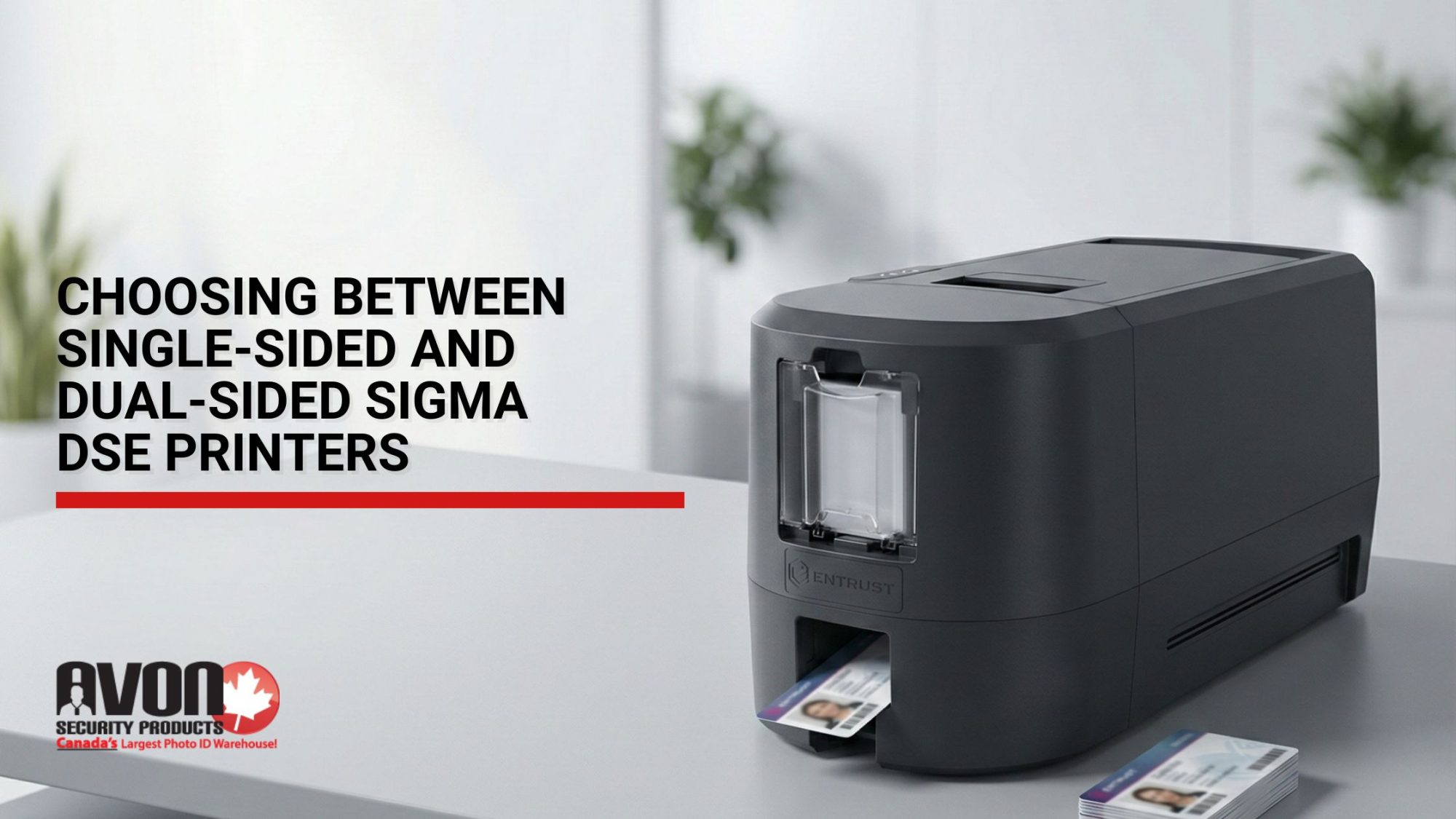
Sigma DSE card printer showing comparison between single-sided and dual-sided ID card printing for secure photo ID production.

Every organization that issues identification cards eventually faces the same question. Should we choose a single sided or dual sided Sigma DSE printer? It may seem like a technical decision, but the configuration you select has long term implications for security, productivity, cost, and how your organization manages access.

The right ID card printer configuration is not about choosing the most advanced option. It is about choosing the one that matches your real world needs. This guide walks through the practical differences between single sided and dual sided Sigma DSE printers so you can make a confident, future ready choice.

Overview of Single Sided and Dual Sided Printers

At their core, both configurations of the Sigma DSE printer are built for reliability, print clarity, and secure operation. The difference lies in how the card is printed.

A single-sided Datacard Sigma DSE prints only on the front of the card. To add information to the back, the card must be manually flipped and sent through the printer again.

A dual-sided Datacard Sigma printer automatically prints both sides of the card in a single pass. The card moves through the printer once, with the system handling the flip internally.

This difference may sound small, but it directly impacts speed, workflow efficiency, data layout, and how securely your cards can store information. Government design standards reinforce why consistent card layouts and disciplined production choices matter, especially when IDs must remain clear, durable, and easy to interpret in real operational settings.

Key Differences Between Printer Types

The most noticeable difference between a single sided ID card printer and a dual sided ID card printer is automation.

With a single sided unit, every card that needs information on both sides requires two print steps and manual handling. This adds time and introduces the possibility of misprints or alignment errors.

A dual sided printer removes that friction. The system prints both sides in one process, reducing touch points and improving consistency. This becomes especially important in environments where cards include barcodes, access rules, or legal disclaimers that must remain readable and correctly positioned.

Security focused programs often align card issuance with federal identity standards such as FIPS 201 3, which outlines physical and logical credential requirements for secure ID systems.

Printing Speed and Volume Considerations

Speed is not just about how fast a printer runs. It is about how efficiently your team can issue cards during peak demand and how well your card printing solutions support real operational workflows.

Single sided printers work well for low volume environments where cards only require front facing information. Schools issuing basic student IDs or small offices printing occasional staff badges often find this setup sufficient.

Dual sided printers are designed for higher volume environments. Hospitals, government offices, manufacturing plants, and corporate campuses often need to issue dozens or hundreds of cards at a time. When cards must include access instructions, security notices, or encoded data on the back, the dual pass process becomes essential.

Organizations that follow digital identity frameworks such as NIST SP 800 63A understand that enrollment and identity proofing processes depend on consistent credential production methods.

Customization Needs and Use Cases

Your card design often determines your printer configuration.

If your organization uses the back of the card for signatures, QR codes, magnetic stripes, or compliance text, a dual sided printer supports this layout without slowing production.

Single sided printers are ideal when the card front holds all required information and the back remains blank or unused. This is common for visitor badges, event passes, or temporary access cards.

Design frameworks such as the AAMVA Secure DLID Card Design Guidelines reinforce the importance of structured layouts that protect card integrity and reduce fraud.

Cost and Budget Implications

Upfront cost is often the first comparison point, but it should never be the only one.

A single sided printer has a lower purchase price and is attractive for organizations with limited budgets or simple card programs.

A dual sided printer costs more initially, but it reduces labor time, minimizes card handling errors, and supports more advanced security features. Over time, these operational savings often outweigh the difference in price.

The true cost is not what you pay today. It is what you spend maintaining efficiency and security over the lifespan of the system.

Additional Features and Options

The Sigma DSE printer is designed to support encryption, authentication, and firmware protections that align with modern secure card printing environments.

Optional modules such as lamination and encoding enhance both single and dual sided printers. However, many of these features reach their full potential when paired with a dual sided configuration that supports layered data placement and compliance requirements.

Criteria for Choosing the Right Printer

Ask the questions that reflect how your organization actually works.

How many cards will you print each month?

Does your card design require back side content?

Will your security needs grow within three years?

How much staff time is spent handling card printing?

Do you need room to expand your access program?

Your answers will guide you toward the configuration that supports both present needs and future scalability.

The Role of the Sigma DSE Printer in Modern Security

The Sigma DSE printer platform supports reliability, clarity, and long term performance.

What matters most is choosing the configuration that aligns with how your organization issues, manages, and protects identity credentials.

Avon Security Products approaches this decision with practical guidance, not sales pressure. Their role is to help organizations choose ID card printers that match operational reality, not feature hype.

When supported by the right partner and configuration, your ID program becomes part of a secure and efficient access ecosystem.

Frequently Asked Questions and Expert Advice

Many buyers worry about choosing too much or too little. The goal is not to overbuy. It is to avoid being locked into a system that limits you as your program evolves.

Do I really need a dual sided printer if my cards look simple today?

If your cards only display a photo, name, and logo on the front, a single sided printer may be sufficient for now. However, many organizations later need to add barcodes, compliance text, access instructions, or encoded data on the back. If you expect your security needs to grow, a dual sided printer gives you room to expand without replacing hardware.

Will a single sided printer slow down our card issuance process?

A single sided printer works well for low volume environments. However, if you frequently print cards that require both sides, the manual flipping process adds time and increases the chance of errors. For teams issuing larger batches, a dual sided printer significantly improves workflow efficiency and consistency.

Which option is better for secure or regulated environments?

Facilities that manage access control, personal data, or compliance requirements typically benefit from dual sided printers. The additional print surface allows for layered security information and reduces the need for manual handling. This supports more controlled, reliable credential issuance over the long term.

Final Thoughts

Choosing between a single sided ID card printer and a dual sided ID card printer is not about features. It is about fit.

The Sigma DSE printer offers both options because no two organizations operate the same way. With the right configuration, your program gains efficiency, compliance readiness, and room to grow.

How the New Datacard Printers Help Businesses Upgrade Their ID Workflow Overnight

Professional woman using a Datacard ID printer system in a modern workplace, illustrating upgraded ID card printing workflows and secure credential management.

Modern identification should feel seamless. Fast printing, crisp graphics, predictable performance, and instant readiness are no longer luxuries. They are expectations. The newest generation of Datacard printers delivers exactly that, empowering organizations to upgrade their ID issuance workflow in a single day with dramatically faster output, simplified setup, and noticeably better print quality.

Strong identification processes are more important than ever. The Government of Canada’s Identity, Credential and Access Management Framework outlines how reliable, secure, and clearly authenticated credentials form the backbone of organizational security. When your physical IDs align with these standards, everything from access control to visitor management becomes stronger and easier to maintain.

Avon Security Products has helped more than twenty five thousand businesses elevate their ID programs. With next day delivery, expert configuration, and lifetime technical assistance, teams can move from outdated equipment to modernized identification almost immediately.

Below is how the new Datacard lineup transforms ID creation from a bottleneck into a reliable workflow that supports your entire organization.

Power Up Faster with High Speed ID Printing That Never Slows You Down

Businesses rely on ID cards every day. Employee badges, visitor passes, student IDs, access control credentials. The faster they are produced, the sooner people can move through buildings and workflows without delay.

The newest Datacard models deliver impressive output speeds along with consistent colour vibrancy and edge to edge clarity. A professional Datacard ID printer produces sharp text, crisp barcodes, and photo quality images that scan correctly the first time.

This level of precision matters. The Office of the Privacy Commissioner of Canada notes that strong identification and authentication practices reduce vulnerabilities across internal systems. High quality, tamper resistant ID cards create an additional layer of trustworthiness and significantly reduce administrative errors.

For organizations that process frequent onboarding or time sensitive identification, what once took minutes now takes seconds. Administrators gain time back, employees avoid delays, and identification becomes a seamless part of daily operations.

Benefits of Firmware Upgrades That Keep Your Printer Performing Like New

One of the most underrated strengths of the Datacard ecosystem is its intelligent firmware architecture. Firmware upgrades give businesses continuous improvements long after installation.

With each update, printers gain enhanced image stability, improved ribbon calibration, refined card feeding, and stronger device security. These adjustments reduce misprints, improve clarity, and maintain accurate imaging even under heavy workloads.

Ongoing updates also support compliance. Canadian Cyber Security Centre guidance emphasizes the importance of well maintained identity and credential systems as part of broader access management. Keeping your printer firmware up to date ensures your hardware supports those evolving standards.

It is a simple upgrade that strengthens your investment and protects long term performance.

Differences Between Printer Models That Help You Choose the Right Fit

Every Datacard unit is designed for reliability, but each model supports different workflow needs. Some offer single sided production for front facing identification, while others offer advanced capabilities like smart card encoding, lamination, or high volume batch production.

Businesses looking for convenience often turn to the dual-sided Datacard Sigma printer, which prints both sides of a card in one smooth pass. Organizations that need cost efficiency may prefer compact units. High traffic environments benefit from systems with larger hoppers and faster card throughput.

Avon Security Products provides direct guidance based on your workflow, security requirements, industry standards, and ID volume. The goal is not simply to recommend a printer, but to identify a system that makes your identification process more accurate and more efficient from day one.

A Firmware Update Process Designed for Simplicity and Zero Disruption

Printer updates used to be intimidating. Today, Datacard firmware upgrades are deliberately simple. Most updates take only a few clicks through a guided utility that checks your device, downloads the correct files, and installs them automatically.

This ensures continuous alignment with security requirements, identity templates, and access control systems. For organizations that follow Government of Canada identity verification guidelines for security screening, maintaining this alignment is essential. Smooth firmware upgrades support that continuity and reinforce the value of working with a trusted security provider in Canada.

When teams need help, Avon’s Canadian based support specialists provide direct remote assistance to resolve issues quickly and minimize workflow interruptions.

Regionalized Ribbon Compatibility That Ensures Print Quality Every Time

Datacard printers use intelligent ribbon recognition that verifies compatibility and ensures optimal print performance. This prevents issues like streaking, dull images, or premature printhead wear.

Using a standard Datacard printer ribbon also contributes to card integrity. 

High quality, clearly readable ID cards support identity verification procedures outlined by Public Services and Procurement Canada, which require clear and accurate credentials for screening, access control, and authentication.

When print quality is consistent, your ID program becomes more reliable, more secure, and easier to maintain.

Troubleshooting and Support That Gets You Back to Printing Immediately

Datacard printers are built to minimize disruptions. Clear messaging and intuitive diagnostics help staff identify issues quickly. Most day to day adjustments are simple.

When additional support is needed, Avon delivers lifetime technical assistance from a Canadian based team. There are no cross border delays, no international call queues, and no uncertainty. Your team receives real time support from specialists who understand both the equipment and the workflow behind it.

Free training is included with every purchase, ensuring that new staff learn best practices for ID printing and card management right away. Whether teams are using an ID card printer for business for the first time or upgrading from older systems, the learning curve stays minimal.

How Canadian Businesses Upgrade Their ID Workflow Overnight

Across corporate offices, hospitals, universities, and government institutions, Datacard printers remain the industry standard for reliable ID issuance. They produce crisp, scannable, tamper resistant credentials that align with authentication guidance from multiple Canadian regulatory bodies.

Buying through Avon brings additional advantages. You receive local shipping, zero import fees, expert setup, and ongoing support from a dedicated Canadian team. You also gain the assurance of purchasing from Avon Security Products, an authorized Datacard supplier trusted nationwide.

It is the simplest path to modernizing your ID program in a single day. Plug in your high speed ID printer, load your card template, and begin issuing clear, vibrant IDs immediately.

Why Avon Security Products Is the Partner Businesses Choose First

A modern ID printer is more than hardware. It is part of your access control system, your employee onboarding, and your compliance framework. That is why choosing the right partner matters.

Avon Security Products delivers Datacard printer Canada wide with free setup, unlimited training, and expert support that extends far beyond the initial purchase. Fast delivery ensures you can upgrade ID workflow without delay, and proven reliability ensures your identification system remains strong for years.

If your organization is ready to move to the next generation of ID printing with authority grade performance and immediate workflow impact, Avon is ready to help.

Your new system can be operational tomorrow. All it takes is the right printer and the right partner.

Meet the New Datacard Professional Series: Faster, Smarter, and Built for Canada’s Most Trusted Organizations

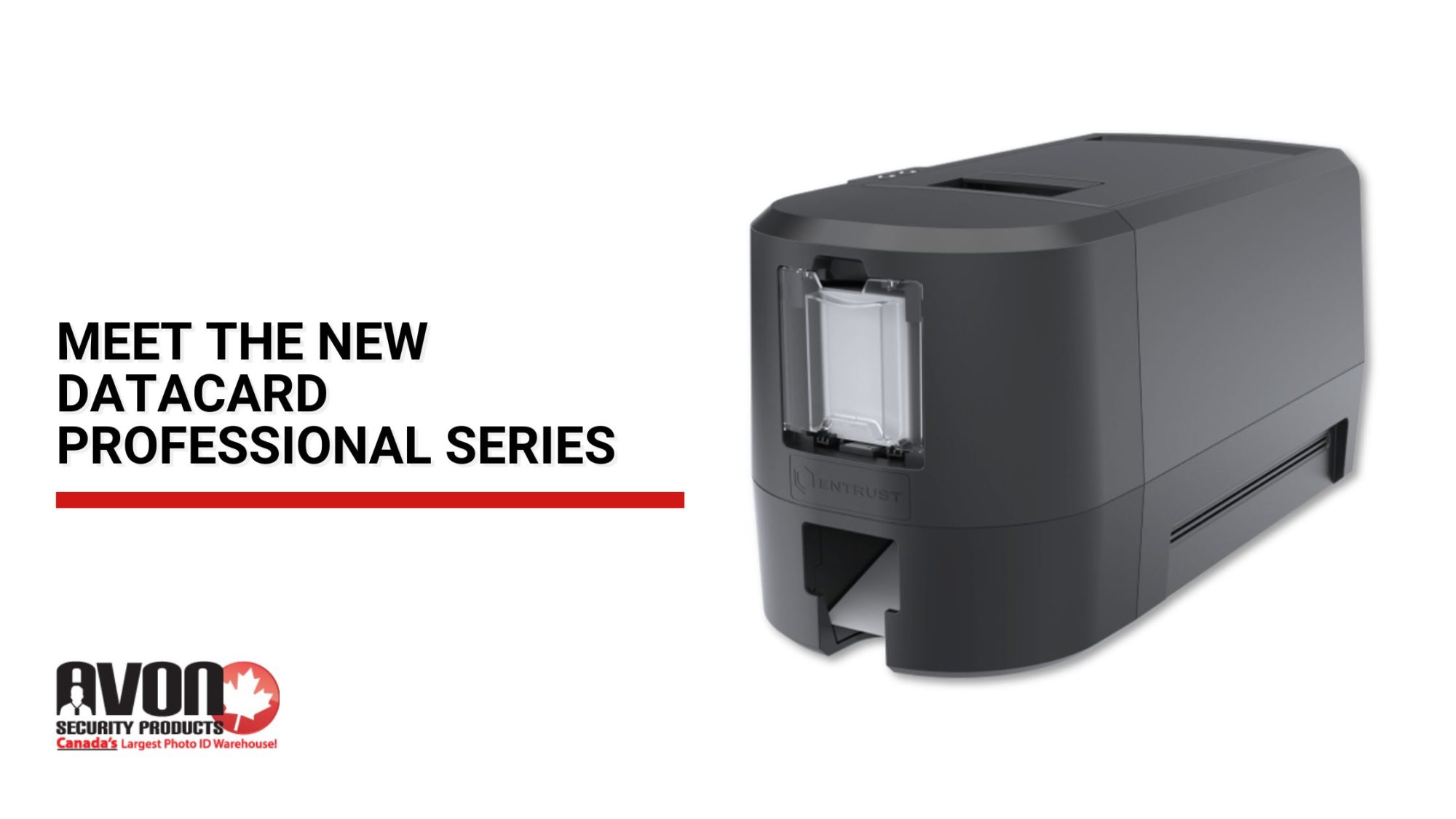
Avon Security Products promotional image showcasing the new Datacard Professional Series ID card printer with branding.

In professional environments where identity matters, such as hospitals, universities, government agencies, and corporate offices, the smallest details carry weight. An ID card is not simply a piece of plastic. It represents access, verification, security, and trust. When it comes to printing those cards, organizations across Canada expect performance they can rely on every single day.

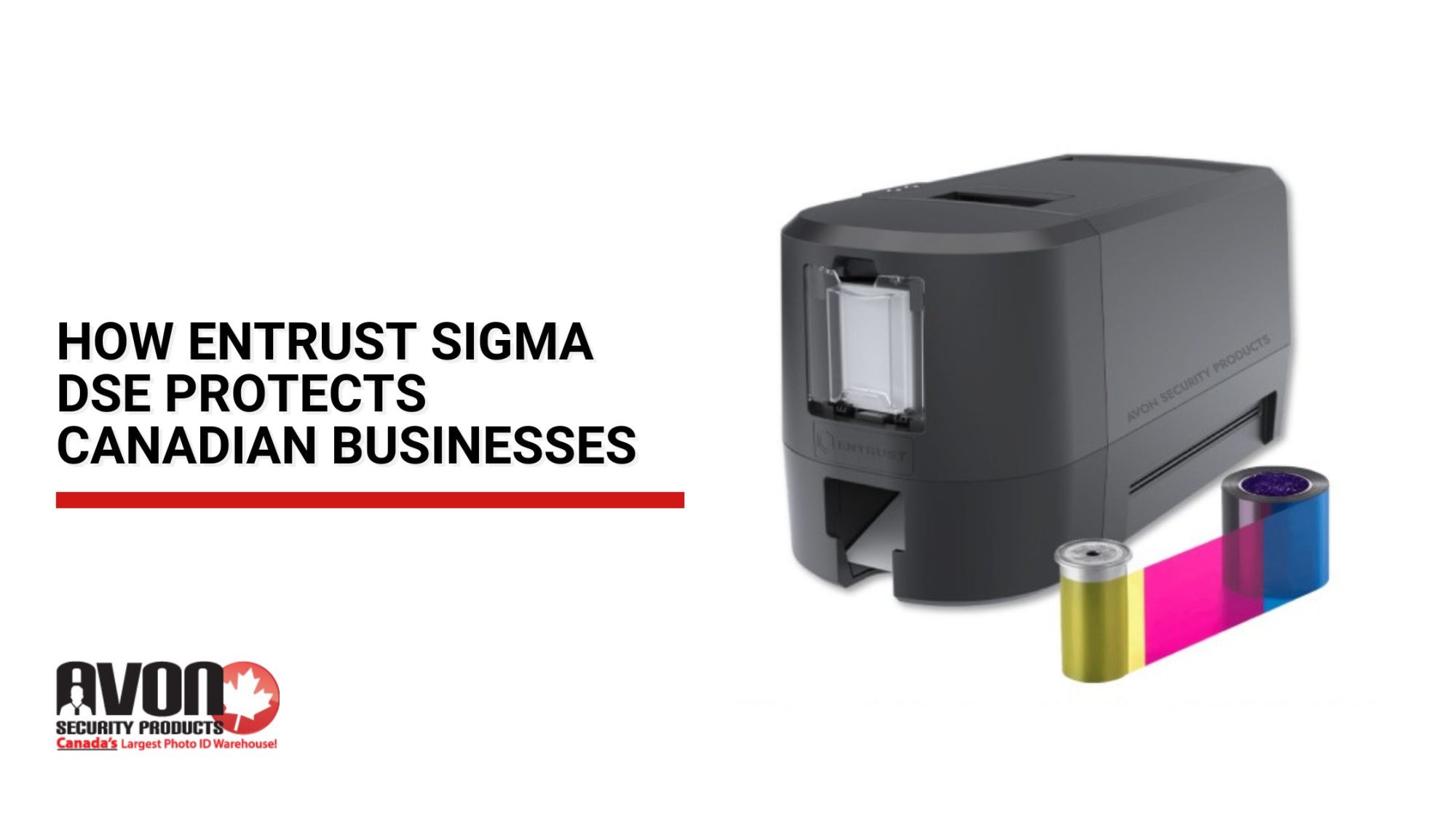
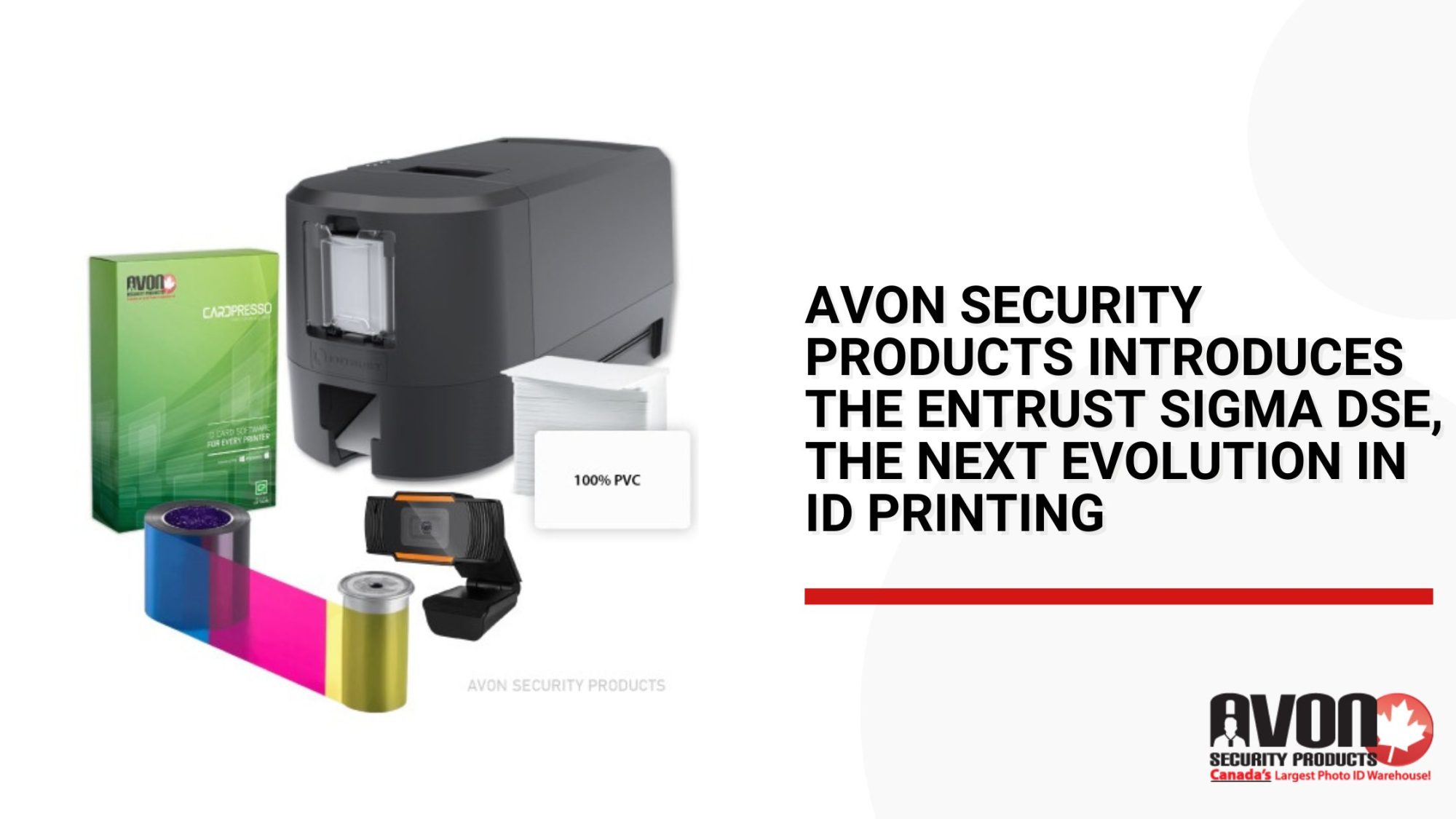
Avon Security Products is introducing Datacard Entrust’s new Professional Desktop ID Card Printer series. This refreshed lineup delivers faster output, elevated colour performance, cleaner design, and smooth operation. These updated models were created with the everyday realities of Canadian organizations in mind.

This launch is more than a hardware upgrade. It reflects a clear standard. Professional ID printing should be intuitive, powerful, and supported by a local partner who understands what reliability actually looks like for organizations that cannot afford downtime.

The Next Generation of Professional ID Printing Arrives

Datacard has long been recognized as a leader in secure card issuance. The new Professional Series builds on that history by bringing modern refinements to an already proven platform. With models such as the single-sided Datacard Sigma DSE and the Datacard dual-sided ID printer, users gain dependable performance paired with enhanced speed, richer colour reproduction, and a more streamlined footprint.

These printers are ideal for entry level to mid volume environments that need consistent results without unnecessary complexity. They are a natural fit for HR teams, security desks, academic administration, healthcare reception areas, and membership based organizations that print cards daily.

The Professional Series brings a clean profile, compact build, and minimal learning curve. It is technology that blends into the workflow while delivering results that stand out.

Trusted Across Canada with Local Support That Never Leaves You Waiting

Before exploring the features, it is worth highlighting something important. The strength of a printer is not just found in the hardware. It is found in the support behind it.

Avon Security Products delivers professional ID solutions to more than 25,000 organizations across Canada. This includes the City of Brampton, Maple Leaf Sports and Entertainment, Bellwood Health Services, and Anderson College. When a printer goes down during orientation week or staff onboarding, there is no margin for cross border delays or support tickets that take days to process.

  • Avon Security Products’ Canadian advantage is clear and dependable.
  • Proudly Canadian operations with no duties or brokerage fees
  • Fast shipping from Canadian warehouses
  • Free training with every printer
  • Lifetime technical support
  • Loaner printers that keep programs running

This is the type of support that organizations value. Reliable printing paired with service that never leaves you waiting.

To help small and medium organizations strengthen their overall security posture, the Government of Canada provides guidance in the Get Cyber Safe Guide for Small and Medium Businesses. This resource supports the same commitment to continuity and protection that Avon Security Products prioritizes.

A Refreshed Design, Cleaner Output, and Intuitive Controls

The Datacard Professional Series introduces upgrades that matter. The Sigma DSE line brings refined engineering and simplified workflows.

Improvements include:

  • Faster output with up to 185 cards per hour in colour and up to 750 cards per hour in monochrome
  • Richer and more consistent colour using YMCKT technology
  • Compact industrial housing for easier maintenance and placement
  • A simplified interface built around a power button and multifunction control
  • A fixed 100 card input hopper and 25 card output hopper
  • A protected printhead guard that improves long term durability
  • Cloud ready architecture on duplex models

These refinements allow teams to work efficiently without dealing with complicated menus or multiple accessories. The Professional Series focuses on practicality and performance.

Key Features to Consider, The Professional Details That Matter Most

Choosing an ID printer can be overwhelming because many models share similar terminology. The Professional Series distinguishes itself by excelling in the features that organizations rely on every day.

1. Professional Speed That Fits Real Workflows

Most organizations need faster issuance without the cost or scale of an industrial retransfer printer. The Professional Series delivers exactly that.

  • Up to 185 cards per hour in colour
  • Up to 750 cards per hour in monochrome
  • Smooth edge to edge consistency
  • Minimal warm up time
  • Busy onboarding periods immediately benefit from these improvements.

2. Clean, Accurate Print Resolution

The Professional Series offers print resolutions of 300 by 300, 300 by 600, and 300 by 1200 dpi. This produces crisp facial details and clear text even on high volume runs.

3. Straightforward Installation

Setup is smooth and reliable, allowing teams to get up and running without delays or unexpected compatibility issues.

4. Design That Supports Real Workspaces

With simple controls, smart layout, and durable mechanics, these printers reduce training time and allow staff to work confidently.

Product Models and Series Overview, Finding the Right Fit

The Professional Series occupies a well defined space within the Datacard Sigma lineup.

Sigma DSE (Professional Series)

  • Designed for small and medium organizations
  • Available as single or double sided
  • USB connectivity for simplex and USB plus Ethernet for duplex
  • Affordable, compact, and cloud capable

Sigma DS1, DS2, DS3

Organizations needing premium ribbons, lamination, Wi Fi, or additional expansion options can explore these higher tier models.

For many Canadian teams, the Professional Series provides exactly the right balance of power, simplicity, and cost efficiency.

Supported Card Types and Applications, Designed for Real Operational Needs

The Professional Series supports the card types and thicknesses used throughout Canada.

This makes the printers suitable for a wide range of applications.

  • Employee identification
  • Student and faculty IDs
  • Healthcare and clinical access cards
  • Visitor and contractor passes
  • Membership cards
  • Volunteer credentials

These printers adapt easily to almost any identification program.

Colour Performance That Protects Brand Consistency

Colour accuracy is critical for organizations whose branding appears directly on ID cards. The updated YMCKT ribbon system produces balanced skin tones, strong contrast, and stable colour across long print runs. This reduces inconsistencies that arise with older technologies.

To better understand why secure identification matters, the Canadian Centre for Cyber Security offers guidance in its resource Protecting Yourself from Identity Theft Online. This aligns well with the importance of accurate identification in professional environments.

Cloud Ready Architecture That Supports Modern Workflows

The duplex models in the Professional Series are cloud ready. This allows organizations to manage printing from centralized systems, coordinate across multiple locations, and provide access to authorized team members regardless of workplace distribution.

For a broader view of identity assurance standards, the NIST Digital Identity Guidelines SP 800 63 4 provide internationally recognized guidance on digital identity proofing, authentication, and credential management.

These standards highlight the growing importance of reliable identity processes in both digital and physical environments.

Supplies That Keep Canadian Organizations Printing Continuously

Avon Security Products stocks a comprehensive range of Datacard supplies within Canada. This includes YMCKT colour ribbons, monochrome colours, PET G supplies, smart card upgrade kits, magnetic stripe upgrade kits, and Sigma protective dust covers. Our Supply Finder tool helps teams locate the correct supplies instantly.

The Canadian Advantage, Why Local Support Creates Real Value

Even the most advanced printer will eventually require support. Avon Security Products eliminates delays, duties, and complications by providing Canadian service and fast response times.

Clients receive Canadian phone and email support, lifetime assistance, free training, and loaner printers shipped quickly when needed. This extends the lifespan of every printer and keeps identification programs uninterrupted.

To understand the broader importance of security in Canada’s digital and physical systems, Public Safety Canada outlines national priorities in the National Cyber Security Strategy. This strategy highlights why secure card issuance remains an essential part of protecting organizational integrity.

Built for High Volume Reliability Without Excessive Overhead

The Professional Series is ideal for organizations that print between a few hundred and a few thousand cards annually. This includes academic institutions, community organizations, retail and corporate offices, healthcare networks, manufacturing facilities, and municipal departments that depend on reliable ID card printers in Canada without the cost or complexity of enterprise level systems.

Where the Professional Series Shows Its Strength

  • Smooth onboarding during busy period
  • Reliable printing at front desk environment
  • Cost effective issuance without compromising quality
  • Secure identification backed by Canadian support

These strengths make the Professional Series a dependable choice for organizations that prioritize continuity, clarity, and professional standards.

Your ID Program Needs More Than Hardware

A complete identification program requires reliable equipment, consistent supplies, training, and ongoing support. Avon Security Products provides an end to end model that helps organizations remain confident in their day to day issuance programs, regardless of volume or industry.

Begin Your Upgrade to Smarter and Faster ID Printing

The Datacard Professional Series introduces a new level of efficiency and consistency for Canadian organizations. With faster printing, richer colours, intuitive controls, and dependable support, this lineup offers a complete and balanced solution for professional identification.

If your organization is ready to move toward a more reliable and modern ID printing experience, the Professional Series is the ideal place to begin.

How the Entrust Sigma DSE Enhances Security for Canadian Businesses

Entrust Sigma DSE ID card printer with colour ribbon shown beside Avon Security branding, highlighting improved ID security for Canadian businesses.

Security is not static. It is a moving target shaped by evolving threats, workplace digitization, and the growing need for identity protection. In this shifting landscape, organizations across Canada are asking a pressing question: how do you issue credentials that are not only functional but also secure enough to withstand modern risks?

The answer lies in a breakthrough device that has redefined ID issuance: the Entrust Sigma DSE printer. As Canada’s exclusive source, Avon Security Products is proud to bring this innovation to businesses, schools, hospitals, and government agencies nationwide. The Sigma DSE is more than a plastic card printer. It is a future-ready solution that puts security, simplicity, and value at the center of every credential issued.

Key Features and Security Capabilities

The Entrust Sigma DSE was engineered to protect what matters most: people and data. Unlike older generations of printers, which often focused on surface-level convenience, the Sigma DSE layers security into every part of the process.

  • Data encryption at every step: Sensitive information is encrypted both in transit and at rest, helping reduce the risk of interception or theft.
  • Secure boot processes: The system only runs trusted code, reducing vulnerability to malware or unauthorized software.
  • Advanced counterfeiting defenses: From UV printing options to microtext, the Sigma DSE helps organizations stay ahead of identity fraud.

These features are informed by the principles in the Government of Canada’s Identity, Credential, and Access Management (ICAM) framework, which helps organizations secure identities, credentials, and access across both digital and physical systems.

When Canadian organizations adopt the Sigma DSE, they are not just upgrading equipment. They are adopting a defense strategy.

Comparison with Competitors and Product Differentiation

Many ID card printers on the market promise speed or efficiency. Few combine those promises with a real commitment to security and flexibility. Compared to other printers, the Sigma DSE distinguishes itself through three key differentiators:

  • Cloud-Readiness: While traditional printers rely on local installations, the Sigma DSE integrates seamlessly into cloud environments. This makes it perfect for organizations modernizing IT infrastructure.
  • Built-In Future Proofing: Firmware updates ensure the printer evolves alongside emerging threats and standards.
  • Effortless Integration: Competitors often require extensive configuration. The Sigma DSE connects quickly, streamlining adoption without draining IT resources.

The result is a product that does not just compete. It redefines expectations for Canadian photo ID systems, setting a new benchmark for ID card printer Canada standards.

Issuance Flexibility and Application Versatility

One of the most valuable aspects of the Entrust Sigma DSE is its versatility. It adapts to the specific credentialing needs of diverse industries, making it the most flexible cloud-ready ID card printer available today.

  • Businesses use it to produce employee badges with embedded access credentials.
  • Hospitals rely on it to create secure staff IDs that help maintain patient safety and regulatory compliance.
  • Schools leverage it for student cards that support both identification and building access.
  • Government agencies depend on its reliability for issuing credentials that meet stringent standards.

The Sigma DSE is more than a printer, it is a full plastic card printing solution that does not force organizations into a one-size-fits-all mold. Instead, it flexes to the needs of each environment, providing issuance flexibility that builds confidence in every card produced.

User Experience and Ease of Use

Technology only succeeds when people can use it with confidence. The Sigma DSE excels here too, offering a user experience designed around simplicity.

  • Out-of-the-box setup: Installation is quick, often requiring less time than competitive models.
  • Minimal training required: Intuitive interfaces mean staff can start producing IDs almost immediately.
  • Cloud dashboards: Administrators can monitor and manage printers remotely, aligning with hybrid workplace demands.

For organizations managing high staff turnover or limited IT resources, these features translate into tangible efficiency. It is the difference between a tool that frustrates and a tool that empowers.

Target Users and Use Cases

The Entrust Sigma DSE is built for Canadian organizations that cannot afford to compromise on identity protection. Its most common use cases include:

  • Corporate security: Reinforcing physical and digital access controls.
  • Healthcare environments: Meeting Canadian standards for privacy and patient safety through compliance with Canada’s health data privacy and cybersecurity frameworks, such as PIPEDA and Health Canada’s guidance on cybersecurity in medical devices.
  • Education systems: Offering flexible, durable student and faculty ID solutions.
  • Public sector: Supporting compliance with policies like the Treasury Board Secretariat’s Directive on Identity Management.

Each of these sectors shares one reality: identity fraud, data breaches, and operational inefficiencies are growing risks. The Sigma DSE provides a practical, secure way forward.

Smart Value and Cost Efficiency

Security and performance are essential, but Canadian organizations also need solutions that respect budget realities. The Sigma DSE strikes that balance.

  • Durability: Built for long-term reliability, minimizing replacement and downtime costs.
  • Energy efficiency: Designed to reduce operational expenses.
  • Flexible scalability: Suitable for small offices or enterprise-scale environments.

The Canadian Centre for Cyber Security’s Baseline Cyber Security Controls for Small and Medium Organizations underscores the value of focusing efforts where they deliver the greatest impact, reinforcing that the Sigma DSE fits within a cost-effective security strategy aligned with these national priorities.

Ordering and Support Resources

Technology is only part of the equation. The partner behind it matters just as much. Avon Security Products ensures Canadian organizations gain not only access to the Entrust Sigma DSE but also unmatched local support.

  • Canada’s Exclusive Source: Avon is the sole distributor of the Sigma DSE in the Canadian market.
  • Canadian Support Advantage: Customers enjoy fast delivery, responsive service, and local expertise.
  • Trusted Reputation: With decades of leadership in secure ID solutions, Avon is a proven partner.

Whether it is ordering supplies, scheduling maintenance, or expanding a system, Avon makes it simple to keep operations running smoothly.

Why Canadian Businesses Should Pay Attention

Identity security is no longer a “nice to have.” It is a necessity. From protecting employees and students to safeguarding data and access, the stakes are high. For Canadian businesses and institutions, the Entrust Sigma DSE represents a turning point.

With its unmatched combination of secure ID card printing, intuitive operation, and future-ready design, it elevates what Canadian photo ID systems can deliver. More importantly, with Avon Security Products as Canada’s exclusive source, organizations know they are backed by a trusted local partner.

For companies considering upgrades to their identity systems, the choice is clear: the Sigma DSE is not just a printer. It is a commitment to smarter, safer, and more resilient operations.

Why the Sigma DSE is the Smart Choice for Canada

Avon Security Products is proud to introduce Canadian organizations to the future of ID issuance with the Entrust Sigma DSE. It is secure, flexible, and cost-efficient, but most importantly it is built to protect people, data, and trust.

If your business, school, hospital, or agency is ready to strengthen its security foundation, the next step is simple: explore how the Sigma DSE can transform your approach to identity protection today.

Avon Security Products Introduces the Entrust Sigma DSE, the Next Evolution in ID Printing

Entrust Sigma DSE ID card printer

Identity is more than a badge. It is access, trust, and security in motion. Every card issued carries the responsibility of protecting people, places, and information. That is why when a new generation of printing technology arrives, it is not just an upgrade. It is a shift in how organizations secure their future.

Avon Security Products is proud to introduce the Entrust Sigma DSE, a breakthrough in ID card printing. In Canada, you will only find it here.

A New Era of ID Card Printing in Canada

Until now, ID card printers were measured by speed and image quality. Today’s workplaces demand something more: tools that are cloud-ready, security-driven, and intuitive enough for everyday users.

The Entrust Sigma DSE answers that call. By combining streamlined design with encrypted workflows, it delivers what Canadian institutions need most: reliable printing with uncompromising protection. For organizations balancing compliance, efficiency, and cost, this release is a decisive step forward.

With Avon Security Products holding exclusive Canadian rights, businesses gain not only access to the technology but also local expertise, faster shipping, and the assurance of working with a partner that understands national standards. For decision-makers, this exclusivity also means peace of mind, knowing they are supported by a supplier trusted by industries nationwide.

Overview of Entrust Sigma DSE Printers

The Sigma DSE is a direct-to-card printer engineered for essential needs, made smarter for the digital age.

  • High Precision: 300 dpi resolution ensures crisp, professional cards suitable for government IDs, access cards, and healthcare badges. High-resolution clarity reduces reprints, saving both time and consumables.
  • Fast Output: Up to 185 cards per hour single-sided, or 145 cards per hour dual-sided, so teams can keep up with large-scale issuance without downtime. This level of speed makes it ideal for institutions where time-sensitive credentialing is routine.
  • Secure by Design: Every card issued is backed by encrypted data transfer, secure boot-up protection, and automatic deletion of personal information after printing. This level of security is unmatched in earlier models.
  • Cloud Integration: Choose on-premises or cloud-hosted deployment. Organizations with multiple locations can issue credentials seamlessly without bottlenecks, ensuring consistent operations across regions.
  • Ease of Use: A mobile printer dashboard connects to phones and tablets, letting operators order supplies, check cleaning schedules, or update firmware in real time. This accessibility reduces IT workload and keeps users focused on their core responsibilities.

Unlike older printers that required extensive training and troubleshooting, the Sigma DSE simplifies ID card issuance from the very first unboxing. It also supports compliance with Canadian privacy expectations. Under PIPEDA Section 4.7 – Safeguards, organizations are required to use measures such as encryption to protect sensitive information, and the Sigma DSE’s built-in security features help meet that standard (PIPEDA, Section 4.7 – Safeguards.

Printer Models and Variants

Avon Security Products offers two models so organizations can choose the right fit.

Datacard Sigma DSE Single-Sided ID Card Printer

  • Prints on one side.
  • USB connectivity.
  • Includes a bonus colour ribbon.

A perfect single-sided ID card printer for schools, small businesses, and clinics needing straightforward, cost-effective credentials. It is an excellent entry point for organizations starting their ID programs without sacrificing quality or reliability.

Datacard Sigma DSE Dual-Sided ID Card Printer

  • Prints on both sides.
  • USB and Ethernet connectivity.
  • Bonus colour ribbon included.

A robust dual-sided ID card printer for large organizations requiring detailed personalization and layered security on every card. Its versatility allows institutions to display branding, compliance details, or emergency information on the reverse side, adding practical value to every credential.

Both models deliver reliability with an affordable price point. This flexibility ensures that organizations of all sizes can benefit from the same advanced Entrust technology, whether they are issuing 50 cards per month or thousands.

Comparison to Other Entrust and Datacard Products

The Sigma DSE represents more than incremental progress. Compared to its predecessors:

  • Better Security: Automatic encryption ensures no cardholder data lingers after printing, an essential safeguard in today’s digital climate.
  • Simplified Maintenance: A patented printhead protector reduces costly wear and accidental damage, extending the lifecycle of the printer and lowering total cost of ownership.
  • Cloud Flexibility: Unlike older printers, the Sigma DSE adapts easily to hybrid and remote environments, which are becoming increasingly common across Canadian workplaces.
  • Sustainability Gains: Extended component lifespans mean reduced waste and fewer replacements over time. This reduces both environmental impact and operational costs.

This is not just a refresh of existing technology. It is a forward-looking investment for Canadian organizations committed to resilience and sustainability. Research from the University of Waterloo shows that Canadian e-waste has more than tripled in the past two decades, underscoring the importance of durable, long-lasting devices that help organizations minimize their environmental footprint.

Why This Launch Matters for Canadian Organizations

Every sector has its unique challenges, but all share the same priority: secure, reliable identity.

  • Education: Campuses can issue student IDs that double as library passes, meal cards, and transit access. With dual-sided capability, schools can easily print schedules, emergency numbers, or academic details on the back for added convenience.
  • Healthcare: Hospitals and clinics handle sensitive information daily. With the Sigma DSE, staff access cards can be encrypted, reducing the risk of unauthorized entry or patient data breaches. This helps facilities comply with strict privacy standards while keeping daily operations smooth.
  • Government: From municipal offices to national programs, compliance-ready technology prevents data exposure and supports strict regulatory requirements. The Sigma DSE offers scalability, meaning programs of any size can be supported without compromise.
  • Business: Cloud readiness means employees can be issued credentials across multiple sites, a valuable feature for companies with remote or hybrid operations. With support for mobile devices, businesses can manage credentialing without disruption, even during peak activity.

The Sigma DSE helps institutions not only meet today’s standards but anticipate tomorrow’s. In a climate where credential theft and identity fraud are real threats, having encrypted issuance built in is essential. The Canadian Centre for Cyber Security advises organizations to protect authentication systems against credential theft and misuse, underscoring that strong safeguards are a cornerstone of organizational resilience.

Product Availability and Latest Releases

The Entrust Sigma DSE is available exclusively through Avon Security Products. Choosing Avon Security Products means avoiding exchange rate surprises, international shipping delays, and import duties.

When you shop local with Canadian ID products, you invest in faster service, stronger compliance, and national expertise. Avon Security Products ensures clients receive the latest releases, with dedicated support that extends beyond the sale. The company’s deep knowledge of Canadian regulations and customer needs makes it uniquely positioned to deliver solutions that perform in real-world conditions.

When you buy through Avon Security Products, you support Canadian supply chains and avoid the hassles of cross-border costs and delays. The federal Industrial and Technological Benefits (ITB) Policy ensures that Canadian industry gains from defence and security procurements, reinforcing how critical it is to source from authorized local suppliers.

Why Choose Avon Security Products

Avon Security Products is not simply distributing the Sigma DSE. We are bringing Canadian organizations into the next era of identity security.

  • Exclusive Supplier: No other company in Canada has rights to the Entrust Sigma DSE. This exclusivity ensures customers receive authentic products and genuine support.
  • Local Advantage: Faster shipping, no hidden fees, and responsive service when clients need it most. As the trusted choice for ID card printers in Canada, Avon Security Products eliminates the uncertainty of ordering from overseas suppliers.
  • Trusted Expertise: Decades of experience serving schools, healthcare, government, and private industry. Our team understands the challenges of secure credentialing and provides tailored solutions.
  • Innovation at Value: High-quality output at an accessible price point. By balancing advanced features with affordability, Avon Security Products makes innovation available to organizations of every size.

By choosing Avon Security Products, customers gain not just a printer but a trusted partner in security and efficiency.

The Future of Identity Printing Is Here

With digital transformation accelerating across Canada, secure identity management cannot be left to outdated tools. The Entrust Sigma DSE gives organizations the control, flexibility, and peace of mind they need to move forward with confidence.

With Avon Security Products as the exclusive distributor, the future of ID card printing is not just global. It is proudly Canadian.

How Buying Canadian Saves Time and Money on Your Security Products

Canadian flags outside an office building with Avon Security Products message about saving time and money by buying Canadian.

When Canadian businesses look for ways to cut costs and stay efficient, security products often fly under the radar. Yet how you source ID printers, card supplies, and other essential security solutions can have a big impact on both your bottom line and your peace of mind. The truth is simple. Buying Canadian pays. It saves you time, money, and countless headaches that come from navigating cross-border transactions. 

At Avon Security Products we have built our reputation on helping organizations across the country secure what matters most. When you choose us you avoid hidden costs and long delays that often come with ordering from overseas or U.S. suppliers.

The Hidden Price Tag of Buying Abroad

It is tempting to click “checkout” on an overseas website when you see a slightly lower sticker price. But once you tally duties, import fees, shipping delays, and unpredictable exchange rates, that deal quickly turns sour. 

According to the Canada Border Services Agency’s guide to importing commercial goods, businesses must account for duties, GST/HST, and brokerage fees on most cross-border orders. These additional costs are exactly what make overseas “deals” far more expensive than they first appear.

Canadian businesses who rely on cross-border shipping face rising costs, complicated paperwork, and constant uncertainty in budgeting and delivery timelines. Buying Canadian means no surprise duties or fluctuating exchange, just fair pricing that you can plan around in advance.

The Canadian Advantage: Predictable Costs and Faster Service

One of the greatest benefits of sourcing from Avon Security Products is what we call the Canadian advantage. It means you pay in Canadian dollars, you avoid surprise import duties, and your order ships directly from within Canada. Your supplies arrive in days rather than weeks, allowing you to plan with precision and keep operations smooth. That is not just cost savings. That is efficiency. When you need solutions you need them immediately. 

With our security products, you get local fulfillment, local expertise, and local peace of mind tailored to your schedule and priorities.

Local Insight That Saves You Time

Another underappreciated advantage of buying Canadian is access to buying guides and product reviews that speak your language. At Avon Security Products we do more than list product specs. We explain what those features mean for Canadian schools, healthcare providers, government offices, and businesses. We understand compliance standards, operational cycles, and budget constraints unique to Canada. That saves you time and frustration translating foreign descriptions into practical decisions. 

Our localized buying guides help you select the right Canadian ID card printers and security solutions on the first try so you don’t waste time or money guessing.

Canadian-Made and Local Security Products

Canada spans nine time zones and countless temperature extremes from coast to coast. Products built for other markets do not always hold up in our conditions. Local suppliers like Avon Security Products source and recommend products proven to perform in Canadian environments. 

Whether it is printers that handle extreme cold reliably or ID card printer supplies stocked in Canadian warehouses for immediate shipment, we ensure your investment lasts and functions. That level of understanding and preparation is hard to find in overseas vendors.

Data Privacy and Security in Smart Systems

Data privacy is a legal requirement in Canada not an optional feature. Canadian businesses must comply with national privacy standards that often differ from other countries’ frameworks. Buying Canadian helps ensure your smart systems align with Canadian privacy laws from day one. 

The Office of the Privacy Commissioner of Canada makes clear that organizations must protect customer data under PIPEDA, Canada’s federal privacy law. By sourcing Canadian security systems, businesses reduce the risk of compliance gaps when handling sensitive information.

With our security products, you choose products and configurations designed to meet local data protection requirements so your investment supports both compliance and security without extra guesswork.

Product Features and Specifications Explained in Plain Language

Technical specifications can be overwhelming. When dealing with ID printers or smart lock systems, the fine print matters. Our experts guide you through Product Features and Specifications that truly affect performance and usability rather than flooding you with jargon. That clarity ensures you do not overbuy (paying for unused features) or underbuy (selecting systems that won’t scale). The right choice the first time saves money today and adds long-term value.

Smart Home Security Solutions for Business Spaces

Increasingly businesses across Canada are adopting Smart Home Security Solutions, such as wireless surveillance or access control, for a cost-effective, flexible layer of protection. Buying Canadian ensures those systems are optimized for local networks and backed by fast, knowledgeable tech support. No overseas call centres, no long waits. Our Canadian support team manages issues immediately and keeps your operation secure and running.

Sustainability and Ethical Procurement

Modern businesses are evaluated on what they deliver and how responsibly they operate. Buying Canadian directly supports Sustainability and Ethical Procurement goals. Local sourcing reduces carbon emissions from transport and supports Canadian jobs and regulatory standards. 

That approach aligns with green procurement policies and builds trust, and along with being good for your brand reputation, it is the wiser long-term choice aligned with customer expectations.

The Government of Canada’s Policy on Green Procurement highlights the importance of sustainable purchasing in reducing environmental impacts. Choosing local suppliers like Avon supports those green goals while strengthening Canadian supply chains.

Types of Security Products Available: Everything in One Place

When you buy from Avon Security Products, you gain access to the full suite of Types of Security Products Available for Canadian businesses. From ID printers and badge accessories to access control, surveillance, and supplies, we have what you need. That means fewer vendors to manage, streamlined logistics, and enhanced reliability. You benefit from a trusted local partner who understands your entire operational and security ecosystem.

We are also proud to be the exclusive Canadian distributor of the Entrust Sigma DSE ID Card Printer, the world’s most advanced essential printer for ID card issuance. The Sigma DSE is built for today’s cloud environments, offering unmatched simplicity, affordable pricing, and industry-leading security features. With options for both single-sided  and dual-sided printing, this powerful device makes it easy to issue secure IDs anytime, anywhere. Learn more on our Entrust Sigma DSE page.

Long-Term Value Through Local Warranties and Support

The real cost of buying from overseas shows up after the purchase when things break. Who do you call? Where do you ship for repairs? How long will your staff be impacted? 

Avon Security Products delivers long-term value through local warranties, repair services, and expert support staff who resolve issues quickly. That results in less downtime, fewer replacement costs, and a stronger return on your investment. When working with Avon Security Products, you know you’re backed by Canadian support that acts fast.

Why Avon Security Products Is the Smarter Choice

Buying Canadian is not just a cost saving tactic. It is a smarter decision. It pauses cross-border risks and aligns your operations with Canadian standards and expectations. At Avon Security Products we are more than a supplier, we are your local, trusted partner. Whether you want to know where to buy ID printers in Canada or are looking for expert support and peace of mind, Avon Security Products delivers every time.

Canadian businesses deserve clarity, reliability, and value without recreating the operational and financial obstacles of imports. By choosing Avon Security Products you embrace the Canadian advantage: predictable costs, fast service, tailored solutions, and long-term value you can rely on. Time is money, and that return is one you cannot afford to ignore.