
 1.866.458.6999
Blank ID Cards
PROUDLY CANADIAN SINCE 2005
Premium Blank ID Cards. Sharp Printing. Secure Credentials.
Match your card stock to your printer, encoding requirements, and finished credential, with help from an Avon ID specialist.
Need Help? 1-866-458-6999
By Type




Complete Control of Your Workplace Security
In-house credential management removes production delays and keeps sensitive cardholder data within your facility.
Managing card issuance internally allows your security, IT, and HR teams to respond immediately to personnel turnover, verify site permissions, and track active facility access. Sourcing graphic-quality blank PVC cards cut to exact engineering dimensions prevents the common operational bottlenecks caused by sub-standard stock, such as broken print ribbons, blurred photos, or jammed transport rollers. Avon Security Products pairs printer-certified plastic card substrates with your existing corporate software and desktop systems. Backed by centralized Canadian inventory in Concord, Ontario, and free lifetime technical support, we help Canadian businesses, universities, government departments, and healthcare networks maintain reliable credentialing programs.
Blank ID Cards by Substrate Class and Technology Type
PVC Cards
Standard graphic-quality PVC stocks provide an ultra-smooth finish optimized for standard thermal dye-sublimation printer systems.
Adhesive PVC Cards
Thin 10 mil printable layers affix directly onto thick clamshell proximity hardware to allow easy photo customization without replacing expensive internal access components.
Composite Cards
Blended 60% PVC and 40% polyester matrices prevent credential warping under the intense temperatures of retransfer printers and lamination modules.
Barcode Cards
Pre-encoded, laser-engraved barcode cards feature deep physical numbers that synchronize with automated time clocks and attendance tracking databases like Ceridian Dayforce.
Chip Cards
Smart cards integrate visible printed identification with embedded technology components to handle multi-factor logical network access or secure facility credentialing.
Polycarbonate Cards
Pure rigid polycarbonate layers resist severe structural cracking, water damage, and physical tampering across high-security public sector programs.
Secure ID Card
Advanced visual components include custom hot stamping, security labels, and color-shifting interference ink to protect card programs against duplication.
Pre-Printed Cards
Centralized batch creation allows organizations to offload complex background printing, keeping your local card printer focused on variable data.
Pre-Printed Event Cards
Centralized high-volume badge printing delivers double-sided, full-bleed color graphics on glossy laminated 30 mil card stocks equipped with custom round or oval slot punches.
Card Personalization: Visual Customization vs. Data Encoding
Separate surface design elements from electronic data programming to eliminate processing errors.
Organizations often treat card printing and data configuration as a single process. However, card customization relies on entirely separate mechanical and electronic systems inside the desktop printer. Understanding this engineering distinction helps purchasing and security teams select the correct materials and prevent costly inventory mismatches.
Visual Surface Customization
Printing handles only the surface elements that are immediately visible to frontline staff, security guards, or automated scanners.
Dye-Sublimation Transfer
Dye-sublimation transfer applies high-precision thermal heat to bond ribbons directly onto a flat graphic-quality PVC surface. The thermal process accurately reproduces clear employee photos, corporate branding, and color-coded department text.
Variable Data Delivery
Variable data delivery prints dynamic alphanumeric strings, issue dates, and high-contrast barcodes directly onto the card face. These visible markers integrate seamlessly with your central user database for real-time tracking.
Visual Authentication
Visual authentication layers security features like holographic overlays or custom watermark-style Magicard HoloKote patterns over the finished print. The secondary step protects credentials against rapid physical duplication.
Electronic Substrate Encoding
Encoding writes unreadable digital data packets into the technology components embedded beneath the card face.
Magnetic Stripe Mapping
Magnetic stripe mapping uses an internal printer encoder module to write unique data strings across Track 1 or Track 2 fields. The step alters the magnetic orientation of iron oxide particles on high-coercivity (HiCo) or low-coercivity (LoCo) stripes.
Smart Card Integration
Smart card integration writes encrypted security paths into internal card microchips via radio frequency. The workflow processes credentials safely for advanced access control networks or cashless payment systems.
Ecosystem Verification
Ecosystem verification requires your internal card technology, the printer’s integrated hardware encoder, and your physical access control software to remain completely synchronized.
Thermal Print Mechanics: Direct-to-Card vs. Retransfer Systems
Your choice of desktop card printer model changes the physical demands placed on blank card stock.
Direct-to-card and high-definition retransfer technologies handle raw plastic substrates through entirely different physical and chemical processes. Matching material composition to the specific printing technology and structural application protects your hardware investment and ensures continuous operation.
Direct-to-Card Systems
Direct-to-card hardware prints directly onto the flat surface of a standard PVC card or colored vinyl substrate.
Printhead Safety
Printhead safety remains a critical consideration because the thermal printhead makes direct physical contact with the plastic card face. Microscopic dust or rough edges on low-grade card options scratch delicate printhead elements, causing permanent hardware damage and immediate system downtime.
Substrate Restrictions
Substrate restrictions require direct-to-card systems to use completely flat card options. Passing technology cards with internal smart chips or proximity antennas through a direct-to-card printer causes the printhead to drop into the minor surface unevenness surrounding the embedded components, resulting in blurred photos and faded text.
High-Definition Retransfer Systems
Retransfer printers use a two-step process, printing your high-resolution layout onto a clear flexible film first before using intense heat to transfer that film to the card body.
Material Limitations
Material limitations apply because the retransfer roller uses sustained high temperatures to complete the molecular bond. The elevated thermal levels cause standard PVC cards to warp, bend, or bubble inside the machine.
Composite Configuration
Composite configurations resolve warping by utilizing high-heat composite cards made of 60% PVC and 40% polyester. The polyester matrix keeps the substrate completely flat under extreme heat, ensuring consistent card throughput and protecting printer rollers.
Over-the-Edge Coverage
Over-the-edge coverage allows flawless, edge-to-edge color layouts across uneven technology cards and rigid polycarbonate cards. Because the clear film wraps completely around the perimeter of the card, the technique eliminates the risk of printhead wear.
Check Your Printer Before Changing Card Stock
CR80 describes a card format, not everything your printer needs to know about the card.
Printer models can differ in the materials and card thicknesses they accept. Magnetic stripe and smart cards can introduce additional encoder requirements.
If you already use an Entrust, FARGO, Zebra, Evolis, Magicard, Matica, Swiftpro, or IDP printer, give Avon the model number. An ID specialist can help identify card stock that works with the equipment already on your desk.
What Blank Card Specifications Do You Need?
Start with the specifications of your ID card printer and the credential you need to produce. Five details can quickly narrow the available card stock.
Card Size
CR80 is a standard format used by many desktop ID card printers. CR79 and other formats are used for specific card applications, including some adhesive-backed cards.
Use the dimensions listed for your printer model rather than ordering by appearance alone.
Card Thickness
30 mil is common for PVC ID cards, but supported thickness varies between printer models.
Thinner adhesive cards and specialty cards may have different requirements. Check the printer’s supported range before ordering.
Card Material
PVC and composite cards are not automatically interchangeable.
Your printer technology, card construction, and finished application determine which material is appropriate.
Card Technology
A printed photo ID may only require blank card stock. Access control, time and attendance, or other electronic applications may require magnetic stripe or smart-card technology.
If you are replacing cards already used with another system, identify that technology before ordering.
Card Colour and Surface
White PVC provides a neutral surface for full-colour printing. Coloured PVC can also be used when the card colour has a specific role in identification or card organization.
Confirm that the stock is suitable for your printer and intended print design.
Cards for Employee, Student, Visitor and Access IDs
The finished credential determines more than what gets printed on the front.
Employee & Contractor IDs
Employee and contractor cards can carry a photo, name, title, department, barcode, or other variable information. Cards used with access control or time-and-attendance systems may also require compatible credential technology.
Schools, Colleges & Universities
Student and staff cards may be produced in large batches before a semester and individually throughout the year for new enrolments and replacements. Card stock needs to match the printers used at each issuance location and any campus applications connected to the credential.
Healthcare Organizations
Hospitals, clinics and healthcare networks use staff credentials for visible identification and, where applicable, existing access applications. Replacement card stock needs to remain compatible with the equipment and technology already in use.
Government & Public Sector
Government departments and public agencies may specify card material, technology, and security requirements across departments or issuance locations. Consistent specifications also make replacement purchasing easier to manage.
Corporate, Industrial & Security Operations
Employee, contractor, and visitor credentials may be visual IDs, encoded access credentials, or cards used with time-and-attendance applications. Card stock should reflect what the credential actually needs to do after it is printed.
Reordering Cards for an Existing Printer?
Provide your printer model to secure a verified material match.
Replacing card stock requires verifying internal engineering tolerances to prevent ribbon breakage and printer downtime. Send our team your current equipment model number, along with any magnetic stripe or smart card encoding requirements, to identify a certified replacement substrate that works flawlessly with your active system.
Complete Your ID Card Printing Setup
Changing your card stock can affect other parts of the issuance process. If you are also replacing equipment, adding encoding, or updating how cards are produced, these are the related categories to check.
ID Card Printers
Direct-to-card and retransfer printers support different card materials, thicknesses, printing requirements, and encoding options. Avon carries models from leading ID card printer manufacturers and can help compare them against your issuance volume and card requirements.
ID Card Software
ID card software controls card layouts, photos, variable data, barcodes, and database-driven information. Software requirements can also change when an organization adds encoding, multiple users, or more advanced issuance workflows.
Ribbons, Films & Printing Supplies
Ribbons and retransfer films are printer-specific supplies. Check the printer model and required ribbon or film before ordering, particularly when more than one printer model is used across an organization.
Proximity & Access Cards
Cards used with access control need to match the technology supported by the existing readers and access system. If you are replacing an existing proximity or technology credential, identify the current card technology before selecting a replacement.
Lanyards & Badge Holders
Lanyards, badge holders, clips, and other ID accessories determine how employees, contractors, and visitors carry or display their credentials during the workday.
Visitor Management
Visitor Management Systems provide innovative expiring visitor badges and temporary ID’s, sign-in books and visitor management software systems to quickly and easily create a safer, more secure facility.
Integrating Credentials with Point-of-Service Terminal Environments
Your card printer does not operate in isolation. Whether you are configuring an internal security kiosk, a multi-terminal retail setup, or a front-desk check-in counter, your printable card stocks must maintain total compatibility with your surrounding point-of-sale infrastructure.

Register & POS Material Compatibility
When cards are constantly swiped or scanned at sales registers, your selected card reader components and plastic ID card materials must connect cleanly with your primary terminals without causing data lag.
- System Integration: We ensure that the pre-encoded data strings on your card stock sync perfectly with your software database to prevent read errors at the gate.
- Device Compatibility: Our specialists verify substrate engineering tolerances so your cards feed smoothly through automated systems running beside hardware like the Elo 1517l terminal or custom NCR system configuration layouts.
- Workplace Environments: We help procurement teams match durable material compositions to high-traffic retail, service, and hospitality environments to survive constant handling.
- Legacy Connectivity: For older terminal setups utilizing an RS232 serial port or a VGA video interface connection, we help you select the exact tracking option, such as laser-encoded barcode cards, to keep hardware updates simple.
Front-Desk Touchscreen Kiosks & Encoders
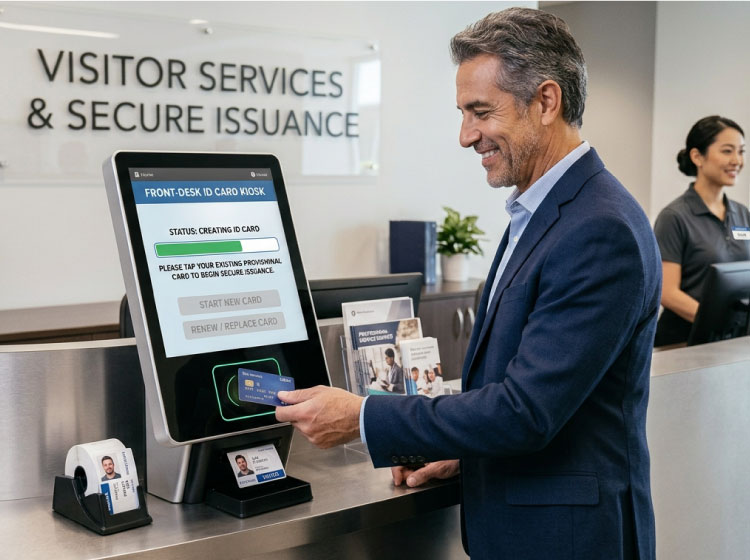
Many modern check-in counters place desktop identity printers directly next to a commercial touchscreen monitor for employee badge creation or real-time visitor tracking.
- Responsive Touch Input: Kiosks running interactive touchscreen technologies rely on a traditional 4:3 aspect ratio and vibrant visuals to display user badge data. Our consulting team ensures that the card stocks you print match the exact dimensional thickness required by the printer models attached to these screens.
- PCAP Touch Technology: Displays engineered with a projected capacitive touchscreen or rugged PCAP touch technology generate localized electromagnetic fields. We help security managers select high-coercivity (HiCo) magnetic stripes rather than low-coercivity options to protect your cardholder records against erasure when badges are handled near these screens.
- Workstation Workflow: Our specialists review your operational environment to verify that your inline print mechanics, color ribbons, and USB touch controller interfaces do not suffer from dust attraction or static build-up, preserving your equipment lifespan.
- Retail-Focused Feature Set: We help you deploy optimized, graphic-energy card stocks that maintain completely vibrant visuals and crisp text across your customer loyalty systems and point-of-information terminals, ensuring long-term system value.
Blank ID Cards From a Canadian Supplier
Avon Security Products has served more than 25,000 organizations across Canada with ID card printers, card stock, software, and printing supplies.
Canadian inventory and support give Procurement and Operations teams a domestic source for both equipment and ongoing supplies, with Avon specialists available to check product compatibility before an order is placed.
Frequently Asked Questions About ID Card Software
Blotchy print results or white specks usually point to surface contamination on your card stock rather than a mechanical printer failure. Dye-sublimation ribbons require an entirely flat, high-surface-energy face to allow clean thermal molecular bonding. Microscopic dust particles, airborne debris, or fingerprint oils on low-grade plastic cards disrupt this heat transfer. Handling your blank card inventory strictly by the outer edges and keeping substrates sealed until deployment preserves material integrity and protects delicate printheads from permanent scratch damage.
Standard PVC cards consist of 100% polyvinyl chloride polymer matrices, providing an excellent and economical choice for direct-to-card desktop printers. Composite cards alter this structure by blending 60% PVC with 40% polyester material. This core reinforcement prevents plastic credentials from bending, bubbling, or warping under the intense thermal stress of heavy-duty retransfer printheads or inline lamination modules. Checking your current equipment model numbers before changing card types prevents transport roller jams and keeps workflows moving.
Printing directly onto proximity cards, contact smart cards, or credentials with internal antennas using a direct-to-card printer introduces serious operational risks. The thermal printhead makes direct physical contact with the card face, meaning it can crush internal microchips or strike surface unevenness, leading to blurred photos and costly printhead wear. High-definition retransfer printers resolve this constraint by printing onto a clear flexible film first, allowing flawless edge-to-edge graphics over uneven technology substrates without risking hardware damage.
Adhesive-back cards feature a thin 10 mil PVC printable face backed by a temporary paper or durable Mylar liner. This specialized design allows organizations to peel and stick a personalized photo ID layout directly onto an existing, thick clamshell proximity card or door access credential. This operation avoids the major administrative expense of throwing away functional internal tracking chips. Security teams can reuse expensive tracking hardware over multiple seasonal rushes or staff transitions by updating only the printable top layer.
Pre-encoded, laser-engraved barcode cards feature deep, permanent numbers that synchronize instantly with automated time clocks and attendance tracking networks like Ceridian Dayforce. Because the numeric data string maps directly to your active software database index, employee scans log hours without administrative lag or manual input typos. Utilizing laser-engraved markers rather than basic thermal printing prevents the barcode from fading over years of heavy daily use, ensuring accurate compliance auditing and continuous operational continuity.
Sourcing your technical credentials from an international online retail outlet introduces hidden costs like unexpected customs brokerage fees, import duties, and border crossing delays. Avon Security Products fulfills orders entirely from our centralized national inventory in Concord, Ontario, providing rapid local fulfillment across Canada. Every procurement program is backed by local product knowledge and free lifetime technical support. Our specialists verify substrate and encoder compatibility before you order, preventing mismatched supply choices and ensuring complete system uptime.