
 1.866.458.6999
Modern ID card systems are secure credentialing platforms that help organizations manage employee identification, access control, visitor tracking, and workplace security through connected badge printing and authentication technology.
Across Canada, organizations are rethinking how identification works inside offices, hospitals, schools, government facilities, and industrial environments. The plastic badge clipped onto a lanyard is no longer just a photo ID. It has become part of a much larger infrastructure tied to security, operations, access management, and workplace efficiency.
As hybrid work models evolve, security expectations rise, and organizations demand faster credential management, many companies are upgrading from outdated badge printers and disconnected systems toward fully integrated modern ID card systems that support smarter, more secure workplaces.
Inside This Guide
- Why Canadian organizations are upgrading outdated ID card systems
- How modern badge programs improve security, access control, and credential management
- What organizations should assess before upgrading printers or software
- How integrated ID infrastructure supports scalability and operational efficiency
- Why enterprise grade printer technology and Canadian support matter long term
The Old ID Badge Model Is Starting to Break Down
A surprising number of organizations still rely on aging printers, outdated software, manually managed spreadsheets, and badge systems that were implemented years ago with little long term planning.
At first, those systems may still appear functional. Employees can receive cards. Visitors can be printed temporary badges. Doors still unlock. But underneath the surface, inefficiencies start stacking up quickly.
Older systems often create problems such as:
- Slow badge issuance
- Frequent printer downtime
- Limited security features
- Inconsistent card quality
- Difficulty replacing supplies
- Weak integration with access systems
- Manual approval workflows
- Limited scalability for growing teams
The problem is not simply that the hardware is old. The bigger issue is that many legacy systems were never designed for how modern organizations operate today.
Canadian businesses are now prioritizing flexibility, centralized management, stronger authentication, and faster credential issuance across multiple departments and locations. That shift is pushing organizations toward smarter, more connected corporate ID systems.
Security Is No Longer Just About the Badge
The modern workplace has changed dramatically over the last few years. Organizations now manage rotating hybrid schedules, temporary contractors, third party vendors, remote onboarding, shared workspaces, and growing cybersecurity concerns. Physical security and digital security increasingly overlap.
That means ID cards now serve multiple purposes at once.
A single badge may be used for:
- Building access
- Secure printing
- Visitor management
- Attendance tracking
- Time logging
- Department authentication
- Cashless cafeteria payments
- Elevator access
- Parking permissions
This is where technologies like proximity card systems become increasingly valuable. Instead of relying solely on visual identification, organizations are integrating RFID, smart card encoding, and encrypted authentication features directly into employee credentials. That creates stronger security while reducing friction for employees moving throughout a facility.
Provincial government guidance in British Columbia also highlights how visible identification programs support workplace safety, access control, and security awareness across organizational environments. The result feels less like traditional badge printing and more like connected infrastructure.
The Organizations Modernizing Fastest Might Surprise You
Large corporations are not the only organizations upgrading their badge programs.
Across Canada, modernization is happening inside:
- Healthcare facilities
- School boards
- Universities
- Manufacturing plants
- Municipal buildings
- Construction firms
- Distribution centers
- Financial institutions
- Property management companies
Healthcare organizations, for example, often need secure staff credentials that support role based access across sensitive departments.
Educational institutions require scalable student and faculty card issuance with integrated access permissions.
Corporate offices are investing in flexible employee badge systems that support hybrid work environments while improving workplace security and visitor management.
The Government of Canada itself maintains structured credentialing and identification programs for employees, contractors, students, and visitors across secure operational environments, reinforcing how important modern badge infrastructure has become for large organizations.
The common thread is simple. Organizations want systems that work faster, integrate more easily, and reduce administrative strain.
Assessing and Auditing Existing ID Card Systems Before Upgrading
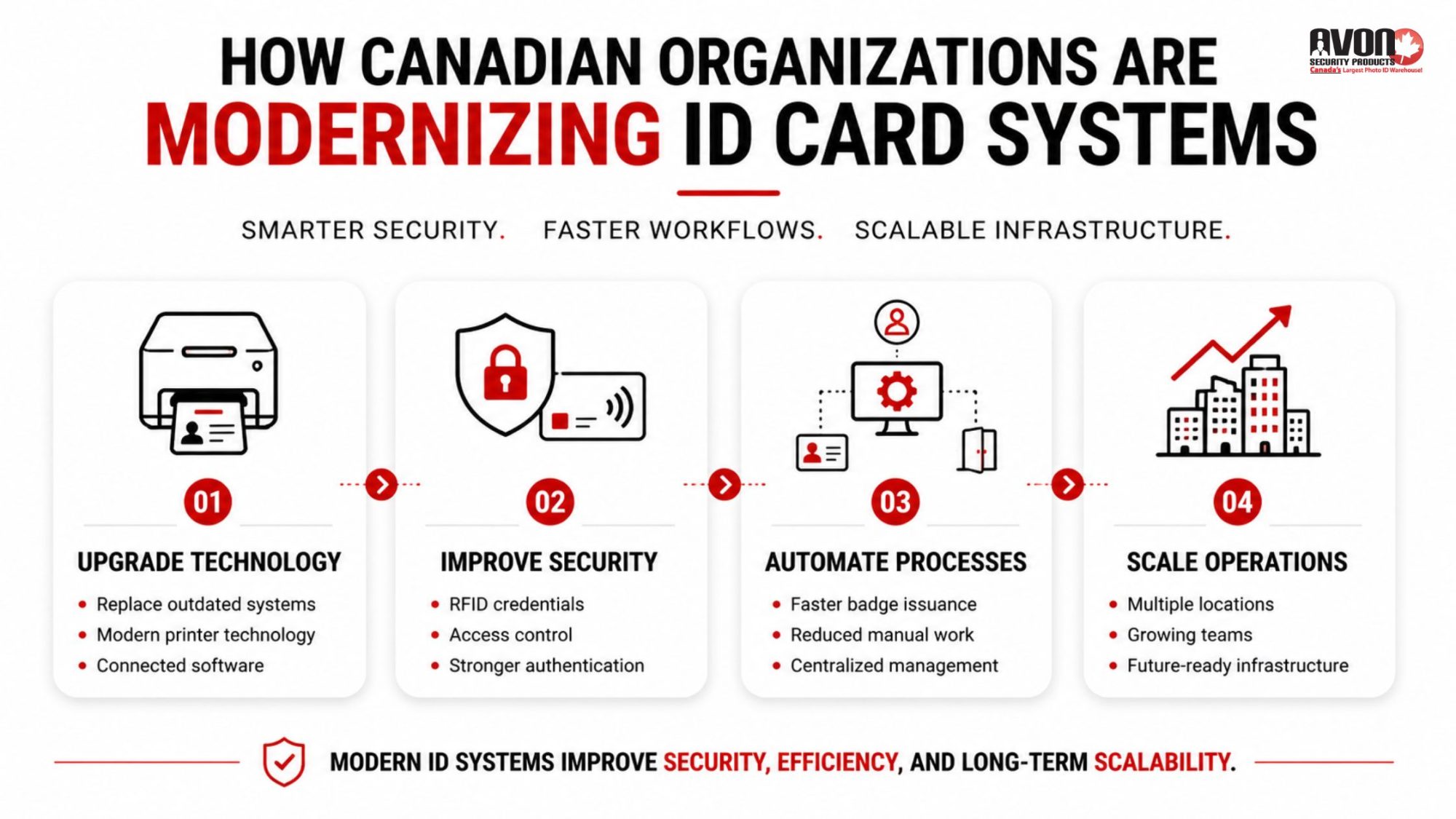
One of the biggest mistakes organizations make is upgrading hardware without evaluating the larger credentialing workflow around it.
A modern printer alone does not solve operational inefficiencies.
Before upgrading, organizations should carefully assess:
- Current badge issuance processes
- Security vulnerabilities
- Software compatibility
- Supply reliability
- Card durability issues
- Printer maintenance history
- Employee onboarding workflows
- Access control integration limitations
Many organizations discover their biggest bottlenecks are not actually the printers themselves. The issues often come from disconnected approval processes, inconsistent policies, outdated encoding methods, or manual credential management.
The RCMP’s Access Management Guide also emphasizes the importance of properly managing physical access systems, credential controls, and ongoing security oversight as part of modern organizational security planning.
A proper audit helps organizations identify where modernization will create the greatest operational improvements.
Design and Branding Matter More Than Organizations Realize
An ID badge is often one of the most visible branded items employees carry every day.
Poorly designed cards can appear outdated, inconsistent, or difficult to verify visually. Modern organizations are investing more heavily in professional card design that balances branding, usability, and security.
That includes:
- Cleaner layouts
- Better photo quality
- Department color coding
- Embedded security elements
- Custom holographic overlays
- Improved card durability
- Scannable barcode integration
Organizations are also paying closer attention to what to include on employee ID cards beyond simply a name and photo.
Depending on the environment, badges may include:
- Expiration dates
- Security clearance indicators
- Department identifiers
- Emergency response roles
- QR codes
- Smart chip encoding
- Visitor classification markers
The badge itself becomes part of the organization’s operational infrastructure.
Integration Is Becoming the New Standard
Modern ID infrastructure no longer operates independently.
Organizations increasingly want badge systems connected directly to:
- HR platforms
- Visitor management systems
- Security software
- Access control systems
- Time tracking tools
- Student information systems
- Building management platforms
This integration reduces duplicate administrative work while improving consistency across departments.
When an employee leaves the organization, access permissions can be updated immediately. When a contractor is approved, credentials can be generated faster. When a visitor arrives, temporary badges can be issued more efficiently.
Connected systems create smoother workflows while strengthening overall security management.
Standards organizations like NIST have also published extensive guidance on integrating secure credentials with physical access control systems as workplaces continue modernizing security infrastructure.
That is one reason organizations are investing more heavily in enterprise grade ID card software solutions that support centralized credential management rather than isolated desktop workflows.
Why Printer Technology Is Quietly Becoming a Competitive Advantage
Printer technology has advanced significantly over the last several years.
Modern printers offer:
- Faster print speeds
- Improved image resolution
- Enhanced encoding support
- Better ribbon efficiency
- Cloud connected management
- Remote diagnostics
- Improved security protocols
- Reduced downtime
Organizations running high volume badge programs often discover that upgrading hardware dramatically improves operational efficiency over time.
Avon Security Products supports Canadian organizations with advanced printer technology through partnerships with trusted manufacturers, including access to systems like the Entrust DSE printer, which helps organizations manage secure, enterprise level credential issuance with greater reliability and scalability.
For organizations issuing hundreds or thousands of credentials annually, those efficiencies matter.
Streamlining Issuance and Management Processes Changes Everything
The organizations modernizing most successfully are not simply buying better hardware. They are redesigning the entire credential lifecycle.
That includes:
- Faster onboarding workflows
- Standardized badge approvals
- Automated card expiration tracking
- Centralized employee databases
- Secure visitor credentialing
- Simplified replacement card management
These improvements reduce administrative burden while creating more consistent security practices across departments.
The Canadian Centre for Cyber Security also recognizes physical access controls, credential systems, and secure authentication tools as important components of broader organizational security strategies.
Modernization also improves the employee experience itself. New hires receive credentials faster. Visitors move through check in more smoothly. Security teams spend less time troubleshooting outdated equipment. Small operational improvements compound quickly across large organizations.
Planning for Scalability Matters More Than Most Organizations Expect
Many organizations outgrow their original badge systems much faster than anticipated.
A company that once issued 50 employee badges may suddenly need:
- Multiple office support
- Visitor management integration
- Secure contractor credentials
- Access control expansion
- Mobile credential compatibility
- Higher print volumes
Modernization should account for future operational growth, not just immediate needs.
Scalable systems help organizations avoid expensive infrastructure replacements later while creating more flexibility for evolving workplace requirements.
This becomes especially important as organizations continue exploring modern uses for security ID cards beyond traditional identification alone.
Canadian Organizations Want Canadian Support
Support matters more than many organizations realize until something breaks.
Printer downtime, supply shortages, software issues, or encoding problems can quickly disrupt daily operations.
Avon Security Products supports organizations across Canada with:
- Enterprise ID card printers
- Genuine ribbons and supplies
- Secure card technologies
- Technical guidance
- Product support
- Professional badge issuance solutions
Organizations benefit from Canadian based expertise, reliable product access, and guidance tailored to real operational environments across healthcare, education, corporate, and government sectors.
That level of support becomes increasingly valuable as ID infrastructure grows more sophisticated.
Key Takeaways
- Modern ID card systems now support security, access management, visitor tracking, and operational workflows simultaneously.
- Canadian organizations are upgrading outdated badge infrastructure to improve efficiency, scalability, and credential security.
- Integrated systems connected to HR, security, and access platforms create smoother management processes.
- Advanced printer technology improves reliability, print quality, and long term operational performance.
Avon Security Products supports Canadian organizations with enterprise grade ID systems, supplies, and credentialing expertise.
Frequently Asked Questions
Why are Canadian organizations upgrading their ID card systems?
Many organizations are modernizing their ID systems to improve security, simplify credential management, support hybrid workplaces, and integrate access control more effectively. Older systems often struggle with scalability, reliability, and modern security requirements.
What features do modern ID card systems include?
Modern systems may include RFID technology, smart card encoding, visitor management integration, cloud connected software, access control compatibility, centralized credential management, and advanced badge security features.
How do proximity cards improve workplace security?
Proximity cards help organizations control physical access more securely by allowing authorized users to access specific areas without relying solely on visual identification. Many systems also support encrypted authentication and activity tracking.
When should an organization upgrade its badge printing system?
Organizations should consider upgrading when they experience frequent printer downtime, slow issuance processes, outdated software limitations, security concerns, or increased credential management demands due to growth or operational changes.
What industries benefit most from modern ID badge systems?
Healthcare, education, government, manufacturing, corporate offices, and property management organizations commonly benefit from modernized ID infrastructure because they often manage high volumes of employees, visitors, contractors, or secure access requirements.
Final Thoughts
Modernizing an ID card system is about more than upgrading hardware. It is about creating a more secure, efficient, and scalable way to manage people, access, and workplace operations.
With the right technology and support, Canadian organizations can build modern ID card systems that are ready for both today’s security needs and tomorrow’s growth.