
 1.866.458.6999
Key Takeaways
- Factory-programmed 125 kHz prox cards in formats such as H10301 arrive encoded with a facility code and a card number, so “programming” them on site means enrolling them in your access control software.
- New cards have to match what your system already reads: the card technology, the exact format, a facility code your system accepts, and a card number range that doesn’t overlap existing cards. They then need correct enrolment and an access level.
- You can find your current format on the original card box, in past order records, or in the card settings of your access control software.
- A card the reader never detects is a different problem from a card the reader detects, but the controller denies, and each has its own checks.
To program proximity cards for an office door system, you get cards encoded with the format and facility code your system already uses, then enrol each card in your access control software with the right access level. A proximity card is a contactless credential with a small antenna coil inside, and the reader at the door picks up the card’s encoded number when the card is held close.
If you’re the security or IT administrator, facilities manager, or office administrator who has been asked to add or replace cards, you rarely program the card itself. HID prox cards ordered as programmed cards, such as the ISOProx II, arrive already encoded. Your part is getting the card details right for the reorder and then adding the cards to your software.
What Does “Programming” a Proximity Card Really Mean?
A factory-programmed prox card carries a short string of data laid out according to its format. In formats such as H10301, two fields matter to you, though not every prox format includes a facility code. The facility code, also called a site code, is a number the system uses to separate your organization’s cards from cards encoded for other sites. An organization can use more than one facility code, for example, when it has several buildings or has run past the card numbers one code allows. The card number identifies one card, and it is meant to be unique within that format, facility code, and numbering scheme rather than across every card made.
Three pieces of equipment work together at the door. The reader is the unit on the wall that powers the card’s antenna and picks up its data. The controller is the panel, kept in a secure electrical or IT room, that decides whether to unlock the door. The access control software is where your administrator adds cards, links them to cardholders, and sets which doors and times each person can use.
In many installations, the reader sends the card’s data to the controller over a Wiegand connection, which is a wiring standard for passing card data down the line. That connection is separate from the card’s bit format, which describes how the credential data is laid out, including, in formats such as H10301, the facility code, card number, and parity bits. If the controller finds that the facility code and card number are enrolled with access to that door at that time, it unlocks the door. If it doesn’t, the door stays locked.
So programming a card is really two jobs: the card is encoded with its numbers before it ships, and your administrator enrols it, which means adding the card to the system and linking it to a cardholder. An HID prox card has no battery: the reader’s 125 kHz field powers the antenna coil and chip inside an HID proximity card, which then sends the encoded number back to the reader. Because the card depends on that field for power, it only works at close range.
How Do You Find Out What Format Your HID Prox Card Is?
Start by identifying the format your system reads, because it defines how the credential data is laid out, including which fields it uses, such as a facility code, card number and parity bits. A card with the right facility code in the wrong format will still be rejected.
The 26-Bit Wiegand Format Explained
The 26-bit format, which HID lists as H10301, is a long-standing open format. It holds one parity bit, an 8-bit facility code, a 16-bit card number, and a final parity bit. A parity bit is a simple error check that helps the system reject a corrupted read.
Eight bits give facility codes from 0 to 255, and sixteen bits give card numbers from 0 to 65,535 within each facility code. Because the 26-bit format is open, another site can end up with the same facility code and card number as yours. Longer formats exist, but bit length alone doesn’t tell you the field layout or whether duplicates are possible. What matters is whether HID tracks the format. HID’s ordering guide lists H10301 and H10320 as open formats that HID doesn’t track, so you choose the number range yourself. Tracked formats such as H10302, H10304 (a 37-bit format), and Corporate 1000 work differently: HID allocates the next available numbers and doesn’t allow duplicates; H10304 facility codes are registered to a specific account, and Corporate 1000 cards are ordered under your organization’s company ID code. HID’s Readers and Credentials How to Order Guide explains how HID specifies card formats, facility codes, and the option codes in a part number, and it is the reference to use when you’re reading an HID box label or invoice.
Where to Find Your Format, Facility Code and Card Numbers
You can piece together your format from four places, and it’s worth checking at least two of them so you aren’t relying on a single record.
- Look at the original card box or packing slip, because HID box labels carry the part number and the programming details used for that batch.
- Check past order records or invoices, which may list the full part number, the format, the facility code, and the starting card number.
- Open the card or cardholder settings in your access control software, where the administrator can see the format and facility code assigned to existing cards.
- Read the numbers printed on an existing card. On HID cards ordered with matching numbers, the printed number is the encoded card number.
If you need to read HID proximity cards you already have, the software can be the quickest route. Depending on the system, the event log records the facility code and card number when a card is presented, sometimes even for a card that isn’t enrolled.
How to Program Proximity Cards Step by Step
Once you know your format, the process is much the same across office door systems. Steps 1 to 3 settle the card details, and steps 4 and 5 happen in your software and at the door.
Step 1: Find the Right HID Prox Format & Part Number
Start with the card type and part number on your existing cards. An HID part number such as 1386 LGGMN names the card type (here, the printable ISOProx II card) followed by a code for its options. Because the ISOProx II is printable, one card can carry both the photo badge and the access credential. It’s a standard 0.76 mm (30 mil) card, so if you print badges in-house, confirm your ID card printer handles that card stock before printing a batch. Matching the card type and the exact format lets your existing readers and controller interpret the new cards the same way as the old ones. The cards still need credential values your system accepts, such as the right facility code, plus correct enrolment and access permissions.
Step 2: Specify Programming Information
Next, confirm the programming options. For the ISOProx II card, per HID’s ordering guide, the five letters after the part number set the card’s options. Other HID product families use their own option structures, so this breakdown applies to the LGGMN configuration of the ISOProx II:
- The first letter covers programming: L for a programmed card, N for a non-programmed card.
- The second and third letters describe the front and back surfaces, such as plain white gloss PVC for printing.
- The fourth letter covers numbering, where M means the number printed on the card matches the number encoded inside it.
- The fifth letter covers the slot punch, which is the hole for a clip or lanyard: N means no punch, while H and V mean a horizontal or vertical slot.
Matching numbers make enrolment easier, because your administrator can type the printed number straight into the software instead of presenting each card at a reader. If your existing box shows a different option code, verify each option against your current requirements before repeating it. An old code can carry forward numbering, printing, or slot punch choices that no longer suit how you issue cards.
Step 3: Select Facility Code & Card Range Number
Confirm the facility code your system accepts and choose a starting card range number. For a sequentially numbered order, 100 cards starting at 1201 run from 1201 to 1300. The key rule is to avoid overlapping card ranges, because two cards with the same format, facility code, and number look identical to your system. If your format uses customer-selected numbering, pick a starting number above the highest card already issued or purchased under that facility code, including any reserved ranges. For tracked formats such as H10302, H10304, and Corporate 1000, HID assigns the next available range, so you request a quantity rather than a starting number.
If your organization uses more than one facility code, confirm which one the new cards should carry and that the readers and controllers at the relevant doors are set to accept it.
Step 4: Enrol the Cards in Your Access Control Software
When the cards arrive, your system administrator adds them to the software. The screens vary between systems, but the job looks much like this.
- Create or open the cardholder record for the employee.
- Add the card by typing the facility code and card number, or by presenting the card at an enrolment reader so the software captures it.
- Assign an access level, which is the group of doors and times this person is allowed to use.
- Save the record and confirm the controllers have received the change before testing. Some systems show a download or sync status for each controller; others update on a schedule.
Step 5: Assign Cards to Employees
Hand each card to the person it was enrolled to and test it at a door together. Keeping the card number on the employee’s record lets you disable it quickly if the card is lost or the person leaves.
What About HID Prox Key Fobs?
Key fobs are programmed the same way as cards. A prox key fob such as the HID ProxKey III is specified with a format, facility code, and card number, so you match fobs to your cards and enrol them in the software exactly as described above.
Do You Need a Proximity Card Programmer?
If you order HID prox cards as programmed cards, you don’t need a proximity card programmer on site, because the cards arrive encoded. The tools you need are your access control software and, if your system uses one, a desktop enrolment reader that captures card numbers into the software.
On-site encoding is an option for organizations that want it. HID’s iCLASS SE Encoder, sold as the CP1000D desktop unit or as an in-line encoder inside a FARGO card printer, can encode HID Prox cards as well as 13.56 MHz credentials, and the in-line version prints and encodes a card in one pass. The encoder uses credential credits and needs the right formats and keys loaded, so it suits organizations that issue cards often or across several card technologies.
How Do You Order Prox Cards That Match Your Existing HID Format?
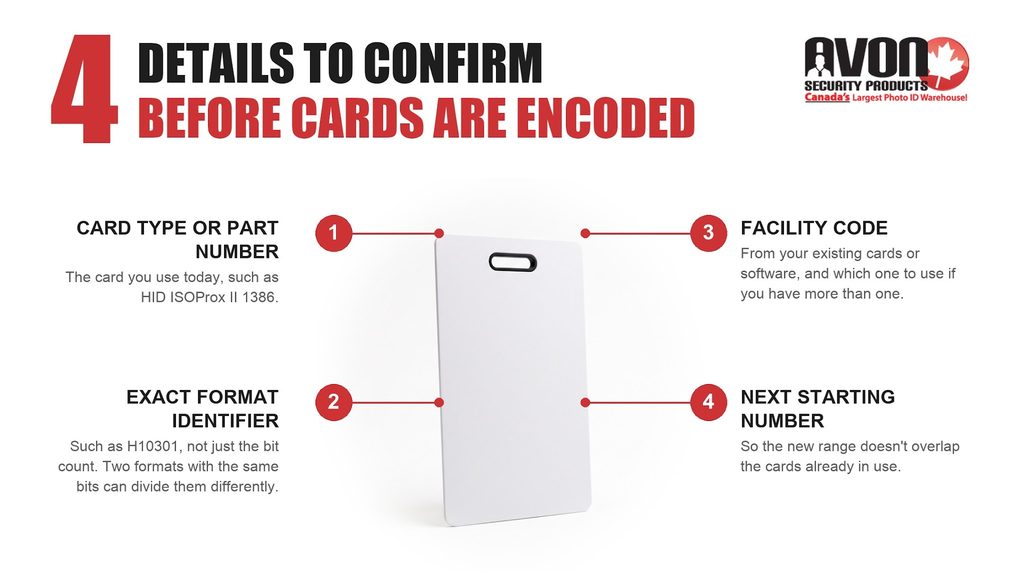
To get prox cards that match your existing HID format, collect four details and have them confirmed before the cards are encoded:
- The card type or part number of your current cards, such as HID ISOProx II 1386.
- The exact format identifier your system reads, such as H10301, not just the bit count. Two formats with the same number of bits can divide those bits differently.
- The facility code on your existing cards or in your software, and which one to use if you have more than one.
- The next starting card number, so the new range doesn’t overlap your existing cards.
With these four details ready, an Avon specialist can check them against your existing cards before anything is encoded. The proximity access cards category covers HID cards and alternative cards for systems such as Kantech, Keyscan, and AWID, and the category page includes the ISOProx II LGGMN breakdown.
Frequency matters as much as format. A 125 kHz prox card won’t be detected by a reader that only reads 13.56 MHz smart cards such as iCLASS, Seos,™ or MIFARE DESFire, because the two technologies operate at different frequencies. A multi-technology reader can read both, so confirm the reader model before choosing a card technology.
Common Proximity Card Problems and How to Fix Them
When a new or existing card won’t open a door, first decide which of two problems you have. Start with the reader’s feedback and the event log: the reader may not be detecting the card, the controller may be refusing access, or access may be granted while the door doesn’t unlock. The checks are different for each.
The Reader Doesn’t Detect the Card
Symptom: nothing happens when the card is presented. On readers configured to give feedback, there is no beep or LED change, and no event appears in the software log.
Likely causes:
- The card’s frequency doesn’t match the reader, such as a 125 kHz prox card at a 13.56 MHz smart card reader.
- The card is being presented too far away, at an angle, or stacked with other credentials.
- Metal near the reader or the card is weakening the field.
- The card’s antenna is damaged, for example by cracking or by a slot punched outside the locations marked on the card. ISOProx II cards have marked positions for a horizontal or vertical slot.
- The reader has lost power or has failed.
What to check:
- Present a card that is known to work at the same reader. If it reads, the reader is powered and detecting cards, which narrows the problem toward the new card, but doesn’t prove the card is faulty.
- Compare the new card’s technology and frequency with the technologies the reader model supports and is configured to read.
- Hold the card flat and close to the reader, one credential at a time, away from other badges and metal.
- Look for a punched slot, crack or bend near the card’s edge.
Corrective action: present cards singly, replace a card that is visibly damaged, and reorder in the correct technology if the frequency doesn’t match. If no card reads at that door, check the reader’s configuration and its communication with the controller before treating it as a reader or power supply fault.
When to get help: if a known-good card also fails, or if one reader detects the card and another doesn’t, contact your access control installer about the reader and its wiring.
The Reader Detects the Card but the Controller Denies Access
Symptom: the reader beeps or flashes, and the door stays locked. A beep on its own doesn’t show that access was denied, so open the event log first. If the log shows access granted, the card and controller did their job, and the problem points to the lock, its relay or the door hardware, which is a job for your installer. If the log shows an access denied, unknown card or invalid format event, work through the checks below.
Likely causes:
- The card hasn’t been enrolled, or it has no access level for that door and time.
- The card’s format doesn’t match a format the system is set to read.
- The facility code is different from the one the system expects, or it was typed incorrectly at enrolment.
- The controller hasn’t yet received the updated cardholder record.
What to check:
- Search for the card number in the software and confirm it is saved to a cardholder.
- Confirm the cardholder’s access level covers that door at the current time.
- Read the denied event in the log and compare its facility code and card number with the box label and the enrolled record.
- Confirm the format reported in the log matches the format the system is configured for.
- Check the controller’s sync or download status.
Corrective action: correct the cardholder record, assign the right access level, or resend the update to the controller. If the format or facility code on a programmed card is wrong, your software can’t change it, so replace the card with one encoded to the correct details.
A related problem shows up as the opposite of a denial: one person’s card opens doors using another person’s access. One possible cause is two physical cards sharing the same format, facility code, and number. The card may also simply be assigned to the wrong cardholder record, or the system may be reading the credential with the wrong format. Check the assignment and the logged values first. If two cards do share a number, remember that disabling that credential record disables both physical cards, so reissue the affected people with cards from a range that doesn’t overlap and verify each assignment.
When to get help: if the log shows a format your system doesn’t recognize, or a facility code that doesn’t match your records, confirm the card details with your card supplier before replacing cards. Problems with controller configuration belong with your access control installer.
Confirm Your Card Details With an Avon Specialist
Matching a reorder to an existing system comes down to the details above: card technology, exact format, facility code, and starting number. Confirm your card format with an Avon specialist before reordering, and the details can be checked against your box labels, invoices, or software records before any cards are encoded. Avon ships proximity access cards from Canadian inventory, with no unexpected duties or brokerage on domestically sourced orders. Call 1-866-458-6999 or contact Avon with your existing card details.
Frequently Asked Questions
How do you program new proximity cards for an office door system?
You program new proximity cards by getting cards encoded with your system’s exact format and facility code, then enrolling each one in your access control software. HID prox cards ordered as programmed arrive encoded, so no programmer is needed on site. Your administrator adds each card to a cardholder record by typing its number or presenting it at an enrolment reader, assigns an access level for the right doors and times, confirms the controllers have the update, and tests the card at a door.
How do I find out what format my HID prox card is?
Check the original box label or packing slip first, since HID labels carry the part number and the programming details for that batch. Past invoices may show the format, facility code, and starting number. Your administrator can also check the card settings in your access control software, and on some systems the event log shows the facility code and card number when a card is presented. Note the exact format identifier, such as H10301 for the open 26-bit format, since bit count alone doesn’t define a format.
How do I order prox cards that match my existing HID card format?
To match your existing HID cards, confirm four details: the card type or part number, the exact format identifier (such as H10301), the facility code, and a starting number that doesn’t overlap issued, purchased, or reserved ranges. If you use more than one facility code, name the right one. An Avon specialist can check those details against your records before the cards are encoded.
Can I reprogram an HID proximity card?
Not through your access control software. HID prox cards ordered as programmed, such as the ISOProx II, arrive encoded, and the software can’t change their facility code or card number. What you can change is how your access control software treats the card. Your administrator can reassign a returned card to a new employee, change its access level, or disable it completely. If you need a different facility code or format, you’ll need new cards encoded with those details, matched to what your readers and controllers accept.
Why is my proximity card not reading?
Start by separating two problems. If the reader shows no response and nothing appears in the software log, the reader may not be detecting the card: check the card’s frequency against the reader, present it flat and close on its own, and look for antenna damage. If the reader responds but the door stays locked, check the event log. A denied event means confirming enrolment, access level, format, and facility code; a granted event points to the lock or door hardware.