
 1.866.458.6999
Key Takeaways
- A PVC security card can log hours, verify staff and visitors at a glance, identify customer-facing employees, carry your brand, store data, and open doors.
- Graphic-quality PVC suits most photo badges, while composite cards hold up better in retransfer printers and laminators that heat the card.
- Barcode cards, magnetic stripe cards, and adhesive-back cards for proximity access let one printed badge handle time tracking and door access.
- Polycarbonate is the most durable card material we carry, and Avon Security Products ships CR80 30 mil polycarbonate cards from inside Canada.
- Blotchy prints usually come from dust, fingerprints, or low-grade card stock, so clean graphic-quality cards and a clean printer fix most of them.
A PVC security ID card is a credential printed on polyvinyl chloride (PVC), a high-surface-energy thermoplastic compound engineered to serve as the primary structural layer in commercial card issuance systems. Its finish is manufactured for precise thermal bonding with dye-sublimation and retransfer print ribbons, so photos and fine text stay crisp; the card acts as the base for multi-layer security features such as holographic overlays, and the same card carries the encoded data that access control and time tracking systems rely on in corporate, academic, and healthcare environments. Understanding what PVC cards are explains why they became the standard: the material resists cracking and fading in daily use, prints sharply, and is far harder to copy than a paper or pouch-laminated badge.
Most organizations buy an ID card printer for security and stop there, but the same blank card can do a lot more work once you pick the right card type for each job. Here are five applications we see again and again at Avon Security Products, and the blank card that suits each one.
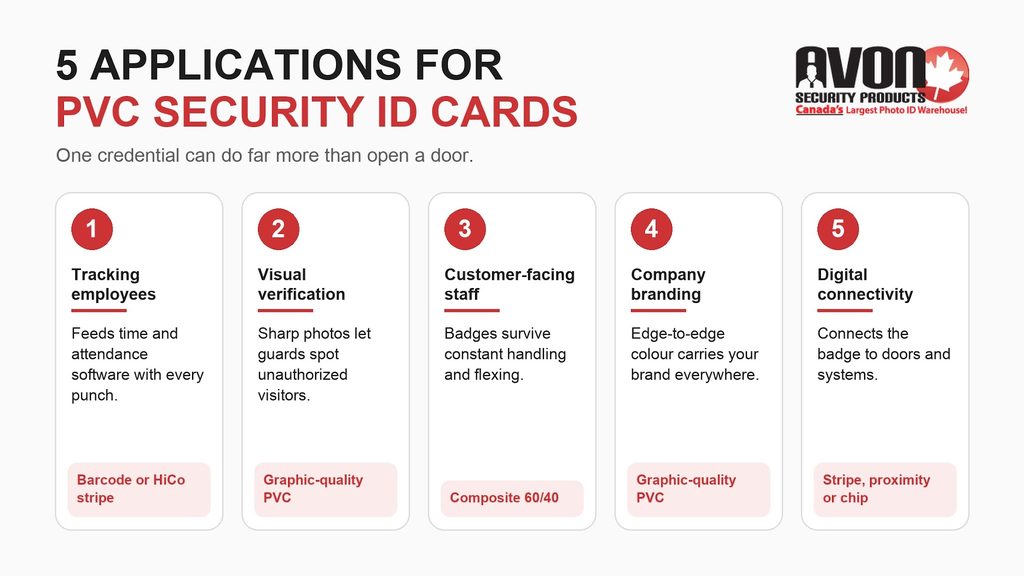
1. Tracking Employees
A time and attendance system is software that logs when each person starts and finishes work, and the badge is the credential that identifies who is clocking in. Federally regulated employers in Canada must keep records of the hours each employee works and hold them for 36 months, so the data your badges feed into that system has to stay accurate and verifiable for three full years. That makes card durability a compliance issue, because a faded barcode or a weakened stripe creates misreads, database errors, and gaps in the record. Security managers should prioritize durable, laser-engraved barcode stock or high coercivity (HiCo) stripes, and two card types handle tracking well:
- Laser-engraved or high-resolution barcode cards scan in a fraction of a second and feed automated time and attendance platforms such as Ceridian Dayforce. The pre-encoded data string on each card must match the employee’s record in the tracking software exactly, so hours log without administrative delay, and laser engraving resists the faded ink and surface damage that cause scanning errors in the records federally regulated employers must keep for years. Pre-encoded, laser-engraved barcode cards are available in a version made for Ceridian Dayforce time clocks.
- Magnetic stripe cards store a number on the dark band across the back, and a reader picks it up when the card is swiped. Choose HiCo (high coercivity) stripes, which need a stronger magnetic field to change, so they’re much harder to erase by accident.
Magnetic stripes fail when strong magnets scramble the data or when grit and constant friction scratch the stripe surface. HiCo stripes, rigid badge holders and climate-controlled card storage are the main ways to protect magnetic stripe cards that get swiped all day.
2. Verifying Staff and Visitors at a Glance
Photo badges are a facility’s first line of visual defence. In corporate buildings, healthcare facilities, and restricted government areas, guards and staff rely on the badge photo to spot unauthorized personnel or out-of-department visitors at a glance, which supports access segregation between departments and floors. That only works if the image is sharp.
Graphic-quality PVC has a smooth, glossy surface made for dye-sublimation printing, the method most desktop ID card printers use, where the printhead heats a coloured ribbon until the dye turns to gas and bonds into the card surface. A clean surface prevents blurred photos and broken detail, so the badge stays a reliable credential across your whole campus.
Print the name in a large font with the department or access zone underneath, so guards can confirm from a distance that a badge holder belongs in that area. Standard CR80 30 mil PVC, the same size as a credit card, is the right starting point for most staff badges, and choosing between ID card sizes such as CR80 and CR79 depends on whether the badge is printed directly or applied to an existing access card.
3. Acquainting Customers With Employees
At a store, clinic, or service counter, a visible name badge lets customers address staff by name and remember who helped them when they need to follow up later.
Customer-facing badges get handled, dropped, and flexed all day, so durability counts here. Composite cards blend about 60% PVC with 40% polyester, and the polyester changes the card’s physical tolerances, raising the heat it can take before softening and letting it flex much further before it fractures. That keeps the badge from turning brittle through daily handling or rapid Canadian indoor-outdoor temperature swings. Composite stock also resists splitting at the slot punch, where tension concentrates when a badge hangs from a breakaway lanyard or a heavy-duty clothing clip, so the credential stays intact and the lanyard’s safety release still works as intended. Our Secure ASP CR80 30 mil composite 60/40 cards are a good fit for badges that see heavy daily wear.
4. Promoting Your Company Branding
Your staff carries your logo everywhere they wear their badge, from a client’s lobby to the coffee shop down the street. Edge-to-edge colour designs print best on graphic-quality PVC, because any flaw in the card surface shows up across a full background. If sustainability is part of your brand story, our EcoCard Pro cards are made from recyclable PVC and come in the same CR80 size as standard white cards.
Branding can also reach beyond staff IDs with 2UP keytag cards, which you print once and then snap apart into two small tags with a hole for a key ring. They work well for loyalty programs, gym memberships and library cards.
5. Digital Connectivity
A printed security card can also carry data that machines read. Writing data onto a card is called encoding, and it usually needs a printer fitted with the matching encoder.
- Magnetic stripe cards store data on a strip of magnetic material, and a reader pulls the data off when the card is swiped through it.
- Proximity cards contain an embedded copper antenna and microchip that a door reader detects when you hold the card near it. Those internal components make thick clamshell cards too rigid and uneven to pass safely through a desktop printer’s transport rollers. The practical solution is a 10 mil CR79 or CR80 self-adhesive card, ideally with a clean Mylar-backed liner that keeps adhesive from tracking inside the printer. You print each employee’s photo and details on the adhesive card and apply it to the existing access card, which saves money and avoids rebuilding your card database.
- Chip cards, also called smart cards, hold a tiny chip that can store more data than a stripe and support encryption, which is why banks use them for payment cards.
What Security Features Can You Add to a PVC ID Card?
A plain printed badge is easy to copy with a home printer, so most security cards add a visual feature that’s hard to fake, and these are the ID card security options we offer:
- Holographic overlays are thin, clear films printed with a hologram that shifts as the card tilts, which a photocopier or home printer can’t reproduce.
- Custom holographic overlays carry your own logo or crest in the hologram, so a guard can confirm at a glance that a card came from your system.
- Magicard HoloKote adds a custom watermark-style security image across the card as it prints, on compatible Magicard printers.
- Custom hot stamping and interference ink add metallic or colour-shifting marks to cards before you print them.
Which Blank Card Is Right for Each Job?
The right card depends on how the badge will be printed and what it has to do. Retransfer printing puts the image onto a clear film and then bonds that film to the card with heat, which is why heat-tolerant composite cards suit it best. The table below matches each job to a card from our range of blank ID cards.
| Substrate Material Class | Primary System Deployment | Mechanical and Thermal Resistance Profile | Integrated Hardware Processing Requirement |
|---|---|---|---|
| Graphic-quality PVC | Staff and student photo badges | Smooth glossy face; moderate flex and heat tolerance | Standard direct-to-card dye-sublimation printers |
| Composite 60/40 PVC/polyester | Laminated badges, retransfer printing, high-wear roles | High heat and flex tolerance; resists cracking | Required for retransfer printers and laminators |
| Polycarbonate | Multi-year, high-security credentials such as government-grade IDs and municipal infrastructure passes | Most rigid; resists water, wear, and tampering. | ID printer with specialized thermal control curves or laser engraving modules |
| Barcode or HiCo magnetic stripe cards | Time and attendance | Laser-engraved barcode or 2750 Oe stripe resists fading and erasure | Barcode scanner or swipe reader; encoder for stripes |
| 10 mil CR79 or CR80 adhesive-back cards | Door access with existing proximity cards | Thin, flexible layer over a rigid clamshell card | Standard desktop printer; Mylar-backed liner preferred |
| 2UP keytag cards | Loyalty, membership and key rings | Standard 30 mil PVC; snap-apart tags | Standard desktop printer |
Who Sells Polycarbonate ID Cards in Canada?
Avon Security Products sells CR80 30 mil graphic-quality polycarbonate cards and ships them from inside Canada, so there are no border delays or customs fees. Polycarbonate is a rigid, long-lasting plastic that Canada now uses for the passport’s personal information page, and according to the Government of Canada, the polycarbonate page lasts longer and is less likely to be damaged by water or rough handling. Confirm that your printer supports polycarbonate before you order.
Why Are Your Printed ID Cards Coming Out Blotchy?
Blotchy prints come from the physics of dye-sublimation. The ribbon panels rely on high-precision heating elements in the printhead that turn the dye to vapour and drive it directly into the card’s surface layer. If the card has surface divots, uneven chemical density in its coating, or airborne dust on it, that heat transfer breaks down, and the result is white specks or patchy, uneven colour. Work through these checks in order:
- Use graphic-quality cards with a smooth, uniform surface made for photo printing, because stock with an uneven coating can’t take the dye evenly.
- Handle cards by the edges, because oil from your fingertips can stop the dye from bonding and leave pale patches.
- Keep cards sealed in their packaging until you load them, since dust that settles on the surface prints as white specks.
- Replace the printer’s cleaning rollers on schedule. The Zebra ZC100/ZC300 user guide says spots and speckles on a card may be caused by dirt and debris in the printer and recommends replacing the cleaning rollers and cleaning the printer, which clears microscopic debris from the card path before it reaches the printhead and prevents downtime and ribbon tears.
- Match the card to the printer, and use composite cards in a retransfer printer because the heat can warp standard PVC.
Need Help Choosing Blank Cards for Your ID Program?
We stock the blank cards in this guide, from graphic-quality PVC and composite to polycarbonate, adhesive-back and barcode cards, and we ship them from inside Canada with no border delays or customs fees. Browse our full range of blank ID cards, contact our team, or call us at 1-866-458-6999 for a free recommendation on the right card for your printer and your ID program.
Frequently Asked Questions
What is a PVC security card?
A PVC security card is an ID credential made from polyvinyl chloride that carries a photo, name, and logo, plus a barcode, magnetic stripe, or proximity antenna where time tracking or door access requires it. Most follow the CR80 30 mil specification, the international physical profile that keeps cards feeding and tracking consistently through enterprise-grade desktop ID card printers and readers. That shared standard lets an organization scale its program across sites, which makes the blank card the foundational piece of a larger secure facility access framework.
Who sells polycarbonate ID cards in Canada?
Avon Security Products supplies CR80 30 mil graphic-quality polycarbonate ID cards from inventory in Canada, with no border delays or customs fees. Polycarbonate is the material the Government of Canada selected for the secure data page of the Canadian passport, which it says lasts longer, resists water damage and rough handling, and carries laser-engraved details that are harder to tamper with. It offers unmatched durability for long-term programs, but it needs an ID printer built for polycarbonate’s higher thermal thresholds, so confirm compatibility before buying.
Why are my printed ID cards blotchy, and is it the cheap blank cards?
Blotchy prints come from surface contamination or material defects that disrupt the printhead’s precise thermal transfer of dye into the card. Prevention covers the whole printing setup:
- Replace cleaning rollers on schedule, as the Zebra ZC100/ZC300 user guide recommends, so airborne dust can’t reach the card surface.
- Handle cards by the edges, because skin oils change the surface energy and stop the dye from bonding.
- Use composite cards in high-heat retransfer printers to prevent warping.
These habits protect print quality and help you avoid equipment downtime.
What security features can you add to an ID card?
The most effective approach combines visual authentication with a protective overlay.
- Visual authentication: holographic overlays and Magicard HoloKote watermarks give frontline security guards an immediate way to spot a fake, because the shifting image can’t be copied on an office printer, and custom holograms can carry your own logo.
- Material preservation: a clear polyester overlaminate improves abrasion resistance and protects the printed photo and text, extending each badge’s lifecycle so your credentialing program scales without constant reprints.
Can a PVC ID card be used for time and attendance?
Yes, a PVC credential serves as the physical key to a corporate time and attendance network. The pre-encoded data string, whether on a HiCo magnetic track or a laser-engraved barcode, must sync exactly with the employee record in an enterprise platform such as Ceridian Dayforce so every punch logs without manual correction. Durable card stock keeps that data readable through years of daily use, which supports accurate hours tracking and record-keeping compliance without constant card replacement cycles.