
 1.866.458.6999
Key Takeaways
- A magnetic swipe card stores its data in a stripe of tiny iron-based particles, so strong magnets and deep scratches are what usually ruin it.
- Keep badges away from desk speaker magnets, hard drive degaussers, magnetic cabinet latches and handheld radios, because each can erase the stripe.
- A card that only works after several swipes, or works on some readers but not others, usually has a scratched or partly erased stripe.
- High coercivity (HiCo) stripes need a much stronger magnet to erase than low coercivity (LoCo) stripes, so HiCo cards last longer in daily use.
- You can re-encode your own ID or membership cards with a magnetic stripe encoder, but a damaged bank card has to be replaced by your bank.
Magnetic stripe cards remain a core credential for Canadian businesses, hospitals and educational institutions, carrying the data behind access control, time and attendance tracking and campus card programs. For operations, security and facility managers, each card is part of the infrastructure that moves people through the building, records hours and pays for services on campus.
When a card suddenly stops reading, the cost goes well beyond one replacement badge. Staff queue at entry points, shift records go missing, and HR and IT help desks absorb a stream of tickets for lockouts and manual corrections. This guide from Avon Security Products explains how the stripe stores data, what damages it in real workplaces, and how to protect, fix and store magnetic stripe credentials so your program keeps running.
How Does the Magnetic Strip on a Card Work?
The magnetic stripe is a thin band of tiny iron oxide particles, which are microscopic bits of magnetic material set into a layer on the card. Encoding is the process of writing data to the stripe, and an encoder does it by flipping the magnetic direction of those particles into a pattern that represents numbers and letters.
The stripe is divided into tracks, which are parallel lanes that each hold their own line of data. A standard card can hold up to three tracks, and the reader turns each magnetic pattern back into data such as an account number or an employee ID. Anything that scrambles that pattern or scrapes the particles off the card will stop it from reading.
What Damages a Magnetic Strip?
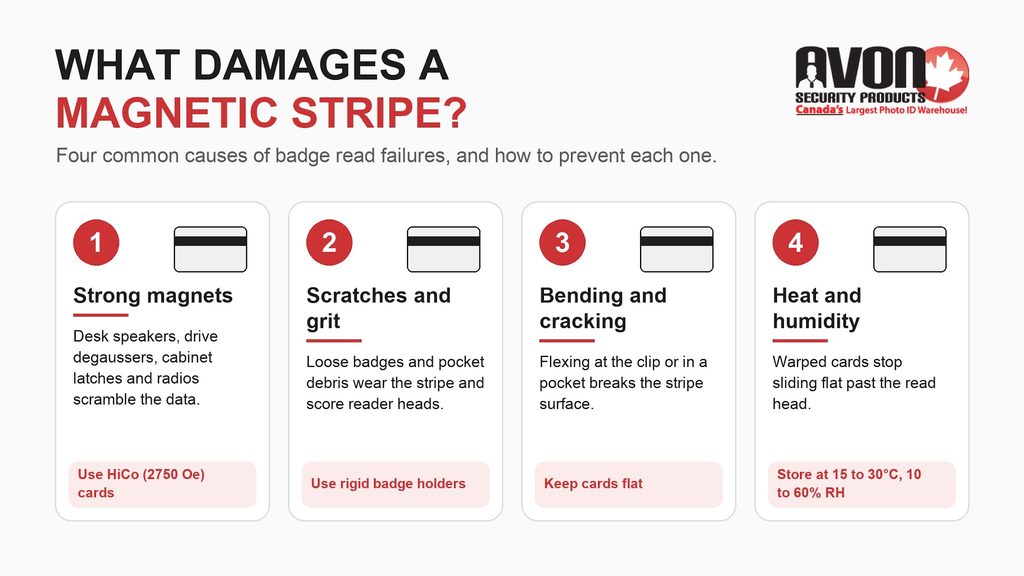
Most damaged stripes come from one of four causes, and each of them is easy to avoid once you know about it.
- Strong magnets can rearrange the particles in the stripe and wipe out the data, which is why a card can fail even though it looks perfect.
- Scratches from keys, coins, and grit wear away the magnetic layer, and a reader can’t pick up data from a stripe that has been scraped thin.
- Bending and cracking break the stripe surface, so a card carried in a back pocket for months often fails along the fold line.
- Heat, such as a card left on a car dashboard in summer, can warp a PVC card so it no longer slides flat past the reading head.
5 Ways to Avoid Damaging Magnetic Swipe Cards
These five habits have been on this page since we first published it, and they still prevent most of the everyday damage that stops a card from reading.
Keep Magnets Away
This is the most important habit, because a strong magnetic field can scramble the data on the stripe and leave the credential useless even though it looks undamaged. In commercial and institutional workplaces, the risk comes from everyday equipment: high-output desk and conference speaker magnets, hard drive degaussing equipment in IT workshops, magnetized industrial tools, magnetic cabinet latches, and handheld radios and security equipment carried by staff. Each can create a localized field strong enough to corrupt a standard card, which is why organizations that want fewer access disruptions and help desk tickets deploy high coercivity (HiCo) card stock.
Badges are also exposed through the way they’re worn and stored at work. A badge clipped beside a two-way radio, left on top of a desk speaker, dropped into a drawer with magnetic closures, or carried into an IT workshop where drives are degaussed can fail without any visible damage. High coercivity stripes, defined in the ISO/IEC 7811-6 standard, are built to resist much stronger fields than low coercivity stripes, so HiCo cards are the practical defence for badges that move through these environments.
Don’t Keep Your Card Loose
Keeping your card loose in a pocket, purse, or glove box is a sure way to cause problems. Keys, coins, dirt, and grit all scratch the stripe as they rub against it, and enough scratches will stop the stripe from reading. This is also the simplest answer to protecting a debit card from scratches, since a card slot in a wallet keeps it away from everything that wears it down.
Don’t Let Two Credit Cards Rub Together
When you store several magnetic swipe cards together, keep them facing the same direction so the stripes don’t grind against each other. Contact between two stripes is unlikely to erase either one, and the international standard for high coercivity stripes, ISO/IEC 7811-6, is designed to limit damage to other stripes by contact. The real risk is friction, because stripes that rub together every day wear down just like cards kept loose.
Get a Card Protection Sleeve
A protective holder is part of the wider hardware system, because it protects the reader as well as the card. When a stripe is left exposed, airborne dust and pocket grit settle on it, and every swipe drags that abrasive debris through the reader channel. Over time, the debris scores the delicate magnetic read head, so read failures spread from one card to every badge that uses that door, and the reader has to be replaced early. Heavy-duty vinyl or rigid open-faced badge holders keep the stripe clean and the card flat, which extends the life of both the credentials and the readers across your facility.
Buy a Hi-Coercivity Card
Coercivity is a measure of how much magnetic force it takes to change the data on a stripe, and it’s measured in oersteds (Oe), a unit of magnetic field strength. High coercivity cards, known as HiCo, need a much stronger magnet to erase, so they resist most of the everyday magnetic exposure that wipes out cheaper cards.
The Fargo 81751 UltraCard PVC cards we sell carry a 2750 oersted stripe, and the Fargo 81762 UltraCard III composite cards are also high coercivity, which makes either one a safer choice for cards people carry every day.
HiCo vs LoCo: Which Magnetic Stripe Is Harder to Erase?
Card manufacturers make stripes in two strengths. HID Global, which makes Fargo cards, lists its UltraCard blanks with either a low coercivity 300 Oe stripe or a high coercivity 2750 Oe stripe.
| Card Technology Type | Magnetic Field Rating (Oersteds) | Physical Ribbon Substrate Appearance | Enterprise Operational Use Case |
|---|---|---|---|
| HiCo (high coercivity) | 2750 Oe | Dark black stripe | Structural resilience for multi-year corporate access, healthcare badges and university campus cards |
| LoCo (low coercivity) | 300 Oe | Lighter brown stripe | Low-cycle, temporary access only, such as hotel room keycards and single-day visitor passes |
If your cards keep failing after a few months, switching from LoCo to HiCo is usually the simplest fix. Our guide to PVC cards explains the card material itself, which matters just as much for a card that bends or cracks.
Signs Your Magnetic Strip Is Damaged or Demagnetized
A demagnetized card often looks perfectly normal, so the clues usually come from the way card readers respond to it.
- The card only reads after you swipe it several times, or only when you swipe slowly.
- The card works at one reader but fails at another, which usually means the stripe is weak and only the most sensitive reader can still pick it up.
- A payment terminal asks you to insert or tap the card after a swipe fails, which points to the stripe and not to your account.
- You can see deep scratches, peeling, or a dull, scuffed band across the stripe.
If the black strip on your debit card is visibly scratched or peeling, the damage is physical, and no amount of cleaning will bring the missing material back.
How to Fix a Card Whose Magnetic Strip Won’t Swipe
Start with the simplest fix and work your way up the list if the card still won’t read.
- Clean the stripe gently with a soft, lint-free cloth, because dirt and residue can stop a healthy stripe from reading.
- Try another reader, since a dirty or worn reading head at one terminal can look exactly like a damaged card.
- Re-encode the card if it’s one your organization issued, such as an employee ID or a membership card, by writing the data back onto the stripe with a magnetic stripe encoder.
- Replace the card if the stripe is scratched or peeling, or if it’s a bank card.
You can’t remagnetize a card with a household magnet, and trying will only scramble the stripe further. A bank card has to be replaced by the bank that issued it, although most Canadian debit and credit cards also carry a chip you can insert or tap in the meantime.
For credentials your organization issues, re-encoding is an internal lifecycle tool that keeps your system running. When ID card printers are fitted with an inline magnetic stripe encoding module, security managers can print the high-resolution card design and write the access data to Track 1 or Track 2 in a single pass. That removes the manual step of encoding cards separately, so there’s no double handling of unencoded stock and no printed badge goes out with a blank stripe. The Fargo DTC1250e, Matica MC310 and Magicard 300 all list magnetic stripe encoding as an option, so each printer can act as a scalable issuance engine within a complete credentialing environment.
How Should You Store Blank Magnetic Stripe Cards?
Blank cards can be damaged before they’re ever printed, so storage is part of running a badge program. Canadian facilities see sharp humidity swings between dry, heated winters and humid summers, and PVC and composite cards stored in an uncontrolled closet can warp or develop surface defects that affect printing. Evolis recommends keeping its magnetic stripe cards between 15 and 30°C at a stable 10 to 60% relative humidity, away from dust, direct sunlight, and chemicals, so treat that range as a firm rule and keep card stock in a climate-controlled supply closet or server room. Stable conditions also prevent static that makes cards cling together, which causes feed errors, printhead damage, and ribbon breakage inside the printer.
Keep unopened packs in their original wrapping and well away from speakers or anything else with a magnet inside. Once a pack is open, handle cards by the edges so skin oils don’t reach the print surface. If you’re choosing cards for a new program, our article on PVC security ID cards covers what each card type is good for.
Where to Buy HiCo Magnetic Stripe Cards in Ontario
Avon Security Products is a Canadian security systems partner with centralized inventory in Concord, Ontario, supplying HiCo blank magnetic stripe cards to organizations across the country with no duties or brokerage fees. The range covers CR80 30 mil PVC cards with a 2750 oersted stripe, cards with a Track II stripe, and 60/40 composite cards with a HiCo stripe for retransfer printers, so one partner can keep your card stock consistent across every site.
Corporate procurement officers and facility engineers can contact our team or call 1-866-458-6999 to reach Avon’s technical consulting desk for a system integration review, hardware compatibility matching, or recommendations for a multi-facility badge rollout.
Frequently Asked Questions
Can environmental magnetic exposure disrupt organizational access control badges?
Yes, strong workplace magnetic fields can erase or scramble the data on a badge’s magnetic stripe, and the card then fails at the reader even though it looks undamaged. Common sources in institutional settings include high-powered desk speaker magnets, hard drive degaussers in IT workshops, magnetic cabinet closures and handheld security equipment. When an employee’s badge fails at a secure entry gate, it creates a queue, a manual override and a help desk ticket, which is why organizations issue HiCo cards that resist far stronger fields.
Can magnetic stripe badges demagnetize each other?
Rarely, because ISO/IEC 7811-6 limits how much one high coercivity stripe can affect another, so stacked badges are very unlikely to erase each other. The real risk in badge issuance is friction. Badges stored loose or stacked rub together, and the friction scratches the magnetic particle layer until readers can’t decode the data track. To keep operations moving as your program scales, store issued and spare badges in rigid anti-print-transfer badge holders or open-faced card dispensers that protect the stripe surface.
How do you fix a demagnetized card?
Start by testing the badge at several reader stations. If it fails everywhere, the magnetic track is weak or erased; if it fails at only one door, that terminal’s reading head is likely dirty or misaligned and needs cleaning or service. To restore a weak badge, use the inline magnetic encoding module in your desktop ID card printer, such as the Fargo DTC1250e, Matica MC310 or Magicard 300, to rewrite the data string to Track 1 or Track 2. The badge works again without throwing away expensive card stock.
What is the difference between HiCo and LoCo magnetic stripe cards?
Coercivity measures the magnetic force, in oersteds (Oe), needed to alter or erase the data stored on a stripe.
- HiCo, 2750 Oe: black stripe, built for multi-year corporate access cards and employee badges.
- LoCo, 300 Oe: brown stripe, meant for short-term, low-cycle uses such as hotel keys.
For an organization, HiCo is the lower total cost of ownership because it resists accidental erasure and prevents constant reissue costs as your security program grows.
Where can I buy HiCo magnetic stripe blank cards in Ontario?
Avon Security Products supplies complete credentialing programs from its centralized inventory in Concord, Ontario, with no duties or brokerage fees for Canadian buyers. Its HiCo magnetic stripe range fits the wider printer setup:
- Standard PVC with a 2750 Oe stripe for direct-to-card printers.
- 60/40 composite with a HiCo stripe for high-heat retransfer systems.
- Track II cards for time and attendance and access control systems.
Facility managers can contact Avon’s expert team for a personalized system compatibility review.