
 1.866.458.6999
Key Takeaways
- PVC cards are plastic cards made from polyvinyl chloride, and they’re the standard material for employee badges, student IDs, and membership cards.
- When an ID card is described as PVC, it means the card is printed on solid plastic, which lasts far longer than a paper or pouch-laminated card.
- Standard PVC delivers the lowest total cost of ownership for low-wear badges, composite cards extend operational lifespan where badges face heat and constant bending, and polycarbonate offers the longest service life for multi-year credentials.
- Cracking badges usually call for composite cards, while peeling print calls for a protective overlay and a closer look at your badge holders.
- Avon Security Products ships blank PVC, composite and polycarbonate cards from inside Canada, so Canadian buyers pay no duties or brokerage fees.
PVC cards are credit-card-sized credentials made from polyvinyl chloride, the rigid plastic that most Canadian organizations use for employee badges, student IDs and access cards. For operations, security, and HR managers, the card is the foundation of the whole security program, because it carries the photo a guard checks, the encoded data a door reader trusts, and the branding visitors see first.
That’s why card material deserves attention before you look at dimensions or print settings. The material you choose decides how long each badge survives daily handling, how reliably it reads at the door, and how often your team has to reprint and reissue credentials. Whether you manage a corporate office, a school board, a hospital or a government department, the right choice up front prevents most badge failures later. This guide explains what PVC means, how it compares with composite and polycarbonate, and how to choose the right card for your program.
What Does PVC Mean?
Polyvinyl chloride (PVC) is the standard material for commercial-grade credentialing, the same class of rigid plastic used for payment cards and government-issued photo IDs. Card manufacturers choose this polymer because it strikes a precise engineering balance. It’s rigid enough to feed reliably through printers and read consistently in multi-factor access readers, flexible enough to survive daily handling without snapping, and finished with a smooth, high-surface-energy face that accepts edge-to-edge dye-sublimation printing.
So when a listing or a government form mentions a PVC card or a PVC ID, it’s telling you the card is printed on solid plastic. The term matters because it separates a durable plastic card from a paper printout or a card sealed inside a laminate pouch. Across Canada, this is the format people already trust in their wallets. Provincial health cards, transit cards such as PRESTO in Ontario and Compass in Metro Vancouver, and the photo badges issued to municipal and hospital staff are all credit-card-sized (CR80) solid plastic credentials. Solid plastic matters for security because a laminated paper badge can be copied with an office printer and a pouch laminator, while a printed PVC card requires a dedicated card printer and matching blank stock. That durability is also what people mean when they ask for a “PVC copy” of an ID.
What Do PVC Cards Look Like?
A standard blank PVC card is a white, glossy plastic card with rounded corners, the same size as a credit card. The card industry calls this size CR80, and the international standard ISO/IEC 7810 defines it as 85.60 x 53.98 mm and 0.76 mm thick. In North America, that thickness is written as 30 mil, where one mil is a thousandth of an inch.
Most blank cards are sold as graphic quality, with an ultra-smooth surface that renders complex corporate logos and fine security text accurately and prevents the ribbon wastage that surface imperfections cause. Beyond the surface, each card variation solves a specific operational problem. Magnetic stripes, embedded proximity antennas, and encrypted smart chips are the components that connect a badge to multi-factor access control and automated time and attendance software.
Adhesive-back cards are an efficient way to reuse the expensive proximity cards your organization already owns. You print each employee’s photo and details on a thin adhesive card and apply it to the existing credential, so you don’t have to replace working access hardware every time a badge changes.
Common Uses for PVC Cards
Organizations print PVC cards whenever they need an ID that looks professional and survives daily handling. Typical jobs for a blank PVC card include the following:
- Employee and contractor photo badges that hang from a lanyard or clip to a shirt pocket.
- Student and staff cards for schools, colleges and universities across the country.
- Membership, loyalty and gift cards for gyms, libraries, clubs and retailers.
- Time and attendance cards that carry a barcode or a magnetic stripe for clocking in.
Magnetic stripe cards store a number on the dark band across the back, and a reader picks it up when the card is swiped. If you want ideas beyond the badge itself, our article on five uses for PVC ID cards walks through each job and the card that suits it, along with fixes for blotchy prints.
Why Do We Recommend PVC Cards for Security?
PVC is the default for most ID programs because it balances cost, print quality, and durability better than any other card material. Photos and logos print crisply, and the card is ready to wear the moment it leaves the printer. Leading desktop printer brands such as Zebra, Fargo, Evolis, Magicard and Entrust Datacard engineer their machines around the standard 30 mil card, but compatibility also depends on matching the card’s composition to the printing technology. Standard PVC can warp, bend or bubble at the surface under the heat of a retransfer printer or a laminator module, so those systems call for composite stock. Avon’s technical support team helps organizations match card stock to their printer mechanics and ribbon chemistry, which protects printheads and extends the life of the hardware.
A plastic card is also much harder to fake than a paper badge. Anyone with an office printer can copy a paper ID in minutes, while a convincing PVC copy needs a dedicated card printer and the right blank stock. Once you add the security features below, a forger has a far harder job.
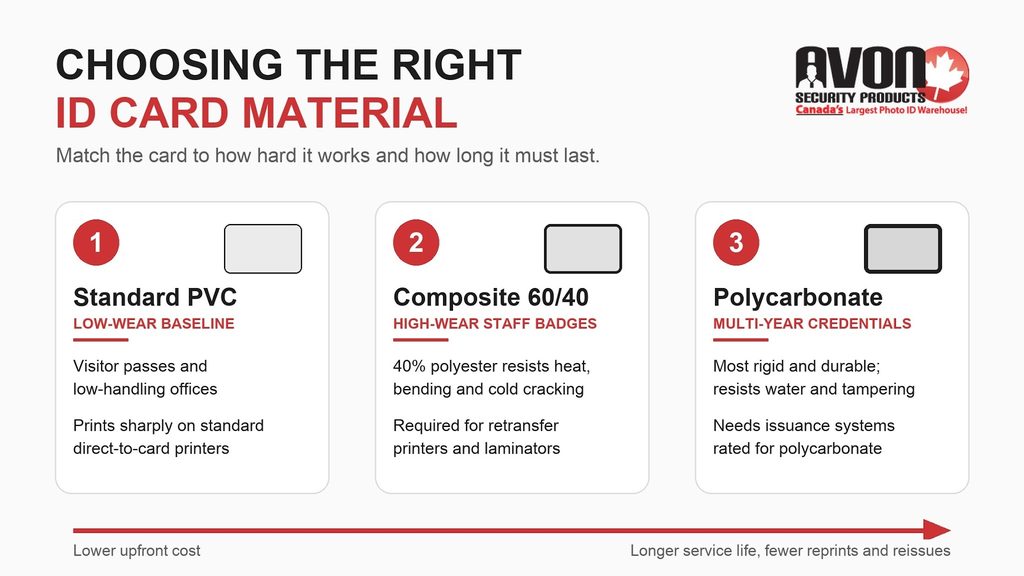
Standard PVC works best as a reliable, cost-effective baseline for low-wear applications, such as short-term visitor passes or offices where staff rarely handle their badges. In high-wear settings, the calculation changes. A cracked badge has to be reprinted, which uses another card and ribbon panel, takes time at the issuance desk, and can leave an employee waiting at a locked door until the replacement is ready. Investing upfront in composite or polycarbonate cards reduces those reissue cycles, so the lowest price per card is often a higher cost over the life of your program.
How Can PVC Cards Be Secured?
You can secure a PVC card in two ways, and most organizations combine them. Visual features let a person spot a fake at a glance, while digital features let a reader or lock check the card automatically.
Visual Security
The most effective visual feature is a holographic overlay, which is a thin, clear film printed with a hologram that shifts as you tilt the card. A photocopier or home printer can’t reproduce it, so a guard can tell a genuine badge from a copy in a second. We offer stock holographic designs, custom holographic overlays carrying your own logo, and holographic varnish ribbons that apply the effect as the card prints.
Digital Security
A digital feature stores information that a machine reads, which is the closest thing a plastic card has to encryption. A magnetic stripe holds data that a reader picks up when you swipe the card. A proximity card hides a small antenna that a door reader detects when you hold the card near it. Smart cards carry a tiny chip that can store more data than a stripe and protect it with encryption.
PVC vs Composite vs Polycarbonate: Which Lasts Longer?
Composite cards outlast standard PVC cards in daily use, and polycarbonate cards last the longest of the three. A composite card blends PVC with polyester, a tougher plastic that resists bending, heat, and sunlight. HID Global, the maker of Fargo printers, says its UltraCard Premium composite card has an expected lifetime three to eight times longer than a standard PVC card.
Heat is the other reason to choose composite. A retransfer printer prints the image onto a clear film and then bonds that film to the card with heat, and HID notes that the heat can warp a standard PVC card. Laminators that seal a protective layer onto the card create the same problem. Polycarbonate is a rigid, long-lasting plastic, and the Government of Canada says the polycarbonate page in the new passport lasts longer and is less likely to be damaged by water or rough handling.
| Card Material Technology | Primary Operational Use Case | Environmental & Structural Resilience | System & Printer Compatibility Requirements |
|---|---|---|---|
| Standard PVC | Visitor passes, membership cards, low-wear staff badges | Sharp print quality; brittle in cold; cracks or warps with constant bending or heat | Standard direct-to-card dye-sublimation printers |
| Composite 60/40 | All-day staff badges; high-wear and outdoor-exposed roles | 40% polyester content resists heat, bending and cold cracking | Required for retransfer printers and laminator modules |
| Polycarbonate | High-security, multi-year federal and government-grade credentials | Most rigid and durable; resists water, abrasion and tampering | Advanced high-temperature issuance systems rated for polycarbonate, such as retransfer printing or laser engraving |
What Should You Buy If Your Employee ID Cards Keep Cracking and Peeling?
Cracking and peeling look similar on a worn badge, but they have different causes, and knowing the cause tells you which fix will work.
Cracking is a physical failure. Standard PVC becomes more brittle in the cold, so badges that move between heated buildings and Canadian winter air several times a day lose flexibility each time. Prolonged sunlight has a similar effect, because ultraviolet light gradually degrades the plastic. The stress concentrates at the slot punch, the cut hole where the clip or lanyard attaches, and small fractures there grow until the card splits.
Peeling is usually a chemical problem. Soft, low-cost vinyl badge holders contain plasticizers, the chemicals that keep the vinyl flexible, and over time those plasticizers migrate out of the holder and into the printed surface of the card. Because dye-sublimation ink sits in the top layer of the card, the plasticizer softens it until the photo and text lift away and stick to the inside of the holder. The fix is to audit the holders your staff wear and move to anti-print-transfer holders or rigid, open-faced plastic holders that keep soft vinyl off the print.
Once you know which problem you have, work through these steps in order:
- If badges crack at the slot punch, move to composite cards, because the polyester content resists repeated bending and cold far better than standard PVC.
- If the print peels or scratches, replace soft vinyl holders first, then add a protective overlay, a clear layer applied from a ribbon panel or laminate as each card prints, to seal the image.
- If badges spend long periods in sunlight or outdoors, choose composite cards with an overlay, since the overlay shields the print and the composite core holds its shape.
- For credentials that must last many years, choose polycarbonate, as long as your printer supports it.
Where Can You Buy Blank PVC ID Cards in Canada?
Avon Security Products supplies blank PVC cards, composite 60/40 cards, polycarbonate cards, magnetic stripe cards, and 10 mil adhesive-back cards for proximity access from its inventory in Concord, Ontario, and ships within Canada with no duties or brokerage fees. For organizations running an ongoing credential program, that local inventory means consistent card stock from one reorder to the next, so badges printed next year match the ones issued today.
Plan Your Credential Program With a Canadian Partner
Choosing the right card is one part of a secure, long-lasting credential program. Avon Security Products works with operations, security, and facility managers across Canada as a long-term partner, from material recommendations and hardware compatibility reviews to printer, custom software, and supply planning backed by local lifecycle support. To book a security consultation, contact our team or call 1-866-458-6999, and our Canadian-based technical team will review your current setup and recommend the right cards for it.
Frequently Asked Questions
What does PVC stand for on an ID card?
PVC stands for polyvinyl chloride, the plastic used for most professional ID cards. A standard PVC ID card follows the CR80 format, 85.60 x 53.98 mm and 30 mil (0.76 mm) thick, the same profile as a payment card. That standard matters operationally, because desktop ID card printers, encoders, and readers are built to transport and read exactly that profile, so cards feed cleanly through printer rollers without jams. For security administrators, the blank card is the foundational physical layer of the whole credential program.
Are there different types of PVC cards?
Yes, PVC cards come in several types, and the right mix depends on the operational problem you’re solving:
- Identity and branding: graphic-quality PVC prints sharp photos and logos for staff badges.
- System integration: magnetic stripe, barcode, and smart chip cards connect a badge to access control and time and attendance software.
- Cost control: 10 mil adhesive-back cards reuse existing proximity cards, which lowers total cost of ownership.
- Operational continuity: composite cards withstand heat and constant handling in high-wear roles.
Choosing by operational need keeps your program consistent as it grows.
Which PVC ID card security feature should I choose?
Most organizations should combine a visual security feature with a machine-readable one, since each stops a different threat.
- Visual authentication: a holographic overlay lets reception staff spot counterfeits at a glance, since a shifting hologram can’t be copied on an office printer.
- Machine-readable security: proximity antennas and smart chips tie the badge to your access control system, so the door checks the credential itself.
A technology your readers don’t support creates badges that look right but won’t open doors, so ask an Avon expert for an integrated compatibility review first.
Can a standard inkjet or laser printer be used for printing on PVC cards?
No. An office laser printer uses a fuser roller heated well above the temperature at which PVC softens, so a 30 mil card can melt or warp inside the machine and cause serious internal damage. Inkjet printers can’t bond ink to plastic at all. Dedicated dye-sublimation and retransfer ID card printers use a precision thermal printhead that transfers dye from a ribbon into the card’s glossy, high-surface-energy face. Feeding unapproved materials through an ID printer can also void the printhead warranty on many models and cause costly downtime.
Which lasts longer, PVC or composite ID cards?
Composite ID cards last longer than standard PVC. HID Global, the maker of Fargo printers and a technology partner of Avon Security Products, says its premium composite cards have an expected lifetime three to eight times longer than standard PVC under heavy handling. Standard PVC can warp under retransfer print heat and crack in extreme Canadian cold, while composite holds its shape. Polycarbonate is tougher still, which is why the Government of Canada uses it for the secure data page of the Canadian passport.