
 1.866.458.6999
Breakaway Lanyards At A Glance
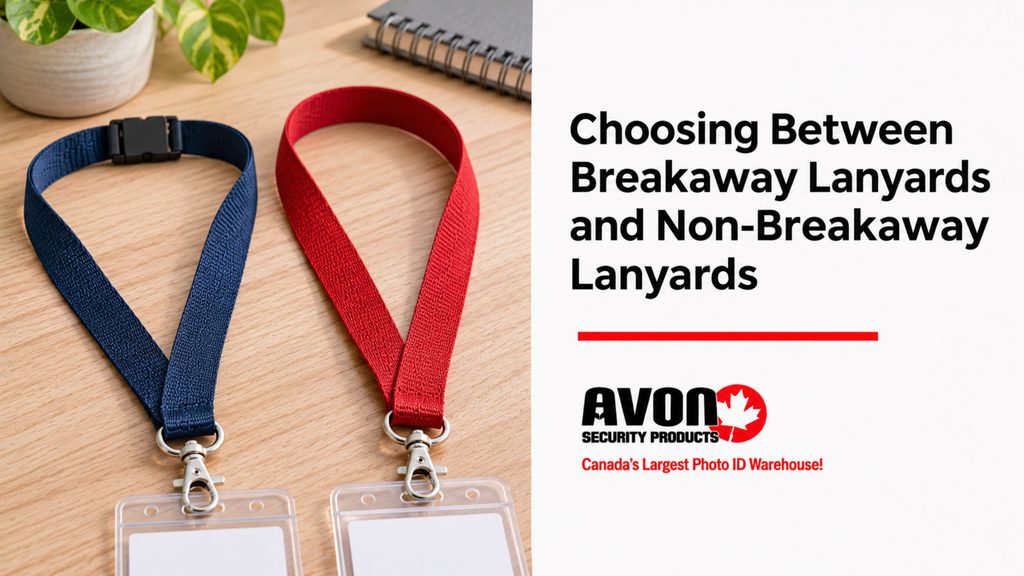
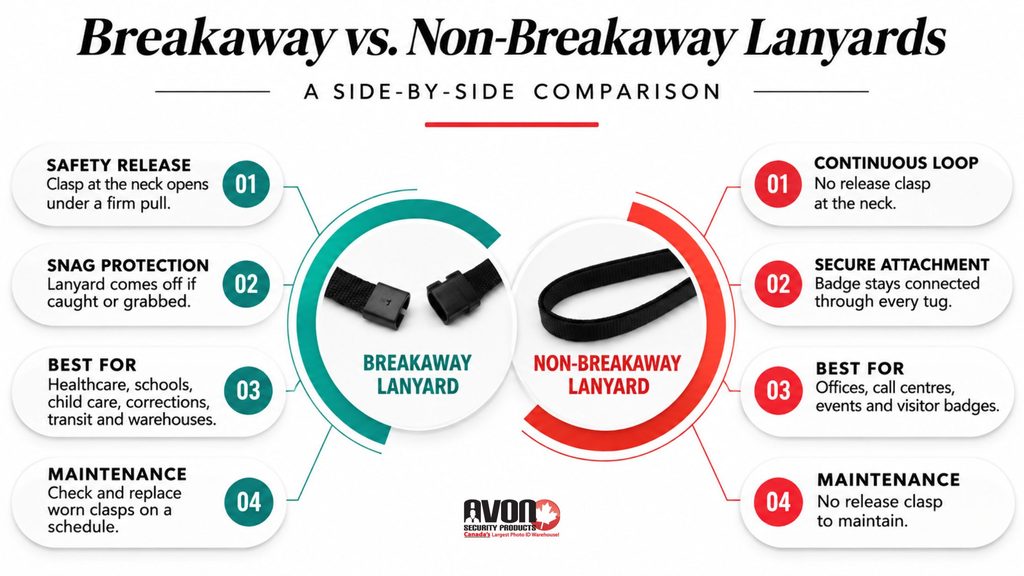
- A breakaway lanyard releases under a firm pull, so a caught or grabbed lanyard comes away instead of tightening around the neck.
- A non-breakaway lanyard is a continuous loop with no release point, which suits office staff, visitors, and printed event lanyards.
- Breakaway lanyards are the standard choice wherever employees work near moving machinery, with patients or residents, or with children.
- Provincial and federal safety rules restrict loose or dangling items near machinery, and a plain lanyard on a production floor falls within them.
- Release force varies by manufacturer, so test a sample with your own badges and readers before ordering in bulk.
A nurse leans in to help a resident out of a chair, and a hand closes on the lanyard around their neck. A maintenance technician bends over a conveyor to clear a jam, and the badge swings toward the rollers. Situations like these happen in Canadian workplaces every day, and the lanyard determines what happens next. A breakaway clasp releases under tension. A standard loop does not.
Choosing the right lanyard style keeps identification visible without adding a snagging or strangulation hazard, and it is one of the simpler safety decisions an organization makes. The right choice depends on where employees work and who they work with, not on the badge itself. Avon Security Products offers lanyards and ID holders suited to different workplace roles and can help organizations match lanyard styles to their safety and badge policies. The sections below cover how the two styles differ, where each is expected, and how to decide for each department.
Non-Breakaway vs Breakaway
A lanyard is a simple loop of flat polyester, nylon, or tubular cord worn around the neck, with a swivel hook, bulldog clip, split ring, or badge reel to carry the card. Width, printing, and attachment style vary, but the clasp is the feature that matters for safety.
A breakaway lanyard has a two-part plastic clasp, usually at the back of the neck. It holds a badge in place through normal daily movement and opens when the lanyard is pulled firmly. If the lanyard catches on a cart handle, a door latch, or a piece of equipment, or if someone grabs it, the clasp separates and the lanyard comes away. The wearer can snap it back together and carry on. A double breakaway adds a second clasp at the front, beside the card attachment, so the loop opens whether the pull comes from the neck or from the badge.
A non-breakaway lanyard is a continuous loop with no release point. It stays in place through everyday pulling, which makes it a practical choice for office staff and printed conference lanyards, where nothing is likely to catch it and a dropped badge is the main concern.
Where Breakaway Lanyards Are Expected or Preferred
Most workplace safety committees apply the same test. If anything at the workstation could catch a lanyard, or if anyone the wearer works with could pull on it, the lanyard should release.
Industrial and Manufacturing Sites
Production floors are where lanyards create the clearest hazard. Ontario’s Industrial Establishments regulation (Regulation 851, section 83) prohibits loose or dangling clothing and jewellery near rotating shafts, gears, belts, and other sources of entanglement, and CCOHS OSH Answers gives the same guidance for metalworking machines. British Columbia’s Occupational Health and Safety Regulation (section 8.10) names dangling neckwear directly, and federally regulated workplaces follow a similar rule under section 12.16 of the Canada Occupational Health and Safety Regulations. None of these rules mention lanyards by name, but a lanyard hanging over a lathe, conveyor, or packaging line falls squarely within them.
For facilities and safety managers, this usually comes down to two options. Breakaway lanyards keep photo ID visible on the floor without creating an entanglement hazard, and many sites go a step further by moving the badge to a reel or clip at the belt or chest pocket, reserving lanyards for office staff and visitors. Avon Security Products supplies both and can help match attachments to the areas where each employee works.
Healthcare and Long-Term Care
Hospitals and long-term care homes face a different hazard than a production floor: the people in the building. Nurses, personal support workers, porters, and security staff work within arm’s reach of patients every shift, and a lanyard can be grabbed during a transfer or by a patient who is confused or agitated. Ontario’s Ministry of Labour expects hospitals and long-term care homes to assess that risk and put controls in place, as its guide to the law sets out. CCOHS lists health care workers among the occupational groups most at risk of workplace violence.
A breakaway clasp, and ideally a double breakaway, is one of the simplest controls a facility can put in place. Many issue them to all clinical staff, and some extend them to anyone who enters a patient area. The lanyard is only half the setup. An open-face holder lets staff tap the card at a reader without removing anything, and because holders are cleaned daily in health care settings, the material matters as much as the clasp. Which ones hold up is covered in our comparison of ID card holder materials.
Schools, Child Care and Youth Programs
Teachers, early childhood educators, and camp staff spend their day bending over desks, lifting children, and occasionally stepping between students. A lanyard within reach of a small hand will be pulled sooner or later, so school boards and child care operators generally issue breakaway lanyards to every adult in the building, including supply teachers and volunteers badged for the day.
Other Close-Contact Settings
Corrections, policing, and transit staff deal with the public at close range, and most of these organizations standardize on breakaway lanyards for the same reason hospitals do. The same thinking applies to veterinary clinics and kennels, where an animal can catch a lanyard, and to stock rooms and warehouses where staff lean into racking, conveyors, or pallet wrap.
Which Workplaces Benefit From Non-Breakaway Lanyards?
A non-breakaway lanyard suits roles where nothing is likely to snag it and the wearer does not work hands-on with the public. Office floors, call centres, data rooms, finance and administration, and event badging where a printed lanyard is worn for a day or two all fit that description.
In those settings, the continuous loop is the more practical choice. A breakaway clasp that is opened and closed every day gradually wears, and a worn clasp can release under a light tug and drop the badge. A plain loop has no part to wear out. Most organizations end up issuing both styles, breakaway for clinical, production, and front-line staff and non-breakaway for office staff, with the same badge, holder, and printed design across the site so employees who move between departments keep the same credential.
Breakaway vs Non-Breakaway Lanyards Compared
| Breakaway lanyard | Non-breakaway lanyard | |
|---|---|---|
| How it releases | Clasp at the neck opens under a firm pull (double breakaway adds a second clasp at the card) | Continuous loop, nothing to open |
| Main benefit | Lanyard comes off instead of tightening when caught or grabbed | Badge stays attached through every tug |
| Expected or preferred | Machinery, patient care, schools, child care, corrections, transit, warehouses | Offices, call centres, events, visitor badges |
| Watch for | Clasp wears with daily use; replace on a schedule | Entanglement if the wearer works near moving parts or the public |
| Reattaching | Snap the clasp together, no tools | Not needed |
| Printing | Full-colour or screen print | Full-colour or screen print |
| Typical width | 3/8, 5/8, 3/4 or 1 inch | 3/8, 5/8, 3/4 or 1 inch |
How to Choose
Most organizations settle this department by department rather than site-wide. Five questions cover the decision.
- What can catch the lanyard? Walk the areas each role covers. Moving machinery, conveyors, racking, vehicle doors, and equipment carts all point to a breakaway lanyard.
- Who could pull on it? Patients, residents, children, animals, passengers, and people in custody can all grab a lanyard. Employees within arm’s reach of any of them should have a breakaway lanyard, and a double breakaway if keys or a reel hang from it as well.
- Does the badge tap a reader? If so, an open-face holder or a badge reel lets the card reach the reader without removing the lanyard. Confirm the holder does not interfere with a proximity card before ordering for the whole site.
- Will it be worn every shift for years? Breakaway clasps wear with daily use, so plan to replace those lanyards on a schedule. A plain loop has no clasp to wear and suits staff who never need the release.
- Is there already a badge policy? If staff are already told how to wear and protect their ID, the lanyard rule belongs in the same document. Our post on work ID badge dos and don’ts covers the rest of that policy.
No Canadian standard sets the force needed to open a breakaway clasp, and it varies by manufacturer. Before ordering in bulk, test a sample with the badges, reels, and daily conditions staff will actually use. It should hold through normal movement and release cleanly when pulled firmly. Avon Security Products can advise on which styles suit each department before an order is placed.
Confirm the Lanyard Fits Your Site First
A lanyard policy is easier to apply when each department has an attachment that suits its work. A nurse moving between patient rooms, a technician clearing a conveyor, and a receptionist greeting visitors each need something different.
Before ordering, consider how employees use their badges throughout a shift. Could a lanyard catch on equipment? Could a patient, student, or member of the public grab it? Does the card need to reach a reader without being removed? Lanyards also work best when chosen alongside the holders, cards, and readers an organization already uses.
Avon Security Products carries breakaway and non-breakaway lanyards, plain or custom printed, along with the swivel hooks, bulldog clips, and badge reels to go with them, and can help organizations select suitable options for each department. Orders ship from Canadian inventory in Concord, Ontario, helping customers avoid cross-border duties and brokerage fees.
Our specialists can recommend lanyards and holders compatible with your card readers. Choosing lanyards for your team? Contact Avon Security Products to compare styles and confirm attachment options for each department.
Frequently Asked Questions
What is the difference between a breakaway lanyard and a regular lanyard?
A breakaway lanyard has a clasp, usually at the back of the neck, that opens when the lanyard is pulled hard. A caught or grabbed lanyard comes off instead of tightening around the neck.
A regular, or non-breakaway, lanyard is a continuous loop with nothing to open. It stays attached through everyday use but offers no release if it catches.
Both styles carry the same holders, hooks, and reels, and both can be printed, so the choice comes down to whether anything at the workstation could snag the lanyard or anyone could pull on it.
Should hospital staff wear breakaway lanyards?
Yes, in most cases. Clinical staff work within reach of patients who may grab a lanyard during a transfer or an episode of confusion or agitation, and Ontario hospitals and long-term care homes are expected to assess and control that risk.
A breakaway clasp releases the loop before it tightens. Many facilities specify a double breakaway for staff who also carry keys or a badge reel.
An open-face holder lets the card be tapped at readers without removing the lanyard. Where a facility’s safety policy sets a specific requirement, follow that first.
Are breakaway lanyards required by law in Canada?
No regulation names breakaway lanyards specifically. Provincial and federal rules do restrict loose or dangling clothing, jewellery, and similar items near moving machinery, and a plain lanyard on a production floor falls within that description.
A breakaway lanyard, or a badge reel or clip in place of a lanyard, allows a site to meet those requirements while keeping photo ID visible. The wording differs by province and sector, so check the regulation that applies to your workplace and follow your own safety committee’s assessment.
What is a double breakaway lanyard?
A double breakaway lanyard has two clasps instead of one: the usual clasp at the back of the neck plus a second at the front, where the lanyard meets the badge attachment.
The loop opens whether the pull comes from the neck or from the badge, which matters when a reel or keys are clipped on and get caught.
It is the version most often specified for nursing, personal support, corrections, and child care staff. Where employees carry keys or a reel on the lanyard, it is worth specifying from the start.
When is a non-breakaway lanyard the better choice?
When nothing at the workstation can catch the lanyard and the wearer is not hands-on with patients, children, or the public. Office staff, call centres, and conference attendees fit that description.
A plain loop has no clasp to wear out, so it will not open under a light tug and drop the badge, which makes it the more reliable choice for printed lanyards worn daily. Most organizations issue both styles and decide by department, keeping the same badge and holder across the site so credentials look consistent.