Published: February 8, 2024
| Updated: February 8, 2024
Author: Team Avon
For decades, workplaces relied on different, older ways for employees to identify themselves and prove they’re authorized to access otherwise restricted areas. Today’s digital technology often revolves around screens, but our ID cards play a vital role in facilitating a seamless co-working experience.
Please keep reading to learn more.
Easy Identification
If you’re a business owner or manager, you need to keep your business safe, and distributing an ID card that has the name of every employee and a high-resolution photograph is a necessity. Every employee will wear one, so identifying them is easy.
The pictures of every employee’s face on the cards make swapping cards or fraudulent use almost impossible. Anyone can see if the cardholder and the face on the card doesn’t match.
Authorization is Simple
Not every employee authorized to enter the building is supposed to have full access to every room in the office. Our proximity and access cards can be digitally programmed to control authorization on an individual level.
If a senior employee is meant to have full access, their ID card will work on every door in the building. Newer, less senior employees’ cards will only work where that individual employee is allowed to be.
Such an efficient approach to authorization streamlines security costs, saving them money. Plus, it is a tactful way of controlling who can go where, as it pre-emptively prevents those awkward scenarios from arising where security must manually stop someone from entering a room.
The latest encoding in Avon Security’s ID and proximity cards can match any security system. As an experienced ID card supplier, we’re happy to customize your proximity and ID cards to fit all your security needs.
Measuring Attendance
As we all know, the COVID-19 pandemic has changed the workplace in many ways. Remote work has gone from a necessity to something many offices opt for, at least to some degree.
Having ID cards for employees can double as a way to measure attendance, as the cards’ technology can tell managers and business owners when an employee entered and exited their workplace. Such a seamless way to determine when people are and aren’t in the office gives the company security while facilitating the flexibility today’s employees need and expect.
Avon Security offers a range of card counterfeiting prevention measures, like holographics and watermarks. We’re also proud to offer many different types of security and ID solutions, like badges, proximity cards, fobs, and more.
Employees don’t want to spend their time at work proving who they are, convincing security they’re allowed to enter a specific space, or demonstrating their hours worked to the company HR. Employees love having a functional ID card because they do a lot more than identification. The company gets added security, efficiency, and cost savings while having their face on a piece of company branding makes every employee feel connected to their work. No wonder ID cards have been such a popular way to facilitate a positive, healthy co-working environment.
Security has always been and always will be a top priority for apartment complexes and their residents. While implementing an ID card system is not meant to replace on-site security personnel or equipment, it is a practical and effective way to enhance or upgrade your building’s existing security measures.
Here’s a quick look at how an ID card system supplied by expert security professionals can be implemented to bolster your apartment’s security.
Identification at a Glance
ID cards provide a simple yet effective way to instantly differentiate residents and authorized personnel from non-residents. By issuing unique ID cards to residents, property managers and security staff can easily spot unauthorized individuals attempting to gain access to the premises. A card reader is also a visual and physical deterrent to potential intruders and prevents security breaches.
Access Control
ID cards can also be integrated with access control systems, allowing residents to enter amenities, parking structures, and common areas seamlessly and further enhancing their security. By programming prox cards, these systems restrict access to unauthorized individuals, ensuring residents that pre-booked facilities such as party, game, and theatre rooms are unoccupied during their scheduled time slot. This straightforward approach eliminates the need for complex security measures or booking procedures.
Visitor Management
Implementing an ID card system for residents can also simplify your building’s visitor management responsibilities. Guests can be issued temporary ID cards or authorized entry through a controlled process to minimize the chances of trespassers gaining access to the building.
Documentation and Accountability
ID card systems provide a robust record-keeping mechanism. Property managers can track the movement of residents and staff, enhancing accountability. In case of security incidents, having accurate documentation can aid in investigations and resolving issues promptly.
Lost or Stolen Card Management
In the event of a lost or stolen ID card, property managers can quickly deactivate the card and issue a replacement – a significantly faster and more cost-effective process than having to potentially change locks.
Cost-Effective Solution
Implementing an ID card system doesn’t require a substantial investment compared to some high-tech security solutions. It provides a cost-effective way to enhance security without stretching the budget.
Customization Options
With proximity card technology, ID cards can be customized to include resident names, photos, and other relevant information, making it easier for security personnel to verify identities quickly and accurately with a single card swipe.
Education and Awareness
Implementing an ID card system provides a subtle yet continuous reminder to residents that reinforces the importance of security. Combined with regular communications regarding security-related news and info, an ID card system can help residents understand their ongoing role in maintaining a safe living environment.
Peace of Mind
Ultimately, ID card implementation offers peace of mind for both property managers and residents. Knowing that there is a simple yet effective security system in place helps create a sense of security and comfort.
The Bottom Line
By integrating an ID card system into your security strategy, your apartment complex can bolster resident safety with a practical, efficient, and cost-effective solution.
Published: January 16, 2024
| Updated: January 16, 2024
Author: Team Avon
When operating a modern sports facility and managing its security, there’s a fine balance to be struck between safety, convenience, and cost-efficiency. Many venues often turn to the tried-and-true card-swipe system as it checks all of these boxes and more.
Here’s a closer look at the benefits of using ID cards as a visitor check-in process and why they’ve become the standard across the sports facility industry.
Streamlined Access Control
By swiping or scanning their ID cards, members are granted entry to your facility without the hassle or costs associated with face-to-face check-ins and verification processes. And when you partner with a full-service security solutions provider like Avon Security Products, you can program ID cards to limit guest access to specific sections of your facility, reducing the likelihood of people being where they shouldn’t – helping you protect the valuable equipment and infrastructure in your sports facility and reduce your liability exposure.
Enhanced Security Features
ID cards from a reputable proximity card supplier are equipped with advanced security features such as RFID technology, biometrics, or barcodes, making it harder for counterfeiters to duplicate your cards and gain unauthorized access.
Seamless Facility Booking
Membership ID cards also streamline your facility’s booking process. Players can reserve courts, fields, or rinks online ahead of time, eliminating the possibility of double-bookings, ensuring that they have a spot secured, and simplifying your booking, payment, and check-in procedures – a win-win for you and your members.
Equipment Management
Equipment management can also be streamlined and made smarter through membership ID cards. When integrated with equipment rental systems, ID cards eliminate the need for deposits or a secondary tracking system, enhancing the overall guest experience. Additionally, data collected from ID cards regarding equipment usage can help facility managers maintain and replace items as needed, ensuring that members always have access to safe and functional gear.
Efficient Transactions
Inside the facility, ID cards can facilitate cashless transactions, making the overall experience more convenient for everyone – which may even help boost your sales. By preloading ID cards with credits, guests can easily make purchases at concession stands, pro shops, and other on-site amenities. This reduces the hassle of remembering to carry their cash or credit cards while enhancing the speed and efficiency of transactions.
Attendance Tracking
ID cards make attendance tracking a breeze. Your sports facility can monitor the number of guests on specific days and times, helping you optimize staffing and resources accordingly. This data can also be invaluable for future planning, enabling you to make informed decisions regarding capacity and expansion.
Attendance tracking is also essential to reporting and investigations in the event of a security incident.
Potential Marketing Opportunities
With data collected through guest ID cards, your sports facility can create targeted marketing campaigns by sending personalized promotions and updates directly to cardholders, increasing engagement and potential sales.
In Summary
ID cards play a multifaceted role in improving the sports facility experience for guests and operators alike. They streamline access control and enhance your facility’s security while facilitating more efficient bookings, equipment management, purchases, and attendance tracking. They can also help you create more personalized email marketing campaigns.
As sports facilities continue to evolve with the times, ID cards remain a vital tool in ensuring a safe, convenient, and enjoyable experience for all. Game on!
Library cards are more than just a ticket to the world of books; they’re a reflection of your library’s identity and a key part of the patron experience. In today’s digital age, the design of your library cards can make a significant impact on the way your institution is perceived.
In this blog, we’ll explore how you can transform your library card designs to create an engaging and secure experience for your patrons. Plus, we’ll touch on the importance of partnering with a top security products supplier, utilizing the best ID card printers, and maintaining your ID card printers for optimal performance.
Elevate Your Library Card Designs
Your library card design is often the first impression patrons have of your institution. Make it memorable! Here’s how:
Branding: Incorporate your library’s logo, colours, and tagline for a cohesive and recognizable brand identity.
Imagery: Consider using images that reflect your library’s unique offerings, whether it’s a landmark in your community or the joy of reading.
Personalization: Allow patrons to upload their own photos or choose from a selection of designs to make their library cards feel personal and special.
QR Codes: Include QR codes that link to your library’s website or app for quick access to digital resources.
Prioritize Security with the Right Supplier
Security is a top concern when it comes to library cards. Partnering with a top security products supplier is essential for safeguarding your patrons’ information and ensuring the integrity of your cards.
Look for a supplier that offers:
Secure Materials: Choose cards made from durable and tamper-resistant materials to prevent unauthorized access.
Advanced Encoding: Opt for cards that can be encoded with secure data, such as RFID chips or magnetic stripes, to enhance library security.
Anti-Counterfeiting Features: Implement features like holograms, UV ink, or microtext to deter fraud.
The possibility of a data breach always seems remote until, suddenly, it happens, and it’s too late to prevent it.
Invest in the Best ID Card Printers
The quality of your library cards relies heavily on the ID card printer you use. Investing in the best ID card printers ensures that your designs are sharp, vibrant, and long-lasting. Look for printers that offer:
High Resolution: Print cards with sharp text and vibrant images for a professional look.
Ease of Use: User-friendly software and intuitive controls streamline the card creation process.
Durability: Ensure that your printers can handle the volume of cards you need without compromising on quality.
Maintenance for ID Card Printers
To keep your ID card printers in top shape, regular maintenance is crucial. Here are some maintenance tips:
Cleaning: Regularly clean the printer’s printhead, rollers, and interior to prevent dust and debris buildup.
Calibration: Periodically calibrate your printer to maintain accurate colour printing.
Update Firmware: Stay up-to-date with firmware updates from the manufacturer to ensure optimal performance.
Library cards are more than just access tools; they represent your library’s identity and commitment to patrons. By elevating your library card designs, prioritizing security with a reliable supplier, investing in the best ID card printers, and maintaining your equipment, you can create a positive and secure experience for your library’s patrons. Swipe, read, and repeat the joy of learning and discovery with your transformed library cards.
Published: December 13, 2023
| Updated: December 13, 2023
Author: Team Avon
The holiday season is a time of joy, camaraderie, and celebration. It’s when company employees come together to recognize their hard work and achievements throughout the year. However, amid the festivities, it’s essential to keep safety in mind to ensure that everyone has a happy and accident-free time.
In this guide, we’ll unwrap the key elements of a secure company Christmas celebration, with a special focus on how Avon Security Products’ visitor management products can streamline the check-in process, helping you spread the cheer while keeping everyone safe.
Venue Safety
The choice of venue sets the stage for your company Christmas celebration. Ensure that the location you choose complies with safety regulations. Here are some considerations:
Accessibility: Confirm that the venue is easily accessible to all employees, including those with mobility challenges.
Emergency exits: Ensure there are clearly marked emergency exits, and that they are not blocked or obstructed.
Capacity: Don’t exceed the venue’s maximum capacity, as overcrowding can lead to safety hazards.
Fire safety: Verify that the venue has fire extinguishers, smoke detectors, and sprinkler systems in working order.
Alcohol policies: If alcohol will be served, ensure responsible consumption and consider providing transportation options for employees who may need them.
Using Avon Security Products help you feel confident that only authorized people are at the party in the first place. Such a proactive approach helps prevent security mishaps from occurring.
However, you don’t want any security processes to cause a bottleneck that causes guests any inconvenience either. Our products help you streamline the check-in process, so you get the best of both worlds.
Food and Beverage Safety
Food is a central part of any celebration. Hungry people can’t enjoy a party! However, to ensure everyone’s well-being:
Catering: Choose a reputable caterer with proper food handling and safety certifications.
Allergen awareness: Ask about dietary restrictions and allergies among your employees, and ensure there are suitable options.
Hygiene: Emphasize handwashing and sanitation among all food handlers.
Alcohol consumption: If alcoholic beverages are served, consider having a designated bartender who can monitor consumption and prevent overindulgence.
Get food that suits people’s tastes and give them safe, easy access — that will fill people’s bellies and hearts.
Decorations and Lighting
While decorations add to the festive atmosphere, they can also pose safety risks. Be cautious:
Fire safety: Avoid highly flammable decorations, and keep them away from open flames, heaters, or candles.
Tripping hazards: Secure cables, wires, and decorations to prevent employees from tripping or falling.
Lighting: Ensure proper lighting in walkways, stairs, and other high-traffic areas to prevent accidents.
Lighting can really improve the mood and atmosphere of an event, but only if it’s safe.
Entertainment and Activities
Entertainment can be a highlight of your company Christmas celebration. Keep these safety tips in mind:
Performer safety: If you’re hiring entertainers or performers, ensure they have a safe and appropriate performance space.
Activities: Plan games and activities that are safe for all participants and provide proper supervision if needed.
First aid: Have a first-aid kit on hand in case of minor injuries, and designate someone responsible for administering basic first aid if necessary.
Our visitor management products can help verify a guest’s identity, because not everybody attending your party will have a guitar around their neck and join the band on stage!
Transportation and Designated Drivers
If your celebration involves alcohol, consider providing transportation options:
Shuttle service: Arrange for a shuttle service to transport employees to and from the venue.
Designated drivers: Encourage employees to have designated drivers or use ridesharing services if they plan to consume alcohol.
Drinking alcohol can be fun in moderate amounts when people are responsible. Hosts have a major duty to ensure nobody drives home drunk, and that alcohol consumption throughout the party is safe.
COVID-19 Safety
In the ongoing pandemic, it’s crucial to prioritize COVID-19 safety measures:
Vaccination: Encourage vaccination among employees and provide a safe environment for those who may be more vulnerable.
Masking and distancing: Follow local health guidelines regarding masking and physical distancing, especially if your celebration is indoors.
Outdoor options: Consider hosting your event outdoors, where the risk of transmission is lower.
Continue to follow the guidelines laid out by medical professionals and create options that let people feel comfortable and safe.
A company Christmas celebration is an opportunity to foster team spirit and show appreciation to your employees. By prioritizing safety at every step and leveraging Avon Security Products’ visitor management products to streamline the check-in process, you can ensure that everyone enjoys a memorable and secure event. Remember, a safe celebration is a happy one, and it leaves everyone with cherished memories of the holiday season.
Parking passes are essential for controlling access to parking areas, ensuring security, and maintaining order in various settings such as schools, businesses, and residential complexes. Designing custom parking passes requires careful consideration to achieve effectiveness and professionalism.
When crafting custom parking passes for your facility, it’s important to buy security products from a reputable company like Avon Security Products. We service over 25,000 customers nationally, including many large-scale identification projects you can learn more about on our site.
But before you finalize any purchase, whether it’s with us or another security products provider, take the time to learn more about proximity cards and how to program them. You may find the following tips for crafting custom parking passes helpful in the process.
Determine Your Purpose and Audience
Before you start designing your custom parking passes, defining the purpose and understanding your target audience is crucial. Different settings may require different types of parking passes. For instance, a university might need colourful, easy-to-identify passes for students, while a corporate office might prefer more discreet and professional designs for employees and visitors. Identify your objectives, whether it’s to control access, track vehicles, or enhance security, and tailor your design accordingly.
Choose the Right Material
Selecting the appropriate material for your parking passes is essential. Common materials include paper, plastic, and vinyl, each with its set of pros and cons. While paper passes can serve adequately for brief periods, plastic or vinyl passes are more suitable due to their prolonged durability and enhanced security. These materials exhibit resistance to weather conditions and tampering, making them especially well-suited for outdoor parking facilities.
Incorporate Security Features
Your proximity and access cards must incorporate security features into your parking passes to prevent fraud and unauthorized use. Consider holograms, UV ink, barcodes, QR codes, or serial numbers. These elements on proximity and access cards not only deter counterfeiters but also make it easier to verify the authenticity of the pass. Security measures enhance the trust of pass holders and ensure the pass’s effectiveness in controlling access.
Design for Visibility and Legibility
A well-designed parking pass should be easily recognizable and readable from a distance. Use contrasting colours and bold fonts to ensure the pass stands out. Include essential information such as the organization’s name, logo, expiration date, and parking zone or space number. Ensure all text and graphics are clear and legible, even in low-light conditions.
Customize for Branding and Personalization
Custom parking passes are an excellent opportunity to promote your brand and create a sense of identity. Our expert customer service team can help you learn more about programming proximity cards to streamline the process and enable you to make informed decisions based on your unique needs.
Incorporate your organization’s logo, colours, and branding elements into the design. Personalization can also enhance security. Consider including a pass holder’s name or vehicle registration number on the pass. This adds an extra layer of protection and prevents unauthorized use.
Crafting custom parking passes involves more than just printing a piece of paper. It requires thoughtful consideration of purpose, audience, materials, security features, and design elements. By following these tips, you can create parking passes that serve their primary function, reflect professionalism, enhance security, and promote your brand identity. Whether for a school, business, or residential complex, custom parking passes are crucial in ensuring order and safety in parking areas.
Published: November 9, 2023
| Updated: November 9, 2023
Author: Team Avon
As an event manager or event facility owner, you likely host several concerts packed with different people. Thousands of ecstatic fans will surround you, all gathered to witness their favourite artist perform live. The energy is electric, the anticipation palpable, but as the crowd swells, so does the need for effective crowd control strategies.
Many of those concerts may also sell out. While this is an advantage for the artist and the venue, it can pose several security risks for the attendees and organizers. Sold-out concerts are exhilarating but also present unique security challenges that require meticulous planning and execution.
So, it’s essential that you use the best security products from a reputable provider like Avon Security Products and combine them with other effective security measures for maximum safety. Here are a few tips to help you keep the crowd safe at a sold-out concert.
Thorough Entry Screening
The first line of defence in crowd control at sold-out concerts starts at the entrance gates. A well-organized entry screening process is essential to prevent prohibited items, such as weapons and contraband, from entering the venue. It is also important to let attendees know what they should and should not bring to the concert beforehand.
Security personnel should use metal detectors, bag checks, and pat-downs when necessary. Additionally, clear signage indicating what is and isn’t allowed can help attendees prepare and minimize delays.
Adequate Security Staffing
Having sufficient trained security personnel is crucial for maintaining order in a packed concert venue. These professionals should be strategically placed throughout the area, focusing on high-traffic areas like entrances, exits, and concession stands. Trained security staff can also assist in managing crowd flow and quickly responding to incidents. Adequate security for high-profile events involves a multi-layered approach, including armed personnel, advanced surveillance technology, and strict access control measures.
Well-defined Emergency Response Plan
No one likes to think about emergencies, but a well-defined emergency response plan is essential for any sold-out concert. This plan should include procedures for medical emergencies, evacuations, and communication.
Adequate medical personnel and first-aid stations should be on-site, and attendees should be informed about the location of these resources. It’s also vital to have a transparent communication system to relay important information to attendees in an emergency. ‘
Crowd Management Techniques
Crowd behaviour can be unpredictable, especially in large, excited crowds. To maintain control, security teams should employ various crowd management techniques. This includes forming physical barriers, using crowd-control barriers or fencing, and monitoring crowd density in different areas. In addition, communicating with the crowd through signage and announcements can help prevent potential issues.
Advanced Technology Integration
In today’s tech-savvy world, technology can significantly enhance crowd control at sold-out concerts. Here are some technological advancements to consider:
Surveillance Cameras: High-quality surveillance cameras placed strategically can provide real-time crowd monitoring, allowing security personnel to spot potential issues before they escalate.
RFID IDs/Wristbands or Tickets: Utilizing RFID technology while making ID cards or wristbands can help track attendance and movement within the venue. When integrated into ID cards, wristbands, or tickets, this data can be valuable for managing crowd flow and ensuring everyone’s safety.
Mobile Apps: Concert organizers can develop mobile apps that provide real-time updates, including emergency notifications, maps, and information about facilities and services.
Social Media Monitoring: Keeping an eye on social media platforms can help identify potential issues or disruptions before they become significant problems.
Published: October 30, 2023
| Updated: November 9, 2023
Author: Team Avon
In times of crisis, when chaos and uncertainty prevail, it’s important to have clear and effective communication. In these critical moments, the role of police ID cards emerges as a powerful tool in crisis management.
Beyond being just a means of identification, these cards play a pivotal role in maintaining order, ensuring safety, and coordinating response efforts. As a trusted security products supplier, we offer several ID card systems that allow the police department to enhance public trust, streamline emergency response, and facilitate the overall effectiveness of law enforcement agencies during these challenging situations.
Learn more about the vital role of police ID cards and their impact on crisis management, highlighting the often-overlooked heroes behind the badges.
Establishing Authority and Accountability
The first and foremost role of police ID cards in crisis management is to establish law enforcement personnel’s authority and accountability. These ID cards for officers typically feature a photograph, name, badge number, and department affiliation of the officer. This information is vital in chaotic situations, helping civilians and other responders identify legitimate law enforcement personnel.
During a crisis, having a clear visual representation of authority fosters trust and cooperation among the affected population. It also allows for accountability, as actions and decisions made by officers can be linked to their individual ID cards, facilitating post-event investigations and reviews.
Facilitating Access Control
In crisis situations, maintaining control over access points and securing sensitive areas is paramount. Police ID cards often include security features such as embedded chips or barcodes that can be scanned to grant or restrict access. This technology allows law enforcement agencies to secure critical infrastructure, command centers, and evacuation zones swiftly and efficiently.
ID cards can be programmed to provide different levels of access to different personnel, ensuring that only authorized individuals enter specific areas. This control helps prevent unauthorized personnel from interfering with rescue operations or tampering with crucial equipment.
Enhancing Interagency Collaboration
Effective crisis management often involves multiple agencies, such as police, fire departments, medical teams, and disaster relief organizations. Police ID cards facilitate interagency collaboration by clearly identifying the respective affiliations of officers.
Another purpose of ID badges is to provide seamless coordination during crises that require multi-agency responses. For instance, a firefighter can easily recognize a police officer and communicate with them for assistance, and vice versa. This smooth interaction improves response times and ultimately saves lives.
Streamlining Information Sharing
Communication is the lifeblood of crisis management. Police ID cards can incorporate communication tools like radio frequencies or QR codes that enable real-time information sharing. This feature lets officers access critical data, such as emergency plans, maps, and contact information, directly from their ID cards.
Quick access to information can make all the difference in a rapidly evolving crisis. These cards empower officers to stay informed and make informed decisions, ensuring a more efficient response to changing conditions on the ground.
Building Public Confidence
During a crisis, public confidence in law enforcement is crucial for maintaining order and ensuring public safety. The sight of uniformed officers with clearly displayed ID cards can reassure the public and provide security.
Police ID cards convey that trained professionals are on the scene to handle the situation. They also demonstrate transparency and accountability, assuaging concerns about potential abuse of power. This confidence encourages civilians to cooperate with authorities, follow instructions, and assist in crisis management efforts.
Police ID cards are far more than just pieces of plastic or paper; they are indispensable tools in crisis management. They establish authority, control access, foster collaboration, streamline information sharing, and build public confidence. These seemingly simple cards play a pivotal role in ensuring the safety and well-being of communities during the most challenging times.
Published: October 16, 2023
| Updated: October 16, 2023
Author: Team Avon
No matter the type of facility you operate, security threats are prevalent everywhere. This is especially a concern for buildings that are open to public visitors. This is where temporary badges come into the picture. Temporary badges, whether for employees, visitors, or contractors, play a pivotal role in enhancing security measures within various environments, from corporate offices to healthcare facilities, educational institutions, and beyond.
Temporary badges are essential for quickly identifying individuals with temporary access to a secured area or event. Whether it’s visitors, contractors, event attendees, or temporary staff, these badges provide a visual cue that helps maintain security, track attendance, and ensure authorized access, making them a fundamental component of effective access control and safety protocols in various environments. The following guide will help you learn the best practices for enhancing security with temporary badges.
Choose the Right Badge Design
Your temporary badges should be easily distinguishable from regular badges. Browse our extensive list to find popular security products you can customize based on your unique needs. Consider using a bright colour or adding a noticeable label like “Visitor” or “Temporary” to clarify who is authorized to enter a specific area. This visual cue helps security personnel identify individuals who may need closer scrutiny.
Issuing Temporary Badges with Care
When someone enters your premises, whether it’s a visitor, contractor, or a new employee, ensure they are properly vetted before receiving their badge. Verify their identity, the purpose of their visit, and the areas they need access to. Only then should you issue a temporary badge with the necessary permissions.
Limit Badge Duration
Temporary should mean temporary! Ensure that temporary badges have a clearly defined expiration date and time. This could be a few hours for visitors or a contractor’s project duration. If you choose expiring temporary badges with a specific time limit, they should immediately be invalidated to prevent unauthorized access. Limiting the time will ensure that unauthorized people who enter particular facility areas don’t wander around, as this can lead to security breaches.
Implement Access Control Policies
To further enhance security, clearly define access control policies for temporary badge holders. Specify the areas they can access and the ones they are restricted from entering. This minimizes the chance of someone with a temporary badge accidentally or intentionally wandering into sensitive or restricted zones.
Keep a Digital Record
Maintaining a digital record of badge issuance is essential. A visitor management system can streamline this process by capturing key information about each badge recipient. This record helps with accountability and provides a trail of who has been on your premises in case of any security incidents or disputes. This is especially important if you issue non-expiring temporary badges to visitors. Keeping a record, especially if anything goes wrong, may help you identify who may be responsible.
Train Your Staff
Your security personnel play a critical role in ensuring the effectiveness of temporary badges. Regularly train them on the proper procedures for issuing, inspecting, and handling temporary badges. They should also know the importance of verifying identities and adhering to access control policies.
Dispose of Badges Securely
Once a temporary badge is no longer needed, it should be returned and disposed of securely. Ensure that there is a process for shredding or securely disposing of badges to prevent someone from finding and misusing discarded badges.
Stay Informed About Security Trends
Finally, remain informed about the latest security trends and technologies. Innovations in badge technology, such as RFID or biometric integration, can offer enhanced security features. You can leverage these advancements to bolster your security system by staying informed continually.
Published: September 25, 2023
| Updated: November 4, 2026
Author: Team Avon
Key Takeaways
A proximity card is a type of RFID card that works at 125 kHz and sends the same fixed ID number to the reader every time.
The cards people call RFID or smart cards such as HID iCLASS SE, Seos, and MIFARE DESFire work at 13.56 MHz and use keys to protect their data.
A 125 kHz reader can’t read a 13.56 MHz card, so the readers on your doors decide what you can issue today.
Prox suits sites that need replacement cards for working 125 kHz readers; 13.56 MHz suits sites where a risk assessment calls for credentials that resist copying, or where readers are being replaced anyway.
Multi-technology readers and dual-technology cards let an existing prox site change over in stages instead of all at once.
The difference between RFID and proximity cards is that a proximity card is one specific kind of RFID card: it runs at a low frequency of 125 kHz and sends a fixed ID number to any reader that powers it. Secure 13.56 MHz access cards such as iCLASS SE, Seos™ and MIFARE DESFire carry a chip that can authenticate the reader with secret keys, and when the system uses their secure application, they are designed to resist copying.
Neither one is right for every building. If your organization already runs prox, the practical questions are what your readers support, how much risk a copied badge would create at your site, and whether changing over in stages makes sense.
Understanding the Basics: RFID Cards and Proximity Cards
RFID stands for radio frequency identification. It describes any card, tag or fob that exchanges data with a reader through a radio field without touching it. Proximity cards and smart cards both belong to this family, which is why you’ll see “RFID proximity cards” and “proximity RFID readers” used side by side. They’re two halves of one system: the card you carry and the reader on the wall.
The main difference is the operating frequency, measured in kHz (thousands of cycles per second) or MHz (millions). A card and a reader must share a frequency and a supported technology to communicate. A reader built only for 125 kHz will not respond to a 13.56 MHz card at all.
What Is a Proximity Card?
A proximity card, often shortened to prox card, is a 125 kHz RFID card used for door access. HID’s ProxCard II datasheet describes it as a passive card, which means there’s no battery. Inside the plastic is a copper antenna coil and a small chip, and the reader’s radio field powers the chip long enough for it to reply with its stored number.
That number has two parts. The facility code identifies your organization or site, and the card number identifies one person’s card. In the common 26-bit format, which HID calls H10301, 8 bits hold the facility code and 16 bits hold the card number, plus a check bit at each end that helps the reader catch a bad read. That allows 256 facility codes with 65,536 card numbers under each one, so two unrelated organizations can hold cards with the same card number. The facility code is what keeps them apart. The reader passes both to the door controller, for example over a Wiegand interface, and the controller checks them against its cardholder list. On HID proximity cards, the format, facility code, and number are encoded before the cards are issued, so replacements have to match what your system already expects. Some organizations use a longer format instead, such as HID’s Corporate 1000, where HID assigns the organization its own company ID and tracks the card numbers issued under it so they aren’t repeated for another customer. If your cards are in a format like that, reorders go through the same company ID.
Not every 125 kHz reader reads every 125 kHz card. HID Prox, Indala, and AWID are separate prox technologies, so the reader has to support the one your cards use.
What Is an RFID Smart Card Credential?
When people compare RFID cards with proximity cards, they usually mean a high-frequency smart card that works at 13.56 MHz. The names you’ll usually see on access control specs and purchase orders are HID iCLASS SE, HID Seos™, and MIFARE DESFire, which is made by the chip company NXP. NXP’s MIFARE DESFire EV3 datasheet lists it as an ISO/IEC 14443 contactless card with memory options measured in kilobytes and room for several separate applications.
The security difference comes from authentication. HID’s Seos™ card datasheet and the DESFire EV3 datasheet both describe AES-based mutual authentication, where card and reader prove they hold matching keys before protected data is released. What a card reveals before authentication varies by credential and privacy settings. Some cards return a fixed serial number, called the UID, while NXP’s datasheet lists a Random ID option for DESFire EV3 that returns a different identifier each time. Either way, a secure deployment reads the protected credential rather than relying on that public identifier.
RFID vs. Proximity Cards: What Sets the Two Technologies Apart?
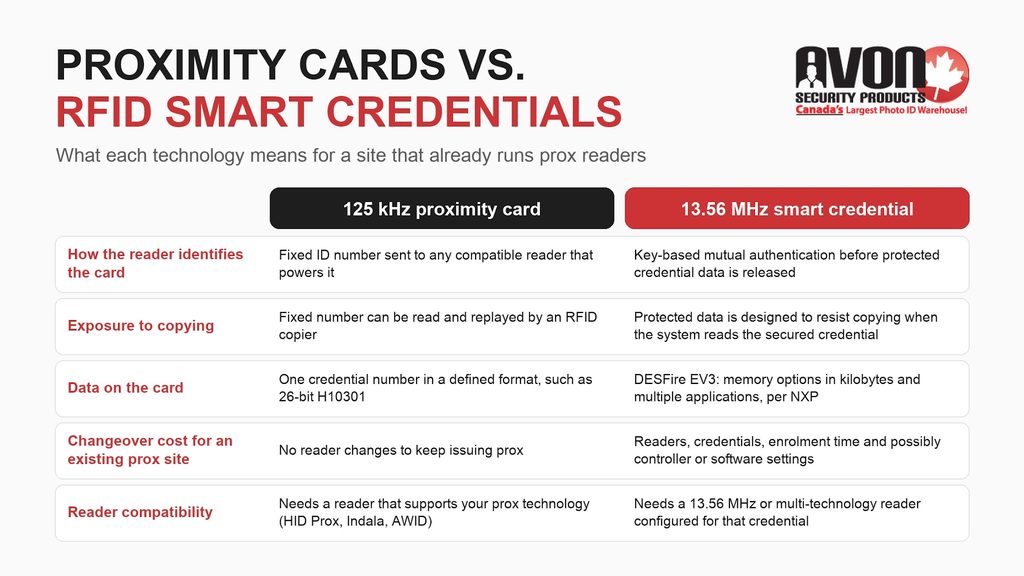
The table compares standard 125 kHz proximity cards with current 13.56 MHz smart credentials on the points that affect an administrator’s decision.
What it means for your site
125 kHz proximity card
13.56 MHz smart credential (iCLASS SE, Seos, DESFire EV3)
How the reader identifies the card
Fixed ID number sent to any compatible reader that powers it
Key-based mutual authentication before protected credential data is released; public identifier behaviour varies by credential and privacy settings
Read range at the door
Set by the reader model and mounting; check the reader datasheet
Set by the reader model and mounting; check the reader datasheet
Exposure to copying
Fixed number can be read and replayed by an RFID copier
Protected data is designed to resist copying when the system reads the secured credential
Data on the card
One credential number in a defined format, such as 26-bit H10301
DESFire EV3: memory options in kilobytes and multiple applications, per NXP; check the datasheet for other families
Changeover cost for an existing prox site
No reader changes to keep issuing prox
Readers, credentials, enrolment time and possibly controller or software settings
Reader compatibility
Needs a reader that supports your prox technology (HID Prox, Indala, AWID)
Needs a 13.56 MHz or multi-technology reader configured for that credential
Range and Speed
For door access, read range depends mostly on the reader model, its mounting surface and the card, not on whether the card is prox or a smart card. Manufacturers publish read ranges for specific reader and card combinations, so check the reader datasheet rather than the card type alone. Mounting matters too: a reader fixed directly to a metal door frame usually reads at a shorter distance than the same reader on drywall, which is why some readers are sold in metal-mount versions or with spacers. Response time at the door also depends on the reader, controller and system configuration, so range and speed shouldn’t decide the choice on their own.
Security Levels
Security is the main practical difference. A prox card sends its number to any compatible reader that powers it, with no check on who is asking. The RCMP’s communique on RFID copiers and duplicators warns that pocket-sized copiers can copy RFID credentials in seconds, and that card readers can’t tell a copied credential from the original. So yes, a standard prox card or key fob can be copied, and the copy works at every door the original opens.
A fixed prox number has nothing to stop that replay. Current smart credentials make copying harder because the protected credential only releases after key-based authentication. Not every 13.56 MHz card is equal, though. MIFARE Classic and the original iCLASS (often called iCLASS legacy or iCLASS Standard) use earlier security designs that published research has since shown can be defeated. Both makers offer newer families with stronger security: NXP’s MIFARE DESFire and HID’s iCLASS SE and Seos™. Because the names overlap, a card marked “iCLASS” isn’t necessarily the current generation, so ask your access control provider which generation and which keys your system uses before treating it as equal to Seos™ or DESFire EV2 or EV3.
The same RCMP communique lists steps that work with any card technology. For the building: keep your threat and risk assessment current, require a card plus a PIN at restricted areas, mount readers where someone can see them, and deactivate any card that’s lost or might have been copied, then issue a replacement. For the people carrying the cards: keep badges out of sight in public, including on transit and in restaurants, don’t leave them in a vehicle, and consider RFID-blocking holders. If you’re keeping prox for now, these steps lower the risk while you plan or budget an upgrade.
Compatibility and Cost
For an existing prox site, staying with prox avoids replacing and reinstalling readers at every door. Moving to 13.56 MHz means budgeting for new or multi-technology readers where the existing readers can’t support the selected credential, new credentials, staff time to enrol cardholders, and possibly controller or software updates to accept the new format. Per-card pricing varies by technology and format, so compare the total changeover cost, not the card price alone.
Types of Proximity Cards and RFID Cards
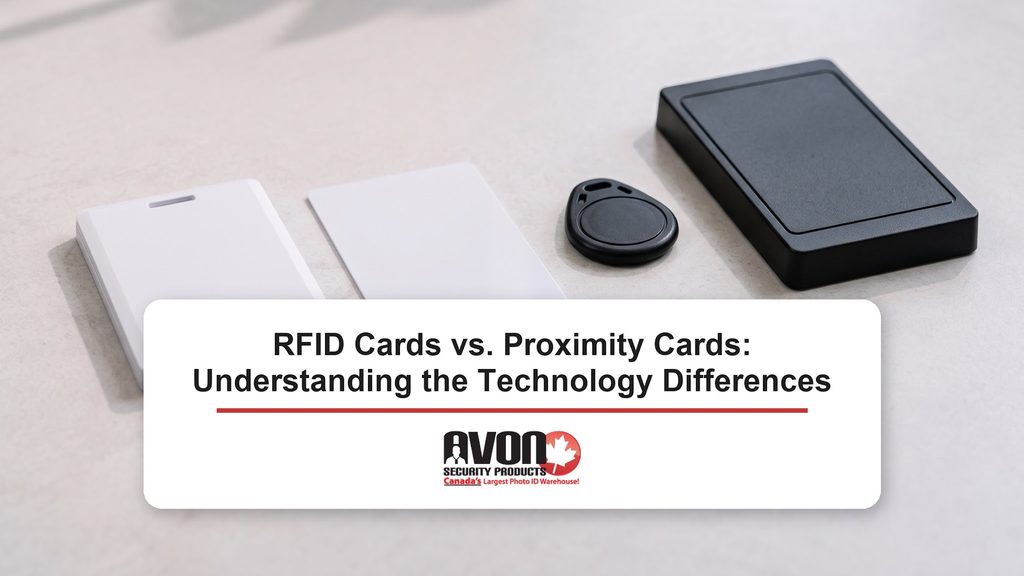
Clamshell cards, such as the HID 1326 ProxCard II, are thick and rigid, and a photo ID is added with an adhesive label on the front.
Thin printable cards, such as the HID 1386 ISOProx II, go through a desktop ID card printer so the access credential and photo badge are one card.
Key fobs and tags, such as the HID 1346 ProxKey III and HID Seos™ key fobs, attach to a key ring for staff who don’t need a photo badge, such as for parking or after-hours access.
Smart credentials such as iCLASS SE, Seos™, and MIFARE DESFire EV3 are offered in more than one form factor, and the available forms vary by credential family.
Dual-technology cards carry a 125 kHz prox chip and a 13.56 MHz chip in one card. Check which 13.56 MHz technology is inside: a card that pairs prox with Seos™ is a different upgrade from one that pairs prox with the original iCLASS.
Matching a replacement starts with the technology and format your readers are set for, not the card style. Avon’s proximity cards range is organized by access control brand, which helps an administrator find cards listed for listed for the system already on the wall.
The Pros and Cons of Proximity Cards
Prox cards work with the 125 kHz readers already installed at a site, as long as each reader supports that card technology and the system accepts its format, so an organization can keep issuing replacements without changing hardware.
Their main drawbacks are the lack of card-to-reader authentication and the limited data, since the card carries one fixed number and nothing else.
Like any electronic access system, prox readers and locks need power. How each door behaves during an outage should follow the site’s approved security and life-safety design.
Applications of Each Card
Proximity cards fit sites with working 125 kHz readers where the organization’s risk assessment accepts a fixed-ID credential, sometimes with added measures such as a PIN at restricted doors. They also fit buildings where the readers belong to a landlord or a shared system the organization can’t change.
13.56 MHz smart credentials fit new installations, reader replacements, and areas that need cards designed to resist copying. Organizations such as universities and hospitals can also use the extra memory to put separate applications on one card, provided every system involved supports that credential.
Should You Upgrade From 125 kHz Prox to iCLASS or MIFARE DESFire?
It depends on what you’re protecting, what your readers and controllers support, and your budget timeline. An existing prox site doesn’t have to change everything at once.
What to check first
Identify the prox technology and format in use (HID Prox, Indala or AWID; for example, 26-bit H10301 or a longer format) and every facility code your system accepts.
List the reader models at each door and check each datasheet for the credential technologies it supports.
Confirm with your access control provider that the controller and software accept the new credential and format.
Count cardholders and doors, then decide which areas move first based on your risk assessment.
How a phased changeover works
Check whether your installed readers already support both technologies, and install multi-technology readers only where they don’t, so old and new cards work side by side.
Issue dual-technology cards to people who need both old and new doors during the changeover. Choose one whose 13.56 MHz side matches the credential you’re moving to, such as Seos™ plus prox, rather than prox paired with an older technology you’ll want to retire later.
Before choosing iCLASS SE, Seos,™ or MIFARE DESFire EV3, verify the exact reader model, which credential technologies are enabled on it, and the keys and application your system will use.
Retire prox credentials once every door reads the new credential through its secured application with the intended keys, and 125 kHz reading and any other insecure fallback modes are disabled.
Each new credential has to be enrolled before it opens a door. Administrators program proximity cards and smart credentials the same basic way: record each card number against a cardholder, then assign access levels. Keeping old and new card numbers on the same cardholder record keeps a phased changeover organized.
How Can You Tell Which Card Technology Your System Uses?
To find out what format your HID prox cards use, check the card format settings in your access control software first. That’s the most reliable record. Then confirm it against your purchase records and the card itself.
The card: look for a manufacturer name, a technology mark such as iCLASS orSeos™, and any printed or embossed number. On some cards, that number is only the card number, so don’t assume it reveals the facility code.
The purchase records: HID’s Readers and Credentials How to Order Guide shows that a credential is ordered by its base part number and configuration suffix, with the programming details (format, facility code, and number range) specified separately. The original invoice or order confirmation may contain those details; if it doesn’t, ask your supplier or installer for the programming records.
The reader and access system: the model number on the reader label or installation records tells you which technologies it reads; the access control software’s card format settings show the formats and facility codes in use. If the software shows a 26-bit format and facility codes between 0 and 255, you’re most likely on the open H10301 format.
Making the Right Choice
Stay with proximity cards when your 125 kHz readers work, your risk assessment accepts a fixed-ID credential, and you need replacements that match the cards already enrolled. Choose 13.56 MHz smart credentials when you’re replacing readers anyway, fitting out a new site, or protecting areas where a copied badge would be a serious problem. Use multi-technology readers and dual-technology cards when you need to move between the two in stages.
Need Help Choosing Proximity or Smart Cards?
Cards your readers can’t read, or a format your controller won’t accept, cost you time at every door. When you reorder, the card technology, the format, every facility code in use and the next unused card number all have to match what your system expects, and a changeover adds reader models and controller settings to that list. Avon’s specialists can help confirm those details against the system you already have and talk through your options if you’re planning an upgrade. Replacement cards come from Canadian inventory in Concord, Ontario, without unexpected duties or brokerage. To confirm compatibility, contact Avon or call 1-866-458-6999 with your reader model and any card records you have.
Frequently Asked Questions
What is the difference between RFID and proximity cards?
A proximity card is a type of RFID card that runs at 125 kHz and sends the same fixed ID number every time it’s read. The credentials usually called RFID or smart cards, such as iCLASS SE, Seos™, and MIFARE DESFire, run at 13.56 MHz and use key-based authentication to protect their data. Current smart credentials are designed to resist copying and can hold more data, while prox cards work with the 125 kHz readers a site may already have installed.
Can we keep ordering prox cards for our existing readers?
Yes, as long as the new cards match the technology, format, and facility code your readers and access system already use. Prox remains a reasonable choice for sites whose risk assessment accepts a fixed-ID credential. Before reordering, confirm the prox technology (HID Prox, Indala, or AWID), the card format, every facility code in use, and the next unused card number. A mismatch on any of these can produce cards that don’t open the door, even when the reader appears to respond.
What is the difference between a MIFARE card and a proximity card?
A MIFARE card is a 13.56 MHz smart card built on an NXP chip, while a standard proximity card is a 125 kHz card. A single-frequency reader can’t read both, so your reader decides which one you can use. MIFARE DESFire EV2 and EV3 use AES-based authentication, while the older MIFARE Classic family uses a different security design. A prox card has no authentication at all, so confirm which MIFARE family and settings your system uses.
Will my 125 kHz reader work with iCLASS or DESFire cards?
No, a reader that only supports 125 kHz can’t read a 13.56 MHz card such as iCLASS SE, Seos™, or MIFARE DESFire. To use those credentials, you’ll need a reader that supports the specific smart card technology, and multi-technology readers can read both frequencies. During a changeover, dual-technology cards carry a prox chip and a smart chip, so one card opens doors with old and new readers until every door has been converted.
Should we upgrade from 125 kHz prox to iCLASS or MIFARE DESFire?
Upgrade when a risk assessment calls for credentials that resist copying, or when readers are due for replacement anyway. If your prox readers work and the risk is accepted, keeping prox with measures such as a PIN at restricted doors is a reasonable choice. Before choosing iCLASS SE, Seos™, or DESFire EV3, verify the reader model, enabled credential technologies, keys, and application. Multi-technology readers and dual-technology cards let you change over in stages.
Do proximity cards need a battery?
No, standard proximity cards and smart cards don’t contain a battery. The reader sends out a radio field, and the card’s antenna collects enough energy from that field to power its chip and reply. That’s why the cards are thin and never need charging. The exception is active long-range tags, which carry a battery so they can be read from a distance, such as at a parking gate or a vehicle entrance to a site.
×
1
Product selection
2
Contact information
3
Review information
How many cards will you print a year?
Organizations needing to print less than 25 cards per year may find it more economical to use a card printing service.
Automatically print on both side of the Card?
Dual-sided printers usually cost significantly more than single-sided printers. In some cases a single-sided printer can be used to print both sides of an ID card:
If the back of every card is identical (i.e.: If lost, return to... This card is property of...), you can use a single-sided printer and pre-print a batch of card backs, often using an inexpensive black ribbon. Those cards can be sent through the printer a second time to include customized information on the other side. This method is not recommended for printing on technology cards due to possible damage it could cause to the card.
Even if the back and front is unique for every card, you can print one side of an ID card, flip it over and print the back. This is much more time consuming, and is not recommended for organizations that print a large volume of ID Cards. This method is also not recommended for printing on technology cards due to possible damage it could cause to the card.
Need to use the printer with an Apple MacTM?
Only a few models of ID card printers on the market are compatible with Mac computers.
There is currently not any commercial ID card software that is compatible with Mac computers. If at all possible, we recommend using a PC to manage an ID card system.

 1.866.458.6999