Published: July 22, 2021
| Updated: September 24, 2024
Author: Team Avon
Every company needs to pay extra attention to security since the workplace withholds an abundance of information. In addition to confidential data, security is also essential to maintain employee safety. A business can be at risk due to several security concerns, from external threats to employee oversight.
The individuals responsible for security tech revealed that news about security problems makes them feel unsafe at work. According to a study, nearly 7 in 10 security professionals witness headlines once a week or more, making them think their office isn’t secure enough. Businesses need to take specific steps to monitor and fill security gaps. Here are some procedures your workplace can follow.
Introduce Improved ID Card System
It may be time to say goodbye to classic ID cards that only security guards look at to identify you. Although it is still an essential security process, you may need to use proximity cards as well. Proximity cards are contactless cards that a machine can read without them being inserted. They are a type of smart card, similar to credit cards that provide the tap service.
Proximity cards enable a higher level of encryption since these cards will ensure that access to authorized areas is limited. It also reduces contact with the security personnel, making it a safer option when everyone is at risk of the COVID-19 spread.
Ensure Visitor Management
Some of the most significant risks that may occur could be from strangers entering the building. If you issue a visitor badge to guests, it is simpler for employees to recognize that they are not authorized to enter certain areas. You can consult a professional card printer to create specific visitor cards for you.
To further enhance security, you should only provide the visitor ID card to individuals after they are fully verified. It is also vital that visitors do not gain access to confidential company information, so it may be helpful to have guest Wi-Fi credentials to provide. Letting strangers use the same internet poses security risks since hackers can get into the system.
Encourage Employees to Follow Protocols
The impact of security measures is almost invisible if employees do not follow the procedures. You can motivate employees to follow security measures by giving them a durable ID card holder to carry at all times. Having a cardholder with them will be a constant reminder to ensure that they come to work with their ID cards, reducing the security breach risk.
Another way to encourage employees to follow protocols is by providing refresher training courses consistently. Training them to avoid and tackle security risks will make them more efficient. You could also offer incentives after every completed training course to keep staff members motivated.
Make Monitoring a Habit
Putting security measures in place without monitoring its impact doesn’t allow you to maximize safety in your office. To ensure that the security methods are working, monitor your workplace with CCTV cameras, go through visitor lists, and compare with past data. Keeping track of activities in your workplace can enable you to spot any potential threats or identify trends with past breaches.
Security in the workplace is one of the most critical factors that require attention. Neglecting safety can be harmful to your employees, clients/customers, and your organization’s credibility.
Published: July 13, 2021
| Updated: September 24, 2024
Author: Team Avon
If you own a business, you probably have an office that consists of private information. Whether the data is precisely about your company’s transactions or confidential client information, you need to safeguard them at all times.
If an individual such as a supplier or the mailman often enters your premises, you might have gotten familiar with them. However, there may be times when a different person comes to complete the task. During those times, an ID card can be helpful.
Mode of Identification
The primary purpose of ID cards is to identify the individual holding the card. Using an identity or ID card allows the security guard to understand who is entering the workplace. The ID card needs to have a picture on it so that security can match the cardholder’s photo. A company can use an ID card to verify both staff members and visitors.
The ID should be unique so that the agency can identify it. Additional details such as the department the individual works in can be beneficial too. If the card is for a visitor, it can also help other employees in the company beyond the security to identify them.
Prevent Unauthorized Access
Even if multiple people enter a building, they may have different levels of access. A visitor may be allowed to enter the lobby, but not the experimental lab or CEO’s office. Similarly, a staff member may have access to the conference room but not the space that holds monetary funds.
Using ID cards allows security or devices to prevent unauthorized access. It may not be possible to have a security guard in every corner of the workplace. If your company uses ID card readers that work with a tap or scan, it can automatically allow or deny access to particular cardholders.
Proof of Accountability
Things do not always go according to plan, and problems may arise sometimes. However, some employees may feel worried and hide any potential encounter. If ID cards are required to enter every area, there will be a record of everything. This will enable company members to go through the list or figure out who might have made a mistake.
It can also be a method of tracking employee attendance without any hassle. Your organization can also use ID cards to capture data if employees borrow any equipment, reducing the chances of damage or misplacement. Using a plastic ID card printer to create a card for each employee can be helpful.
Use as Payment Method
In many industries, ID cards work as payment methods. You can implement this by customizing a card that suits your company’s needs. If you offer meal allowance funds, you can incorporate them into the ID cards. There are ID cards for different industries that can be created to match your organization’s needs.
Boost Company Professionalism
When outsiders notice that your company has a high-security level, they will realize that it can be challenging to conduct any illegal activities on your premises. This will reduce the number of potential security breaches. It will also help build a relationship or gain customer or client trust. Using ID card systems can enhance your company’s credibility as well, allowing you to attract more business.
ID cards serve multiple purposes and can help your company in many ways. If you don’t have a system already, get started on yours soon to maximize your business’s potential.
Published: June 24, 2021
| Updated: September 24, 2024
Author: Team Avon
Security is essential anywhere, but it may be important to take extra measures to protect a workplace. Since a work environment consists of multiple components such as money, assets, and confidential data, any workplace could be the target of a security attack.
There are numerous security risks that your organization may face. The potential risks could take place on the premises through a burglary or digitally through a cyber-attack. Both versions can be scary and have the ability to harm a firm and its employees.
By staying alert of all the security mistakes and implementing practices to prevent them, you can avoid these threats. Here are some measures you can take.
Not Enforcing ID Cards
If employees can access any part of a worksite without an ID card used to authenticate them, they may get used to that. Employees must understand the importance of user authentication methods in the workplace.
Invest in a plastic card printer service to provide each employee with an access card to enter the workplace. By making ID cards mandatory and denying entry without it, staff members will be motivated to wear them at all times.
Insufficient Security Measures
Not implementing suitable security measures can severely harm your company. It is crucial to have security guards present in the workplace at all times. However, you cannot just hire any company without research.
Before hiring any security:
·Make sure to do a background check.
·Ask for license proof.
·Determine how well they are trained.
Security personnel is one of the most critical elements of a company, and they will need to be qualified to tackle any potential problems that may arise.
Neglecting Unauthorized Access
If your company’s ID card system is old-fashioned, it may not require a scan. During times like these, if the employee has to show the card at the door, outsiders who pose risks can create fake ID cards.
It is fundamental to get on board with new technology and use contactless cards that the machine can automatically read. New security measures such as proximity cards provide security in the entrance and inside the workspace. Due to the proximity card system, the reader will know if the person attempting to enter the workplace or a secluded area is authorized. This will prevent unauthorized access.
Undermining Cyber-Attacks
On-site security measures such as a prox card will certainly enable higher security levels in the workplace. However, if the threat comes from cyber-attacks, different security measures would need to be applied.
Cyber-attacks are becoming more common now due to the COVID-19 pandemic. According to a study, there is a hacker attack every 39 seconds. It is necessary to use updated anti-virus technology, a multi-step authentication process, and constantly train employees to deal with cyber-attacks quickly.
Sharing Passwords
Even if you trust someone in your company with all your heart and soul, it may still be necessary to protect your password from them. This is not because they will necessarily gain access to all of your information and somehow manipulate it.
Although data breach is a significant concern, if you share your password with someone, they may be logged into your account on their device. If a security breach does occur, it will affect both your personal information and theirs, potentially resulting in losses for the company.
To avoid making these security mistakes, educate yourself and your employees. It is essential to know when to identify risk and effectively prevent it. Incorporate extra security measures and make technology your best friend. Avon Security has a range of products that can help your company stay safe!
Published: June 15, 2021
| Updated: September 24, 2024
Author: Team Avon
Technological advances have led to higher productivity in various methods. Usually, when we think of workplace efficiency, dollar bills cross our minds. But, did you know that money isn’t the only way to motivate employees to do better?
In some cases, using advanced technology and creating custom ID products can contribute to the work culture benefits at work. Customized identification can improve workflow and lead to increased productivity in the office. Are you still wondering how that’s possible? Here is how.
Safety
No matter where the office is located, an employee wants to feel safe. When somebody spends several hours of their time at an unknown place, they expect to remain secure. Creating custom ID products blocks strangers from entering a private area.
Companies can increase safety by using a reliable ID printer to produce cards for every employee. When the staff knows that every person that enters their workspace will be adequately identified, they are likely to feel comfortable working there.
Importance
Custom ID products can also help employees feel important. If the company makes thoughtful gestures such as the provision of custom items, employees feel valued. You can do this by providing accessories for security measures as well.
Some organizations create custom lanyards in Toronto that can be ordered by companies and distributed among staff. By allowing the team to choose what colour or design they prefer, they may feel like their input matters, resulting in a more positive work culture.
Opportunity
Employees may see custom ID products as a chance to grow within the company. They may think that if they were temporary, the company would not put in the effort to create custom products for them. So, custom products can enable the staff to see a future within the company, which will be a helpful incentive for them to work more efficiently. Increasing productivity may even be a gesture of gratitude from team members.
Reliability
Taking steps to make employees feel like the company relies on them can also be motivating. If the staff members feel like the company trusts them, they will work harder to keep that trust.
You can show them that their time and effort are valued by supplying personalized proximity cards for them to use at work. A proximity card is a contactless card that doesn’t require the card to be entered for reading. This can help because the employees may be able to enter specific areas with those cards, which will make them feel trusted. When they think that the company relies on them to handle confidential information, their productivity levels may rise.
Capability
Another way that custom ID products can improve workflow is by linking the IDs to efficiency. The company can set a goal for employees, and whoever meets the target the faster or most effectively could receive a reward. Incorporating incentives into the mix can be very helpful. The company can track their progress with the custom IDs. You can talk to experts in our company and explore your options for customization.
No matter your goal, taking measures to make employees feel safe and supported can go a long way for your company. Avon Security is here to walk you through the process at any time!
Published: May 26, 2021
| Updated: September 24, 2024
Author: Team Avon
Businesses commonly use an ID card printer, and it is an investment just like other assets. The printer will perform a significant task of securing employees and access to spaces within your company.
Due to new risks appearing at workplaces often, achieving security in the workplace can be tricky. However, the right ID card system can limit how attackers can intervene.
There are differences in these devices, and ensuring you have the right one for your organization is vital. Here are some things you can consider while finding a suitable printer for your firm.
Technological Advancements
During your ID card printer hunt, you will come across many different types of products and services. To find the most efficient ID card printer in Canada, it is essential to do some research.
Thanks to the constant updates in technology, new features are added to ID card systems now and then. For example, Avon Security offers proximity cards and contactless readers. This digital feature allows employees to enter a work environment by tapping their cards. It uses heavily encrypted digital technology. It will enable the company to limit access to sensitive areas, keep tracking of everyone who accesses the company, and more.
Price Variations
Different companies may provide similar printing services. However, some research can help you find affordable proximity cards to make the process simpler. There are various options available, such as SecureASP, Kantech, and Indala, and each of them has particular features within different price ranges. Avon Security offers reasonable prices, and business can further lower their costs by ordering a larger amount. Our experts are here to explain what each card offers and which may be best suited for your organization.
Experience Level
While making this critical business decision, it is essential to find a company that has been around for a long time. Avon Security has been around for ten years, and we service over 5,000 customers nationally. However, the decision about which company to proceed with is yours. Do some research and look at work samples and understand what each printer has to offer before making any investments.
Security Functions
One of the most crucial functions of an ID card is its ability to provide better security and protection within a workplace. Every business in operation has confidential data that needs to be protected. It is necessary to ensure that the ID card system you are using only allows employees to access certain areas and limits access. This may avoid any potential data breach.
Transparency Promises
Find an ID card printer that is transparent with you throughout the entire process. Transparency is vital, and companies can provide them in different ways, such as updates on the timeframe, improvements made within the company, or information on better pricing. If a company is honest with you about the entire process and keeps you in the loop at all times, you are in good hands.
Using the right ID card for your system can benefit your company in many ways. Do your research and find the one that best suits your needs.
Published: May 13, 2021
| Updated: September 24, 2024
Author: Team Avon
Businesses of all sizes continuously deal with security problems. Whether the issue is within the workplace or while working from home, security challenges persist. It is tough for businesses to let their guard down since data breach is a significant concern.
Due to the gap in knowledge among the staff and the new techniques created by criminals, security remains a concern every day. Here are some challenges businesses face and ways you can tackle them.
Unauthorized Access
Outsider access to confidential information a significant issue that businesses face while working onsite. In some cases, strangers may walk into private areas where only employees are allowed. Your business can prevent this by using secure ID cards. It is essential to find the correct ID printer that can provide the features that your company needs.
Cyber-attack
Cyber-attack is one of the most common forms of data breach and can significantly impact any company. According to statistics, the average cost of a data breach was $3.86 million as of 2020. Cyber-attacks can take place whether a business is operating from the site or home.
The fear of a cyber-attack is not enough to keep the company safe. It is essential to take multiple steps to prevent damage. Businesses need to provide continuous training to teach employees how to avoid cyber-attacks and tackle them if they occur. You should also be aware of the threats and use multi-level authentication and updated software for protection.
Lack of Investment
Security breaches are a considerable risk, and sometimes, to save costs, businesses may opt for a basic version of ID cards. However, efficiently preventing theft or any other security problems might require a more thoughtful approach.
In some cases, outsiders may request entry or make a plausible excuse to enter a building, and security may allow it. One way to prevent people without authority from entering a private area is by investing in proximity cards for employees. A proximity card is a contactless card that can be read without insertion into a card reading device. It allows for a deeper level of encryption and will not allow anyone without access to the building to enter.
Insufficient Training
Employees are the backbone of most companies, so they need to be aware of how to keep the company safe. If employees are not well trained, they will not understand the significance of a security threat or how to deal with it.
It is vital to provide frequent security awareness training to employees. It would also be beneficial to give incentives after the employee completes each training module. The motivation could be in the form of a gift card or an item, such as a notebook.
It is almost impossible to predict what kind of security risk your company may face in the future. But, there are numerous ways to stay prepared in advance. For example, security and proximity cards go hand in hand while attempting to keep the company secure. It is also essential to keep all the employees up-to-date with any potential threats and always remain alert. You can never be too safe.
Published: April 27, 2021
| Updated: November 4, 2026
Author: Team Avon
Key Takeaways
An HID proximity card is a battery-free 125 kHz card that sends a fixed number to the door reader.
New cards only work when their technology, format, and facility code match what your system accepts.
HID, Indala, and AWID prox cards all run at 125 kHz, but a reader only reads the technologies it’s set up for.
For photo badges, use a printable prox card, because clamshell cards won’t go through an ID card printer.
Prox cards can be copied, so sites that need more security can move to Seos™ or MIFARE DESFire in stages.
An HID proximity card is a 125 kHz access card with a small antenna inside that sends a stored number to a door reader when you hold it a few centimetres away. The reader passes that number to your access control system, which decides whether to unlock the door. HID Global makes the ProxCard II, ISOProx II, DuoProx II and ProxKey III, and many organizations say “HID card” when they mean any prox card from these families.
If you already run a prox card system and need to replace, add or reissue cards, three things decide whether new cards will work: how the card talks to the reader, which 125 kHz technology your readers accept (HID, Indala or AWID), and the format and facility code your controller expects.
How Does an HID Card Work?
An HID card works by borrowing power from the reader, the small unit beside the door, which gives off a weak radio field at 125 kHz. That figure means the signal repeats 125,000 times a second. 125 kHz sits in the low-frequency (LF) radio band, which runs from 30 to 300 kHz, so spec sheets call these low-frequency prox cards.
Inside the card sits an antenna, a coil of fine copper wire around the edge, connected to a tiny chip. When the card enters the reader’s field, the coil picks up enough energy to wake the chip, which then sends back its stored number.
Because the card takes all its power from the reader, it’s called a passive card, and it never needs a battery. It’s also an RFID card. RFID (radio frequency identification) is the technology, and HID Global is a manufacturer, so “HID vs RFID” is really a comparison between HID’s 125 kHz prox cards and 13.56 MHz smart cards, which the limits section below covers.
What Happens When You Wave Your Card at the Reader?
The cardholder presents the card near the reader, and the reader’s radio field powers the card’s antenna and chip.
The card sends its number back to the reader, and the number is the same every time because a classic prox card can’t change or hide it.
The reader passes the number to a door controller. In installations using Wiegand, the number travels as a string of bits that carries the card number and, in formats such as the 26-bit H10301, a facility code.
The controller checks the number against its list of approved cards and unlocks the door if that card is allowed in at that time.
The card holds no names or permissions. Everything that decides who gets in, and when, lives in your access control software, which is why a lost card can be switched off without touching the reader.
What Are the Different Types of HID Cards and Prox Fobs?
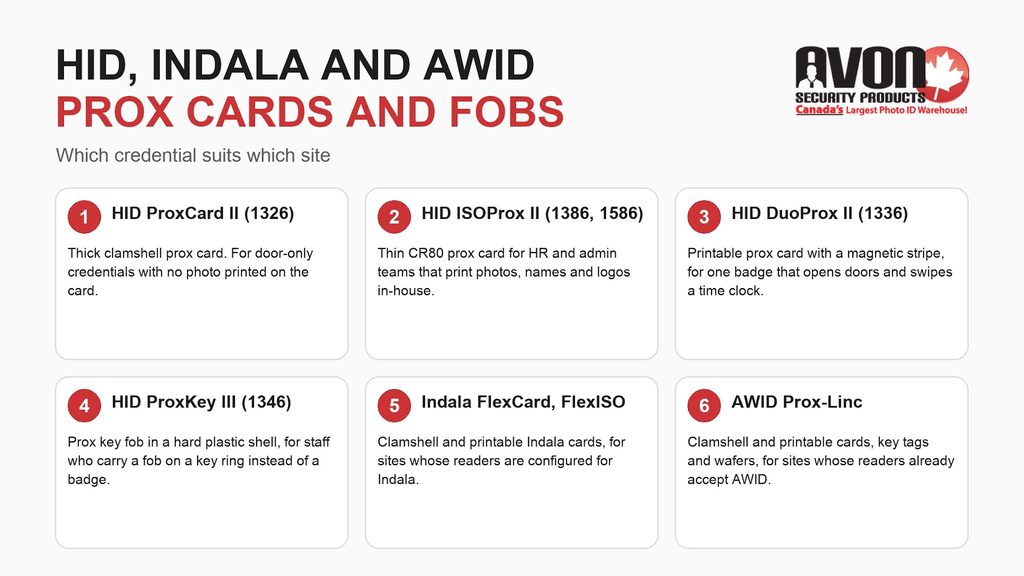
HID offers its 125 kHz prox technology in several card and fob forms, and Indala and AWID make credentials on the same frequency that need readers set up for their own technology. The right choice depends on what your readers accept today and how your staff carry and display their credentials.
Card or fob
What it is
Who it suits
HID ProxCard II (1326)
A thick clamshell prox card. HID’s ProxCard II datasheet sets out its specifications and its compatibility with HID proximity readers.
Sites that need a door credential only and don’t print photos directly on the card.
HID ISOProx II (1386 and 1586)
A thin prox card made to ISO ID-1 (CR80) size, offered in more than one card construction under these two part numbers.
HR and admin teams that print photos, names and logos on the card in a desktop ID card printer.
Organizations where one badge must open doors and also swipe through a magnetic stripe time clock or cafeteria reader.
HID ProxKey III (1346)
A key fob with prox technology sealed inside a hard plastic shell.
Warehouses, maintenance crews, and other staff who would rather carry a fob on a key ring than wear a badge.
Indala FlexCard and FlexISO
Indala’s clamshell (FlexCard) and printable (FlexISO) prox cards, which need a reader set up for Indala.
Existing system owners whose readers are already configured for Indala credentials.
AWID Prox-Linc
AWID’s prox range in clamshell cards, printable cards, key tags and thin wafers.
Existing system owners whose readers already accept AWID cards or AWID key fobs.
What Is a Clamshell Card?
A clamshell card is a thick prox card made from two plastic halves sealed around the antenna, like a shell. The thickness protects the antenna, but it also means the card won’t feed through an ID card printer, which matters if your badges need a photo.
Indala Cards and AWID Key Fobs
Indala and AWID cards also run at 125 kHz, but each brand sends its number in its own way. An HID prox reader won’t read them unless it supports that technology and has been configured to accept it. If your staff carry AWID key fobs or Indala cards today, reorder the same technology and format unless your installer confirms the readers accept another one.
Avon Security Products groups proximity access cards by access control brand, with separate sections for HID, Indala, and AWID, which helps an existing system owner match the credentials already installed rather than replace readers.
What Is an HID Card Format, and Why Does It Have to Match?
A card format is the layout of the number stored on the card, meaning how many bits it holds and how they’re divided. HID’s Readers and Credentials How to Order Guide identifies cards by format and facility code, and the open 26-bit format appears in HID documentation as H10301. In that format, the 26 bits are made up of one leading parity bit, an 8-bit facility code, a 16-bit card number, and one trailing parity bit.
The facility code is a number shared by a group of cards, and a site can use more than one. The card number identifies each credential, so issue a person’s card and fob separate numbers so each can be tracked and disabled on its own. An 8-bit facility code allows values from 0 to 255, and a 16-bit card number allows values from 0 to 65,535. Depending on how your controller is configured, it can deny a card whose format or facility code doesn’t match, even if the card is the right brand and frequency.
Because H10301 is an open format that HID doesn’t track, another organization can hold cards with the same facility code and card number as yours. Tracked formats avoid that: HID allocates the next available numbers and doesn’t allow duplicates. Examples are H10302, a 37-bit format with no facility code (check that your controller accepts one without), H10304, a 37-bit format whose facility codes are registered to one account, and Corporate 1000, which is ordered under your organization’s own company ID code. Whatever the format, a reorder needs three things: the format, the facility code or company ID if the format uses one, and a starting number (or, for a tracked format, a quantity).
How Do You Find Out What Format Your HID Prox Card Is?
To find out what format your HID prox card is, check the card, the original order paperwork, and your access control software, and confirm the answer with at least two of these clues.
Read the numbers printed or laser-engraved on the card, which may include the card number and sometimes a second code tied to the original order.
Find the label on the original box or the packing slip. HID’s How to Order Guide explains how its ordering codes describe a card’s format and build options, so the code from your last order is worth keeping.
Present the card at a reader and check the event log in your access control software. Some systems record the facility code and card number of an unrecognized card, which confirms what the card is sending.
Key fobs follow the same checks, but a fob has little room for markings, so the box label and your software records carry more weight. The printed number alone doesn’t always reveal the format, because two cards with the same printed number can carry different formats, and the printed number can differ from the encoded value. Before you enrol a new batch, write down the format, facility code, and number range your system already uses, then program proximity cards against those records so new numbers don’t overlap existing ones.
Can You Print on an HID Proximity Card?
You can print directly on thin, flat prox cards such as the HID ISOProx II, DuoProx II, Indala FlexISO, and AWID Prox-Linc printable cards. They’re made to ISO ID-1 (CR80) size, but size alone doesn’t make a card printable in a given printer. Check that your printer supports the card’s thickness, material, and construction before adding photos, names, and logos.
ProxCard II and other clamshell cards are too thick for an ID card printer. The workaround is to print thin CR79 adhesive cards and apply one to the front of each clamshell, after confirming your printer supports CR79 adhesive stock at that size, thickness, and backing. A CR79 card measures about 83.9 x 52.1 mm, slightly smaller than the 85.6 x 54 mm CR80 size set by ISO/IEC 7810, which leaves a small margin so the label sits inside the edges of the clamshell.
When Should You Create an ID Entry Card System?
An ID entry card system makes sense when you need to revoke access without changing locks, control who enters specific zones, set schedules for when doors open, and keep a record of which credential was used where. Hospitals, universities, municipal buildings, and multi-shift warehouses are typical examples, because staff, contractors, and visitors share the same buildings but not the same access.
Advanced Control and Monitoring
The cardholder only presents a card. The administrator gives each card its own access levels, reviews access events by door, and disables a lost card as soon as it’s reported.
What Are the Limits of 125 kHz Prox Cards?
The biggest limit of a 125 kHz prox card is that it sends the same number every time without encryption, so it can be copied. Because a copy sends the identical number, the reader has no way to tell it from the original. The RCMP’s physical security communique on precautions for RFID copiers and duplicators warns organizations about these devices and sets out steps to reduce the risk.
Whether that risk is acceptable should be assessed against each site’s security requirements, including what sits behind each door and what other controls are in place. Where the assessment calls for more, the step up is a 13.56 MHz smart card. HID’s Seos card datasheet describes cards and readers that authenticate each other before protected application data is released, and NXP’s MIFARE DESFire EV3 datasheet covers its encrypted, multi-application design.
Moving off prox can happen in stages. Combination cards carry both a 125 kHz prox chip and a 13.56 MHz chip, so staff can keep one card while readers are replaced door by door. Check which 13.56 MHz technology the card carries: HID offers Seos plus prox cards, while a card that pairs prox with the original iCLASS pairs it with an older generation. Smart credentials also come as key fobs, including HID Seos, iCLASS SE and MIFARE DESFire EV3 fobs, so staff who carry a prox fob today can stay with a fob after the upgrade. The differences between RFID cards and proximity cards, from frequency to encryption to read range, decide which readers and credentials belong in that staged plan.
Where Can You Buy HID Proximity Cards in Canada?
You can source HID proximity cards in Canada through Avon Security Products, a Canadian ID card and access credential specialist based in Concord, Ontario. Avon has served more than 25,000 organizations and works with those that already run HID, Indala, or AWID readers and need replacement or additional cards that match.
Have three details ready: the card format, the facility code or company ID, and the starting number for the new batch (or the quantity, for a tracked format). Avon’s Canadian inventory and support also mean no unexpected duties or brokerage on domestically sourced orders. To confirm your card format, talk to an Avon specialist or call 1-866-458-6999 with an existing card or the original box label on hand.
Frequently Asked Questions
What is an HID proximity card used for?
An HID proximity card is used to open doors, gates, and parking barriers controlled by an electronic access control system. The cardholder presents the card near a reader, the reader sends the card’s number to a controller, and the controller unlocks the door if that card is allowed in. Organizations also print photo ID badges on printable prox cards, and some choose DuoProx II cards with a magnetic stripe for time clocks or cafeteria readers.
Can an HID reader read Indala or AWID cards?
An HID prox reader can’t read Indala or AWID cards unless it supports that technology and has been configured to accept it, even though all three work at 125 kHz. Each brand sends its number in its own way. Some multi-technology readers can accept more than one, but only if your installer has turned that option on. The simplest path is to reorder the technology and format your staff already carry, or have an Avon specialist check your reader model first.
What do the numbers on my HID prox card mean?
The numbers printed or engraved on an HID prox card can include the card number your access control system uses to identify that credential. The printed number can differ from the encoded value, depending on the numbering option chosen when the cards were ordered. Some cards also carry a second code linked to the original order, and the box label may list the format and facility code. Confirm the numbering option against your access control records before reordering.
Where can I buy HID ProxCard II cards in Canada?
HID ProxCard II cards can be sourced in Canada through Avon Security Products, an ID card and access credential specialist in Concord, Ontario. ProxCard II is a clamshell card, so it suits sites that need a door credential rather than a printed photo badge. Before reordering, confirm three details with an Avon specialist: the card format, the facility code, and the starting number. Matching those to your existing cards keeps new cards working on the readers you already have.
Who sells printable proximity cards and key fobs in Ontario?
Avon Security Products, based in Concord, Ontario, supplies printable proximity cards and key fobs to organizations across Canada. Printable options include the HID ISOProx II and DuoProx II, Indala FlexISO cards, and AWID Prox-Linc printable cards, made to ISO ID-1 (CR80) size. Confirm your printer supports each card’s thickness, material, and construction. Key fob options include the HID ProxKey III, Indala key fobs, and AWID-compatible fobs. An Avon specialist can confirm the format and facility code of the credentials you already use.
Published: April 14, 2021
| Updated: September 24, 2024
Author: Team Avon
Healthcare settings face unique security and safety challenges. They have to balance speed and efficiency, the safety of patients, valuable equipment, controlled medications, and restricted areas in buildings often shared by patients, visitors, healthcare workers, support staff, and contractors. It can be a busy, chaotic environment with high compliance demands and major security needs.
How Can Healthcare IDs Help?
Medical facilities of all kinds need to implement healthcare ID cards to restrict access to appropriate personnel only and help patients identify staff when they need assistance. Institutions need healthcare ID cards that are durable and professional to help identify doctors, nurses, staff, and even patients or visitors. They may also need proximity access cards that help keep the general public or unauthorized personnel out of restricted areas, such as areas where controlled drugs or valuable medical equipment can be accessed.
Medical facilities often need to print ID cards on the spot for patients and visitors. They can do so with an in-house ID card printer.
When it comes to staff ID cards, healthcare workplaces need watermarking and holographic features to prevent counterfeiting and ensure the security of their premises. ID badges are the first step to developing more robust security protocols in a healthcare environment.
Drug Diversion Prevention Strategies
Drug diversion is one of the most pressing issues facing hospitals and healthcare settings from a security standpoint. While drug diversion can be perpetrated by patients or pseudo-patients, it’s an even bigger issue when healthcare workers divert controlled substances. An alarming 79% of controlled drug loss reports are unexplained. Not only are these losses expensive for healthcare operators, but they are contributing to unprecedented opioid-related mortality.
There are already robust policies healthcare operators must comply with when it comes to restricting access to controlled substances and recording who signs out controlled substances. Access cards and ID cards can help physically limit access to controlled drugs and should be considered as part of your diversion prevention strategy.
Improve COVID Safety in Health Facilities
Looking beyond hospital and pharmacy environments, health facilities like gyms and fitness clubs have a big task ahead of them. In some jurisdictions, they’ve been shut down due to COVID-19 for the better part of a year. Listed as high-risk environments, they can expect continued limitations on capacity as they reopen.
They are going to have to take extra steps to lower risk levels and re-establish the trust of their members. As much as people are eager to get back to their fitness routines, there are still plenty who will be reluctant to get back to indoor environments unless they’re confident that their health and safety are primary concerns.
There are many different guidelines for reopening across North America, but reduced capacity is a common theme. A membership card that monitors activity and helps administrators know exactly how many people are in their facility at the same time will go a long way toward providing a safe health club environment.
Published: March 22, 2021
| Updated: September 24, 2024
Author: Team Avon
Repeat business is good for business. That’s why so many companies have created customer loyalty programs. At a time when businesses of all sizes have been struggling, there’s never been a better time to reward and cultivate customer loyalty.
A customer loyalty program such as a points program can both reward your repeat customers and help your bottom line. These tips can help you introduce a program that works.
#1 Use PVC Cards
How many half-stamped paper cards do you have falling apart in your wallet? Coffee shops and other small retail businesses often start customer loyalty programs with the kind of paper cards that get stamped with each purchase. But they often get forgotten or worn down quickly.
There’s a better way to encourage customer loyalty. With a card printer on-premise, you can print and program durable PVC cards that let customers earn points or rewards while you to track valuable data like purchase history. They look better, fit easily in customers’ wallets, and they won’t fall apart. You can also print them on demand.
#2 Integrate Your Branding
Every aspect of your loyalty program should reinforce your brand, from the rewards you offer to the physical cards themselves. The underlying goal of your rewards program should always be about enhancing customers’ experience of your brand. Not only should the rewards reflect the experience you offer, but you should pay attention to the details as well.
Your customer loyalty cards should show off the personality of your brand. You want customers to instantly recognize it when they’re flipping through their wallets – and think about you when they see it. Using high-quality PVC cards, you can make sure that your custom-designed cards always look great.
#3 Collect Data
Printing physical rewards cards isn’t just a branding exercise. It can also give you access to valuable information about your customers and their purchases. Using supplementary software, you can track the purchases of customers who use your rewards program.
Information is power, and you can start connecting the dots between repeat businesses and what they buy to start targeting your marketing campaigns.
#4 Design Your Program for Your Best Customers
Your top 10% of customers can be worth five to six times more than the rest of your customer base. These are your most loyal and profitable customers, and they should be the targets of your loyalty program.
They are the clientele who will be more motivated by the program. They want to support your business, and they benefit from sticking with you.
#5 Discounts vs. Other Benefits
Discounts are some of the most popular rewards given in loyalty programs, but they’re not the most memorable. There are many other rewards you can provide. Depending on the nature of your business, they might include:
·Free shipping
·Early access
·Free products
Redeemable points programs can be a great way to appeal to basic human behaviour. People enjoy the feeling that they’re progressing toward a goal, such as a free purchase or other rewards. Points should be earned quickly enough that customers feel a sense of progress and momentum. You might even be able to make a more memorable experience by giving out surprise rewards.
A loyalty card program is a great way to both give back to your customers and inspire repeat business. Get started with a loyalty card program system today.
Published: March 10, 2021
| Updated: September 24, 2024
Author: Team Avon
Workplace security breaches are a source of concern across industries. They can pose a danger to your staff and/or customers, disrupt the workday, lead to loss through theft, or jeopardize data and records. If you’re responsible for building or workplace security, these are the kinds of security breaches you can cut down on by introducing ID cards.
Breach of Health Protocols
As the world slowly gets back to normal, you can expect many workplaces to return with health protocols to ensure that staff are able to work safely and ease any anxieties they have about returning to the office.
COVID-19 screening is one method to make sure the office remains safe for workers, but it’s not just staff who should be screened. Anyone entering the office should have to go through the screening process, or else you could have a potentially deadly breach. An ID card can help reassure everyone in a large office setting that visitors have been properly screened.
With a plastic card printer in house, you can quickly print cards or lanyards for visitors so that everyone knows a guest, contractor, or client has been properly screened and has followed workplace health protocols.
Protecting Records and Data
If you work in an industry that handles personal, confidential information, such as medical records or financial information, you need to make sure that your physical records and data servers are protected from breaches.
Whether these documents are stored on a particular device, server, or on paper, you can restrict access with proximity ID cards. A contact-free proximity card reader prevents those without authorization from physically accessing sensitive data.
Proximity cards are the most widely-used identification credential for controlling physical access. They can be programmed and printed in-house. Credentials can be changed as an organization needs to update them, such as removing credentials from cards that have been lost or stolen.
To help improve durability, provide an access card holder with proximity cards. They’re an affordable way to attach access cards to lanyards or protect them from scratches.
External and Internal Theft
Businesses of all kinds need to protect themselves against theft. Whether you’re worried about your bank deposits, theft from the register, inventory, or data, you can reduce the risk of theft with access ID cards.
While the use of safes and best practices for bank deposits can help you protect cash at critical times, proximity cards might be what you need to limit access to inventory and data. They can prevent customers or guests from accessing restricted areas, and they give you control over which employees can gain access at what times.
Don’t Lose Access Cards
Access ID cards help make sure that only the right people gain access to your premises, but how do you make sure no one who shouldn’t gets their hands on your access ID cards? You can introduce policies that impress the importance of their proximity cards on employees, but the best way to reduce loss is to invest in security accessories like lanyards, badge holders, and anything that simply makes it harder to lose them.
Security breaches are a concern for all kinds of workplaces. Fortunately, ID cards make it easier to ensure that no one winds up where they don’t belong.
×
1
Product selection
2
Contact information
3
Review information
How many cards will you print a year?
Organizations needing to print less than 25 cards per year may find it more economical to use a card printing service.
Automatically print on both side of the Card?
Dual-sided printers usually cost significantly more than single-sided printers. In some cases a single-sided printer can be used to print both sides of an ID card:
If the back of every card is identical (i.e.: If lost, return to... This card is property of...), you can use a single-sided printer and pre-print a batch of card backs, often using an inexpensive black ribbon. Those cards can be sent through the printer a second time to include customized information on the other side. This method is not recommended for printing on technology cards due to possible damage it could cause to the card.
Even if the back and front is unique for every card, you can print one side of an ID card, flip it over and print the back. This is much more time consuming, and is not recommended for organizations that print a large volume of ID Cards. This method is also not recommended for printing on technology cards due to possible damage it could cause to the card.
Need to use the printer with an Apple MacTM?
Only a few models of ID card printers on the market are compatible with Mac computers.
There is currently not any commercial ID card software that is compatible with Mac computers. If at all possible, we recommend using a PC to manage an ID card system.

 1.866.458.6999